Korea's 3.1 Trillion Won Bet on Physical AI and Humanoid Robots
South Korea is tripling its physical AI budget to 3.1 trillion won for 2027, targeting humanoid robots for factories, farms, and ports. The move is a direct response to a shrinking workforce and a bid to stay ahead of China in robotics.
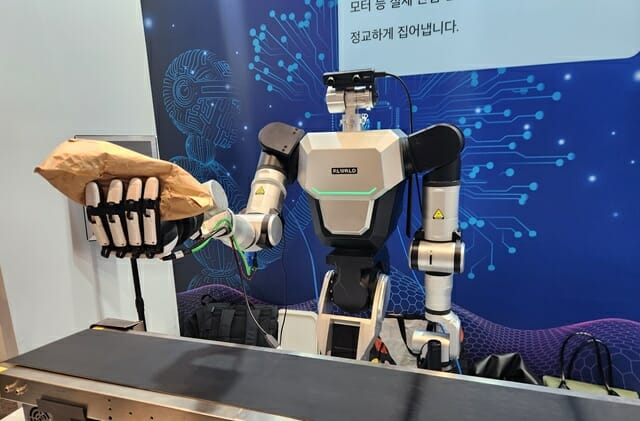
Korea Is Bypassing Chatbots for Robots
South Korea just revealed a budget that reframes its entire AI strategy. For 2027, the government is allocating 3.1 trillion won — roughly $2.1 billion — to physical AI, up from 900 billion won this year. That is not a marginal increase. It is a three-and-a-half-fold expansion in a single fiscal cycle, and it signals that Seoul has concluded the next competitive frontier is not in language models but in machines that move through the world.
The announcement came at a cross-ministry briefing in Seoul on October 13, hosted by the Ministry of Science and ICT. Officials laid out how the money would flow to factories, farms, ports, and logistics centers — the places where Korea’s aging, shrinking workforce is already causing real friction.
Who Gets What
The bulk of the new spending goes through three channels, each revealing a different priority.
The Ministry of SMEs and Startups is dedicating 172.8 billion won next year to a physical AI demonstration program for small manufacturers. Over three years, the total comes to 340 billion won. The structure is deliberate: companies receive support at three levels. Process demonstrations — up to 1 billion won over two years — target tasks too irregular for existing automation. Hazardous-work demonstrations — up to 2.5 billion won — aim to replace humans in dangerous roles like those in foundries. And the largest category, integrated demonstrations, offers up to 4.5 billion won over three years for companies that want to deploy multiple physical AI systems across an entire production line.
Sixty-three large corporations will be recruited next year to bring their AI models and platforms down to SMEs under a paired-development scheme. That is a structural attempt to prevent the technology gap between big conglomerates and smaller suppliers from widening further.
The science ministry is committing 55 billion won to develop general-purpose physical AI models — systems that can adapt to unfamiliar tasks rather than repeating pre-programmed motions. An additional 40 billion won funds a training center where robots and sensors will generate the behavioral data needed to train those models. A separate 26 billion won program will test autonomous sorting of irregularly shaped mail, a problem that conventional automation struggles with.
Agriculture gets 78 billion won over five years for autonomous farming equipment, and maritime affairs is allocating 25 billion won over five years for port automation, including 7.35 billion won in the 2027 budget for demonstration projects.
Why This Matters Now
Korea faces a demographic squeeze that makes this investment feel less like ambition and more like necessity. The working-age population is declining. Factories report difficulty filling positions. The government’s own language acknowledges that physical AI is being deployed partly to absorb tasks people simply are no longer available to do.
But there is a second, sharper motivation: competitive positioning. China has been investing heavily in humanoid robotics through companies like Fourier Intelligence, Unitree, and several state-backed initiatives. Japan has decades of industrial robotics advantage through Fanuc, Yaskawa, and SoftBank’s Pepper line. If Korea wants to remain central to advanced manufacturing in Northeast Asia, it cannot cede the physical AI layer to competitors who are treating humanoid robots as an industrial commodity.
Nvidia’s presence at the same tech week was telling. The company argued that the physical AI supply chain presents a structural opportunity for Korean manufacturing — precisely because Korea already possesses the factory infrastructure, the engineering talent, and the corporate ecosystem to integrate AI into hardware at scale.
What Could Go Wrong
Several risks are visible.
The 3.1 trillion won figure is a budget proposal, not a guarantee. It must pass through the National Assembly, where fiscal conservatives may push back against the pace of expansion. The source material itself notes this explicitly.
There is also an execution gap between model development and factory-floor deployment. General-purpose physical AI models remain experimentally immature. The training center and data-collection programs are necessary infrastructure, but building them does not automatically produce robots that can handle the variability of real Korean manufacturing lines — irregular parts, unpredictable environments, tight quality tolerances.
And the SME-focused programs carry their own risk: smaller manufacturers may lack the technical capacity to integrate physical AI even when subsidies cover the cost. Without deeper organizational change inside those companies, the demonstrations could remain showcases rather than spreading into broad adoption.
What Happens Next
The timeline is already mapped. The science ministry plans to release detailed project guidelines in December, announce课题 in January, and select implementing institutions by March. The agriculture and maritime programs follow similar windows. The SME demonstration program will open submissions next year with the goal of deploying funded projects within the current fiscal cycle.
The National Growth Fund, a 150 trillion won investment vehicle, has been flagged as a potential financing partner for physical AI companies, though officials were careful to note that it is not a dedicated physical AI fund and individual projects will face standard investment review.
The most consequential signal here is not the number itself but the direction. Korea has chosen to bet that the next wave of industrial advantage belongs to machines that can learn, adapt, and operate in unstructured environments — not to algorithms that only manipulate text. If the budget passes and the demonstration programs deliver results, the implication is clear: Seoul sees physical AI as the lever that can offset demographic decline and sharpen Korea’s manufacturing edge across Asia.