Korea's New President Is Turning Chaebols Into National Security Partners
President Lee Jae-myung is coordinating directly with Samsung, SK, and Hyundai CEOs on three mega projects worth over 800 trillion won — a shift that treats corporate capital as infrastructure strategy.
The Meeting That Wasn’t Announced
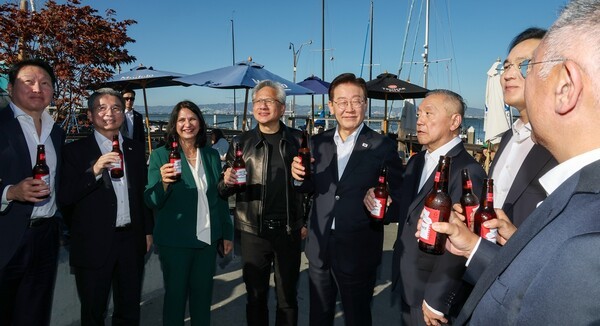
On October 20, SK Group chairman Cha’e-won shared a private dinner with President Lee Jae-myung in Seoul. Four days later, Samsung Electronics chairman Lee Jae-yong sat across from him. By late October, Hyundai Motor Group chairman Chung Eui-sun was next in line.
These were not scheduled press events. The Blue House declined to confirm details. But the sequence tells the story: South Korea’s president is treating its three biggest conglomerates not as regulated industries but as direct policy partners in a race that, by his own framing, demands something beyond speed.
“We need to fight a lightning war, not just a sprint,” Lee said, according to media reports. The metaphor fits a government that appears to have concluded Korea’s window to remain a top-tier semiconductor and AI player is narrowing faster than existing timelines allow.
Three Projects, One Strategy
The meetings centered on what officials are calling the “three mega projects”: semiconductor expansion in the Honam region, physical AI development, and AI data center infrastructure. Together, they represent more than 800 trillion won in planned corporate investment.
Samsung and SK Hynix are each building new fabrication plants in Honam, a push that would add four major fabs to an already dense regional cluster. The government’s role goes beyond zoning and permits. It includes accelerating the completion of the Yongin semiconductor cluster, securing dedicated power grids for AI data centers, and guaranteeing water supply — resources that historically lag behind the pace of construction in Korea.
The regulatory ask from industry is equally specific: carve out exceptions to working-hour limits for R&D personnel under the Mega Special Zone Act, and introduce greater employment flexibility. Those are not trivial concessions. They represent a renegotiation of Korea’s strict labor framework in service of a single strategic objective.
Meanwhile, Hyundai’s piece of the puzzle is the Saemangeum Innovation Growth Base, a 9 trillion won project the company plans to execute through 2029. The president has reportedly referred to the project as a “Saemangeum hope torture,” signaling that bureaucratic delays are eroding its credibility. Hyundai’s acquisition of a full stake in Boston Dynamics earlier this year now sits inside that calculus — a bet that physical AI, not just autonomous vehicles, is the group’s most defensible competitive edge going forward.
The US Factor Is Not Secondary
What makes these meetings unusual is not just their frequency or their secrecy. It is the American pressure that hangs over every agenda item.
Commerce Secretary Howard Lutnick has publicly called on Samsung and SK to increase memory chip investment in the United States. That kind of open demand from a senior US official is rare in trade relations with an ally and raises the stakes for any agreement that emerges from these consultations.
Analysts are already flagging energy sector investment as a potential first Korean response — a sector where domestic capital can be deployed quickly and where Washington would see tangible results. But the real question is whether chaebol compliance with US demands and domestic mega-project timelines can coexist without one crowding out the other.
For global chip and AI supply chains, the answer matters. Samsung and SK Hynix dominate the memory market. Any diversion of capital toward US facilities reduces the pace at which they can complete the Honam expansion. Any delay in Korea shrinks the supply headroom that AI developers outside the United States rely on.
Who Wins, Who Loses
The immediate winner is the president’s office. Coordinated engagements with Samsung, SK, and Hyundai allow the government to signal strategic direction without legislative delay. Mega-project approvals move faster when the CEOs sitting across the table have already committed capital. That is the advantage of a model that treats industrial policy as negotiation rather than decree.
The loser is regulatory friction. Korea’s labor laws, environmental review processes, and permitting timelines are being explicitly treated as obstacles to override. The Mega Special Zone framework provides the legal mechanism, but the political message is unambiguous: strategic sectors will operate under different rules than the rest of the economy.
Global competitors will watch closely. China’s state-directed semiconductor push has been underway for years. Japan’s recent subsidies and facility incentives are now flowing. Korea’s approach is different — less about state spending and more about aligning private capital with state objectives. If the lightning-war logic holds, the Honam fabs could come online faster than anyone predicted. If regulatory pushback or US investment demands pull resources away, the timeline fractures.
What Happens Next
The Hyundai meeting is expected to produce the first concrete regulatory concessions. Working-hour exemptions for R&D staff are the lowest-hanging fruit and the most immediate signal that Korea intends to accelerate.
The Honam semiconductor project faces harder constraints — power and water infrastructure cannot be legislated into existence. The government will likely commit to accelerated grid expansion and industrial water allocation, but those decisions require coordination across multiple ministries and local governments. Delays there would undermine the president’s own framing.
On the US side, the Trump administration’s investment demands are unlikely to soften. A Korean energy-sector deal could serve as a diplomatic face-saving measure, but it does not resolve the structural tension between domestic mega-projects and American expectations. That tension will define the relationship between Seoul and Washington for the rest of the year.
The secretary-general of the president’s policy office has been quoted saying Korea cannot afford to play catch-up in AI. The meetings with Samsung, SK, and Hyundai suggest the administration believes the only way to stay ahead is to stop treating corporate strategy and national strategy as separate domains.
Whether that model delivers results or simply coordinates a faster collapse remains the question global markets will answer.