Korea's Record Surplus Is a Semiconductor Mirage
South Korea posted a record July current account surplus of $42.1 billion, but the number conceals a dangerous truth: the entire surplus is semiconductor-dependent, and the economy is importing more capital goods than it consumes. Here's what the data actually signals.
The Number That Isn’t What It Looks Like
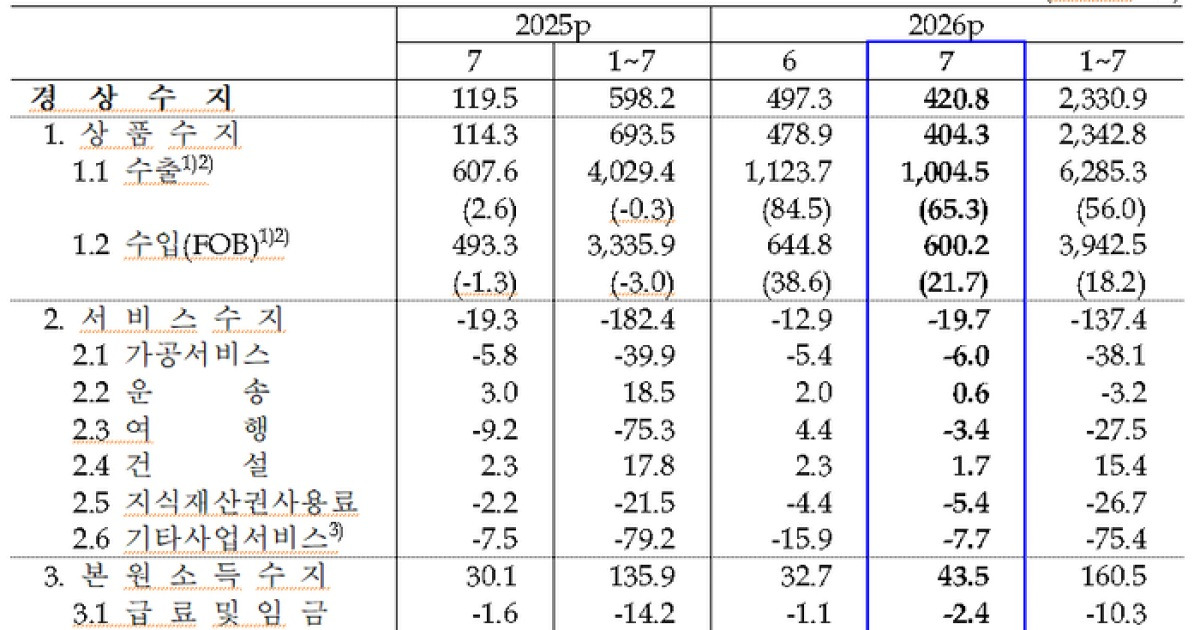
South Korea’s July current account surplus came in at $42.08 billion — a record for the month. The Bank of Korea revised its full-year forecast upward to $450 billion, nearly double the original estimate. On the surface, this is a macroeconomic triumph. In practice, it’s a narrowly constructed one.
The surplus is almost entirely a semiconductor story. Export growth of 65.3% year-on-year — pushing total exports past $100 billion for the second straight month — was driven overwhelmingly by IT hardware. SSD peripherals surged 344.5%. Semiconductor exports alone jumped 176.3%. Nothing else in the export basket came close to moving the needle at that scale.
Meanwhile, consumer goods imports fell 3.0%, the first year-on-year decline in 15 months. South Koreans are buying fewer foreign cars and appliances. The domestic economy is not broadly revving up. It is leaning hard into one sector.
Who Wins, Who Loses
SK Hynix and Samsung Electronics are the obvious winners. Both posted record revenues in recent quarters, and the domestic stock market reflected it — foreign investors returned to Korean equities in July, buying $598 million in net shares for the first time in six months, after posting the largest outflow on record the month before.
But the upside is concentrated. Korea’s industrial structure means that when semiconductors surge, everything looks good on aggregate. When they dip — and the cycle always dips — there is no offsetting pillar strong enough to catch the fall. The economy has been here before, most recently in 2023, when a chip downturn dragged the current account into deficit and the won deteriorated sharply.
The import data tells a similar story. Capital goods imports rose 36.7%, led by a 60.1% jump in semiconductor manufacturing equipment and a 56.7% increase in semiconductor imports themselves. This is not demand-pull consumption. It is capacity expansion — Korean firms and their supply chains investing aggressively in next-generation memory and advanced packaging. The bet is that the AI-driven chip cycle will sustain itself through at least 2027.
The Hidden Leak: Services and Travel
Beneath the goods surplus sits a services deficit that is quietly widening. The services account recorded a $197 million deficit in July, up from $129 million in June and $193 million a year earlier. The travel sub-account flipped to a $34 million deficit — the first monthly travel deficit in three months.
This sounds small. It is not. Korea has run persistent travel deficits for years, and they compound. With the won weakened from its 2022 peak and domestic tourism capacity constrained, outbound spending continues to outstrip inbound receipts. The July data showed 2.42 million departures against 2.09 million arrivals — a structural gap that goods surpluses alone cannot erase indefinitely.
What Global Markets Are Missing
International financial media are reporting the surplus headline as validation of Korea’s economic rebound. The narrative is seductive: chip demand, AI infrastructure spend, and Korean exporters aligning into a virtuous cycle. But the global press is under-tracking three dimensions that matter.
First, the concentration risk. A $42 billion surplus built on a single export category is not diversification. It is a leveraged position on DRAM and NAND pricing. If memory prices correct — as they did in 2023 after the 2021-2022 boom — the surplus evaporates with it. The BOK itself raised its forecast by $200 billion in a single revision, which is a sign of Model Confidence, not economic resilience.
Second, the capital goods import acceleration signals that Korea is re-industrializing around semiconductors, not rebalancing away from them. The $60.1% surge in chip equipment imports is a bet on future output. It is not a signal of present consumption strength. If the bet misfires — if AI demand plateaus or if TSMC and Intel capture more of the advanced node share — Korea faces a double squeeze: shrinking export revenue and sunk capital in equipment that cannot be easily redeployed.
Third, the foreign investment reversal is fragile. The $598 million net purchase in July followed a $31.6 billion net sale in June — the largest on record. Foreign flows into Korean equities remain opportunistic, driven by SK Hynix ADR listings and relative value plays, not structural conviction. When chip volatility returns, those flows reverse with equal speed.
What Happens Next
The most likely scenario is a prolonged surplus window through late 2026, assuming memory prices hold and AI capex continues at current levels. The BOK’s $450 billion annual surplus estimate implies an average monthly surplus of roughly $37.5 billion for the remaining five months — achievable if the current pace holds.
The risk scenario is sharper than most analysts admit. A memory price correction of 20-30% — not unprecedented in this cycle — would erase a significant portion of the surplus in a single quarter. The won would depreciate, import costs would rise, and the current account would narrow fast. Korea’s household sector, already showing signs of consumption fatigue with consumer goods imports falling, would feel the pinch.
The strategic question for Korea is whether this surplus buys enough time to diversify. The answer so far is no. The data shows an economy doubling down on the same export engine rather than building new ones. That is rational in the short term. It is risky in the medium term.
The world is watching Korea’s surplus as a barometer of the global chip cycle. What it should also be watching is how narrowly that barometer is calibrated.