Korea's Robot Dream Runs on Chinese Bodies and American Brains
KAIST and other Korean labs are building AI research on Chinese Unitree hardware and American Nvidia chips. Without domestic body and brain manufacturing, Seoul risks total dependency in the humanoid race.
The Lab at KAIST Reveals a Structural Trap
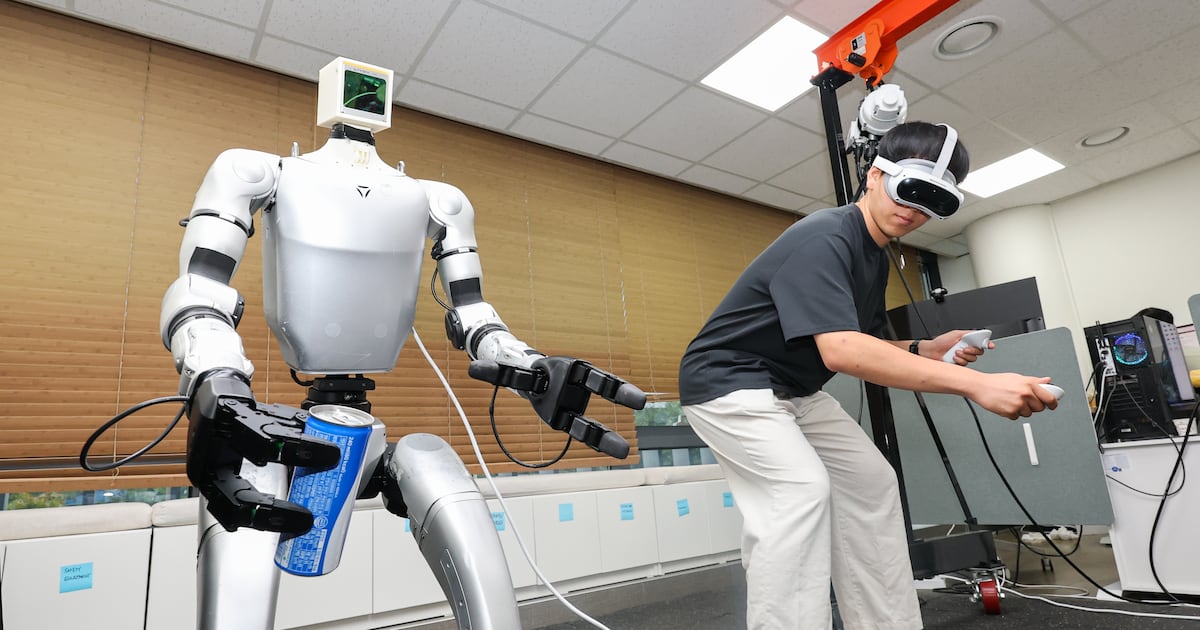
In a research room at KAIST in Daejeon, a graduate student wears a VR headset and extends an arm. A 130-centimeter humanoid robot on the floor mirrors the motion, picks up a beverage can, and drops it in a trash bin. The demonstration is smooth. The reality underneath is not.
The robot’s body is a Chinese Unitree G1. Its computing brain is an American Nvidia Jetson Orin. The AI models being trained on top of that stack are Korean. This is the architecture of South Korea’s humanoid ambition in 2026: Chinese hardware, American silicon, Korean software layered on top — and a growing anxiety that the whole structure rests on foundations Seoul does not control.
The Korea Advanced Institute of Science and Technology is one of the country’s most prestigious research institutions. Its Physical AI and Robotics Lab has developed navigation and full-body precision manipulation models, including an AI system that can guide an industrial robot arm to fit parts into narrow spaces or press tiny buttons. None of that research would be practically possible without the Unitree robot beneath it.
“Domestic humanoids lack the reference data and failure-repair history to serve as immediate research alternatives,” said Associate Professor Park Dae-hyung. “Chinese robots already have basic walking and posture control implemented, and their research platform ecosystem is well built. At this stage, it is difficult to accelerate humanoid research without overseas platforms.”
That admission, made publicly in a Chosun Ilbo report, captures the paradox at the heart of Korea’s push to become a physical AI superpower.
The Government’s Grand Target vs. the Lab’s Reality
In June, the South Korean government bundled semiconductors, AI data centers, and physical AI into three mega-projects, declaring “Physical AI Global #1” as its goal. The rhetoric is ambitious. The lab bench tells a different story.
Korea’s share of the global humanoid robot market sits at roughly 1 percent, according to tech industry estimates. That figure is not the result of a single policy failure. It is the output of a structural dependency that has been hardening over years of practical compromise.
When research teams need a robot to walk, grasp, balance, and recover from perturbations — and they need it yesterday — the choice is often Unitree. The company’s H1 and H2 models are now core research equipment across government-funded labs, not just at universities but at state research institutions running national R&D projects.
Price is part of the explanation. Unitree robots cost a fraction of domestic alternatives. But price alone does not explain the lock-in.
The deeper reason is ecosystem. Unitree has opened its software development kit, which means a growing pile of community code, shared experiments, and accumulated troubleshooting data exists outside Korea’s borders. A new researcher can download the SDK, clone a repository, and start running experiments within hours. Domestic robots offer neither the price nor the playground.
Robothics’ Sapience and Rainbow Robotics’ Hubo 2 — among the most visible Korean humanoid efforts — struggle with higher unit costs and a development software environment that researchers find difficult to integrate into fast-moving projects. The gap is self-reinforcing: limited field use means limited real-world motion data and repair experience, which means less trust from researchers, which means even less use.
Who Loses When the Body and Brain Are Not Yours
The supply chain geography matters more than most English-language readers outside East Asia may realize. Humanoid robots are not a single product category. They are a stack: actuators, sensors, motor controllers, central processors, vision systems, locomotion algorithms, manipulation models, and the integration layer that makes them work together. Control any one critical node and you control the market’s direction.
China controls a massive share of the hardware stack. Unitree and Agibot alone account for approximately 97 percent of global humanoid shipments, according to the Chosun Ilbo report. That is not a competition yet. It is a default position.
America controls the AI compute layer. Nvidia’s Jetson platform is the de facto standard for edge AI in robotics worldwide. Korean researchers using Unitree bodies are also almost certainly using Nvidia chips. The dependency runs in parallel, not in series.
Korea sits between them with manufacturing capability but neither the volume nor the integrated ecosystem to dictate terms. The country can produce motors, sensors, and microprocessors — professors at Seoul National University and Korea University have pointed to this as a genuine advantage. But producing components is not the same as integrating them into a competitive, mass-producible humanoid system with a software ecosystem that commands global research adoption.
The strategic vulnerability is clear: without domestic body manufacturing and domestic AI compute, Korea’s humanoid sector cannot insulate itself from export controls, price shifts, or supply disruptions on either side. A US restriction on Chinese robotics hardware — which is already underway — or a China restriction on advanced semiconductor exports would each independently threaten the current research model.
Where the Opening Might Be
The same US move that constrains China also creates an opportunity for Korea. In July 2026, the Federal Communications Commission announced it would no longer grant equipment approvals for new models of foreign advanced robots, including quadruped and humanoid systems. The rule also blocks robots containing communication modules or chipsets from designated manufacturers. With Chinese firms dominating global shipments, the policy effectively targets them.
This is not a blanket ban on Chinese robots in Korea. But it signals a growing Western preference for non-Chinese robotics supply chains in sensitive applications — and that preference is where Korean manufacturers could insert themselves.
Experts interviewed for the report argue that Korea should not chase Unitree on price or general-purpose capability. The play is narrower and more strategic: secure the segments where security and trust matter more than cost.
Defense and medical are the obvious candidates. “No matter how cheap a Chinese robot is, you cannot simply deploy it in security-sensitive fields,” said Professor Song Jae-bok of Korea University. “Domestic robots need to build track records and trust in these areas first.”
That track record is precisely what Korea’s domestic humanoids currently lack — which circles back to the vicious cycle described above. Breaking it requires either a sudden performance leap or a protected market that gives Korean robots field time they cannot yet win in open competition.
What Happens Next
The Korean government has committed 50.4 billion won through 2030 to develop a Korean-type AI humanoid in partnership with LG Electronics and other industry players. The scale of that investment is meaningful but modest compared with Chinese state-backed scaling or American venture funding behind Figure, 1 AI, and related efforts.
The more actionable path, according to multiple academics quoted in the report, involves bundling domestic component suppliers — motor makers, sensor firms, MPU producers — into a single supply chain and scaling production to reach price competitiveness. Han Yang University’s Professor Han Jae-kwon argued that doing so could produce a humanoid that competes with Chinese offerings on both price and performance.
Whether that happens depends on execution speed, integration depth, and the willingness of Korean institutions — universities, hospitals, defense contractors — to adopt domestic robots despite their current shortcomings. Each deployment builds the very data and repair history that the current dependency cycle denies them.
The KAIST lab’s VR-controlled Unitree robot is a capable research platform. It is also a mirror. South Korea can do important physical AI research on top of it today. But the longer the body and the brain remain foreign, the harder it becomes to convert that research capability into market power — and the more exposed the entire industry becomes to decisions made in Beijing and Silicon Valley.