Korea's Market Crash Exposes Semiconductor Fragility
South Korea's KOSPI just broke below 5,000 after a circuit breaker and sell-side sidecar triggered in rapid succession. The crash reveals deep vulnerabilities in the country's semiconductor-dependent economy.
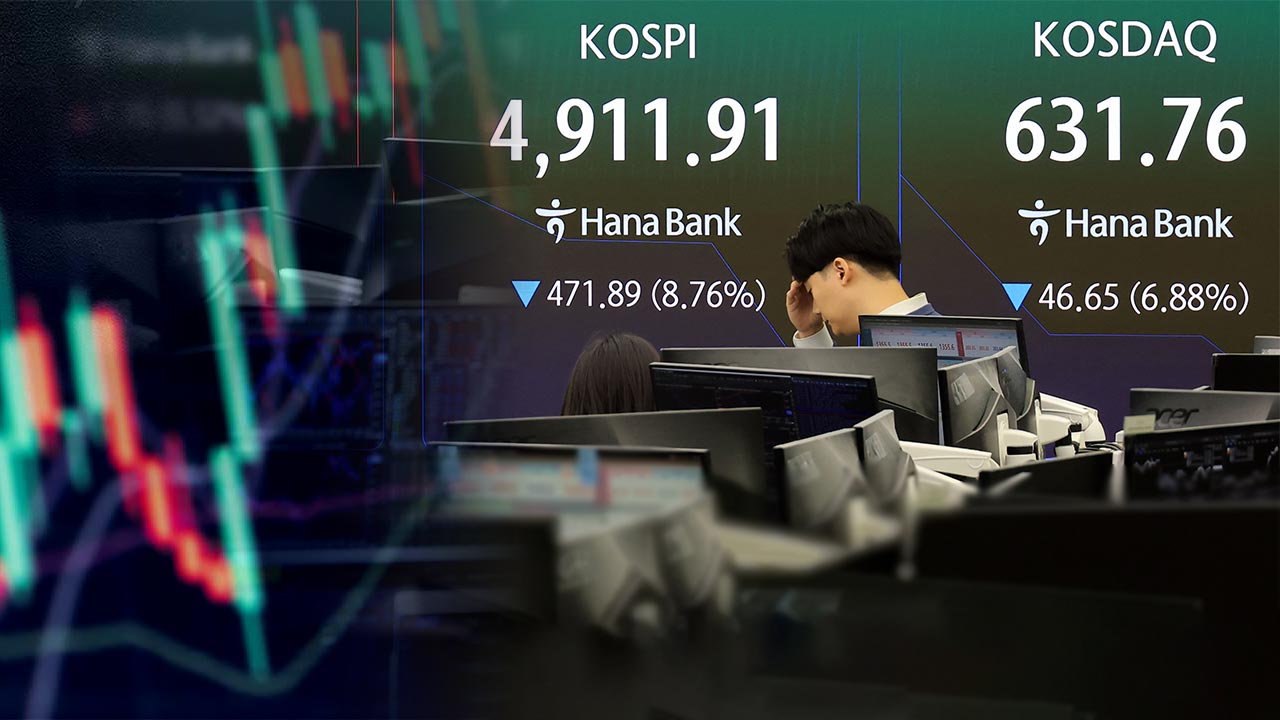
The 5,000 line just fell, and Korea is paying attention
South Korea’s stock market opened lower on November 6 and did not recover. The KOSPI dropped more than 8% in the first minutes of trading, triggering the exchange’s circuit breaker, then immediately ran into a second safeguard: a sell-side sidecar order that froze program-driven sell orders for five minutes. This was only the second time in two consecutive days the sidecar activated.
By mid-morning the index had settled around 4,900, down more than 7% from the prior close. The psychological 5,000 level, long considered Korea’s floor, had broken for the first time in the current cycle.
The Korea Exchange confirmed the sell-side sidecar kicked in at 9:34 AM. It activates when KOSPI200 futures fall more than 5% from the previous close and stay there for at least one minute. Yesterday’s activation was already unusual. Today’s was a repeat, which is rarer still.
Why semiconductors are the fault line
The contagion originated in the US semiconductor complex. American chip stocks sold off sharply overnight, and Korea’s equity market, whose market cap is disproportionately weighted toward memory chip makers, could not absorb the shock. Samsung Electronics and SK Hynix — the two pillars of the KOSPI — bore the brunt. When their shares weaken, the entire index follows, regardless of what domestic companies are doing.
This is the structural weakness that policymakers have acknowledged privately but rarely quantified in public. Roughly half of the KOSPI’s market capitalization traces back to the semiconductor cluster. When American demand expectations shift, Korea’s index moves twice as hard as it would in a more diversified market.
Export data reinforces the exposure. Korea’s semiconductor shipments remain heavily concentrated in memory chips, and a meaningful share of those sales depend on US-based data-center and AI accelerator buyers. Any signal that those buyers are pulling back — whether from pricing pressure, inventory gluts, or policy changes — reverberates through Seoul faster than it does through Tokyo or Frankfurt.
The sidecar mechanism, and what it reveals
A sell-side sidecar is designed to pause program selling, not to arrest a trend. In practice, it delays liquidity for five minutes and then releases it all at once. The result can be a compressed wave of selling that arrives with greater force than if it had trickled out.
Two consecutive days of sidecar activations is a warning signal. It means algorithmic systems and institutional desks are responding to the same triggers at the same time, and the exchange’s usual speed bumps are not absorbing the pressure. The market has enough depth for normal volatility. It does not have enough depth for coordinated, cross-asset unwinds that originate on foreign screens.
Retail sentiment, visible in the comments section of MBC’s report, reflected the disorientation. One investor noted the index had only recently touched 9,000 and was now falling sharply. Another questioned whether the bottom had passed and whether Korea could afford to stay exposed to three-year supply contracts with American buyers while the market wobbled. The frustration was audible, and it was not misplaced.
Who wins, who loses
The immediate losers are Korean retail investors who bought near the 9,000 peak. Their gains were paper gains for much of the year, and the latest drop erased a significant chunk of the advance in a single session. The secondary losers are the regional governments counting on semiconductor cluster investment to drive local employment. Gwangju and other cities that planned chip-fab expansion around the assumption of stable export revenues now face a budgetary recalibration.
The winners are unclear. Foreign investors with cash on hand could step in if valuations compress further, but only if they believe the selloff is temporary. Long-only Korean funds are constrained by redemptions and cannot meaningfully support the index without triggering additional outflows. The Bank of Korea faces a familiar tension: lowering rates could ease the currency and the equity pressure simultaneously, but it would also make the won more vulnerable to further speculative attacks.
What happens next
The sequence matters more than the level. A circuit breaker followed by a sidecar on the same day, for the second straight day, is not a normal correction. It is a liquidity squeeze with an external trigger. If the US semiconductor complex stabilizes within a week, Korea’s index will likely retrace part of the loss. If the American sell-off widens — or if US policy signals tighten demand expectations for chips — the 4,900 level could give way to 4,700 or lower before any meaningful support appears.
Regulators in Seoul have not yet issued a formal statement on additional intervention. The Korea Exchange is likely to monitor the situation closely and could adjust sidecar thresholds if the pattern repeats. The financial authorities may also coordinate with major banks to provide short-term liquidity to brokers facing margin calls, though that would be an emergency measure rather than a strategy.
For international readers, the takeaway is not that Korea is in crisis. It is that Korea’s market is structurally one sector away from a systemic shock, and the current shock is coming from the wrong geography. The semiconductor export engine that powered growth for two decades is now the engine’s single point of failure. Until that dependency is reduced — through diversification of export markets, expansion into non-memory chip segments, or a broader industrial base — the KOSPI will continue to amplify whatever happens in Silicon Valley.
The 5,000 line is gone. The question is whether it was ever really a floor, or just a number everyone agreed to pretend was one.