Korea's 20% Rout Is an AI Liquidity Crisis, Not Just a Bubble
The Kospi's 20.7% collapse in seven days looks like the AI dot-com echo everyone feared — but the mechanics tell a deeper story about liquidity, positioning, and what it means for US chip valuations.
The 20% Drop That Has Nothing to Do With AI Chips
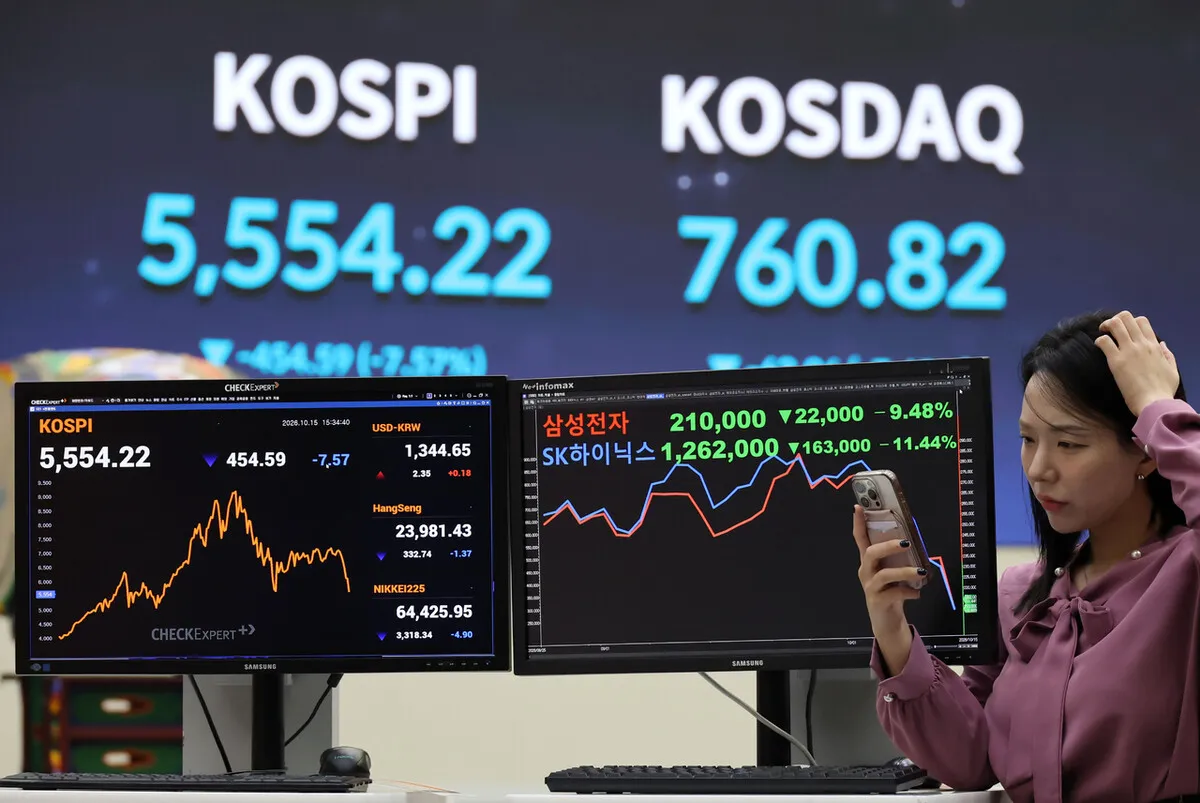
The Kospi fell 20.67 percent in seven straight sessions last week. The circuit breaker tripped for the tenth time this year — and the sixteenth time in the index’s history. Samsung Electronics dropped nearly 10 percent on a single day. SK Hynix shed over 11 percent. By close, the benchmark was trading at its lowest level since July 30, and intraday it brushed levels not seen since April.
Almost immediately, the word bubble appeared in headlines. Not just any bubble — the AI equivalent of the late-1990s dot-com wreck. It is a tempting comparison. The Kospi had been riding a memory-chip supercycle that sent the index up 96.7 percent in the first half of the year, roughly seven times the Nasdaq’s gain over the same stretch. When the下半年 came, the Nasdaq drifted up 2.5 percent and Korea cratered 33.1 percent. The asymmetry is dramatic. The narrative writes itself.
But the mechanics behind the rout tell a different story — one that is less about AI demand collapsing and more about positioning, leverage, and the sudden withdrawal of the very liquidity that fueled the rally in the first place.
What the Numbers Actually Show
The trigger was not a disappointment in AI fundamentals. It was the US September CPI, printed at 3.7 percent year-over-year against a 3.6 percent consensus forecast. The surprise was modest in absolute terms but devastating for sentiment. It revived fears of a Federal Reserve rate hike rather than a cut, which immediately re-priced risk assets worldwide.
For Korea, the damage was amplified by structure. Samsung and SK Hynix together account for more than half the Kospi’s market capitalization. When those two names sell, the index does not drift — it plunges. The program-driven selling that hit the KOSPI 200 futures triggered a sidecar halt within minutes of the open, then a full Stage 1 circuit breaker twenty minutes later. These are not mechanisms designed for gradual repricing. They are emergency brakes. The fact that they fired twice in a single session signals panic, not rational reassessment.
Foreign investors sold 3.6 trillion won on the day. Domestic individuals bought 1.3 trillion. Institutions picked up another 1.6 trillion. The foreign flow is the meaningful variable — it is the same pattern that preceded the July 28 to 30 crash, when the index shed 17.2 percent in three sessions before a 17.9 percent single-day rebound partially repaired the damage. This time, there was no bounce. The selling compressed into a tighter window with greater force.
Why the Dot-Com Parallel Is Misleading
The 2000 bubble burst was driven by companies with no revenue, no path to profitability, and valuations detached from any measurable cash-flow story. Korea’s rally was not built on fiction. Memory-chip revenues have been real, strong, and rapidly expanding. Samsung and SK Hynix are generating genuine earnings power from AI data-center demand. The question is not whether that demand exists — it is whether the pace of growth that justified the H1 valuation multiples can sustain itself once borrowing costs rise and capex cycles turn.
Kim Seok-hwan at Mirae Asset Securities noted that memory-semiconductor earnings had already been largely reflected in the Kospi during the first half. The market, he argued, is now searching for a narrative beyond what has already been priced in and not finding one. That is a positioning problem, not a fraud problem. The distinction matters because the unwind dynamics are very different.
Lee Eun-taek of KB Securities called the current phase the late stage of a bubble — a view that acknowledges the stretch in valuations without conflating it with the dot-com wreck. The more useful comparison may be to commodity cycles: sharp rallies followed by swift, painful corrections when the next inflection point arrives. The memory-chip industry has always behaved this way. What is new is the speed at which the Kospi’s extreme concentration translates that industry rhythm into broad market chaos.
The China Factor the Market Is Underpricing
There is a second headwind that deserves more attention than it has received. Chinese memory-maker Changxin Memory Technologies has been advancing its capabilities over the weekend and beyond, raising competitive concerns that compound the US rate story. If China achieves meaningful progress in DRAM or NAND production, the pricing power that has underpinned the current supercycle faces a structural challenge on a multi-year horizon. The market is not yet pricing this in fully — but the fear is visible in the selling.
For a market already running on thin optimism about uninterrupted AI capex growth, the combination of tighter monetary policy expectations and rising competitive pressure from China creates a double exposure. That is why the rout has been steeper than the July correction, even though the macro trigger — the CPI print — was far less severe than the events that preceded the earlier crash.
What This Means for US Chip Stocks
The most consequential question is not where the Kospi goes next but what this episode signals about American semiconductor valuations. US chip names have priced in years of uninterrupted AI demand growth. Nvidia, AMD, and the broader semiconductor basket carry multiples that assume the memory-chip supercycle will persist at current intensity through at least 2026. If Korea’s unraveling is a preview of how quickly that narrative can evaporate when rates move against growth stocks and competitive dynamics shift, then US valuations may be running ahead of reality in a way that mirrors Korea’s H1 excess — only on a larger absolute scale.
The Nasdaq’s relative calm through the same week is partly a function of diversification and partly a function of the dollar. But the directional risk is the same. AI capex is enormous, but it is not infinite. When the cost of capital rises, the math changes. When new entrants emerge, margins compress. Both forces are visible now.
The Path Ahead
The Financial Services Commission convened an emergency meeting and said the market overreacted, pointing to excessive speed and imbalanced supply-demand dynamics. It hinted at contingency plans if needed. That language is standard — and standard for a reason. Korean officials have done this before. The July rebound proved that panic selling can reverse quickly when liquidity returns.
Whether a W-shaped recovery is possible, as some analysts suggest, depends on three variables: US rate trajectory, the durability of AI capex commitments from hyperscalers, and whether Chinese memory competition accelerates faster than expected. None of those are resolved. The market is currently pricing the worst combination.
The bubble label will persist in commentary. But the more accurate reading is simpler: a concentrated, leverage-fueled rally met a modest macro shock and found no buyers at the new higher cost of capital. That is not a dot-com rebroadcast. It is a reminder that even real earnings can support unsustainable price moves — and that when the music stops, the fall is fastest for the names that rose the furthest.