Korea Watches as Ukraine Peace Talks Stall Again
Zelensky met US envoys Witkoff and Kushner in Kyiv after talks with Putin, but no breakthrough emerged. For Seoul, the stalled negotiations raise urgent questions about alliance dependence and the limits of middle-power diplomacy.
When Great Powers Talk, Everyone Else Waits
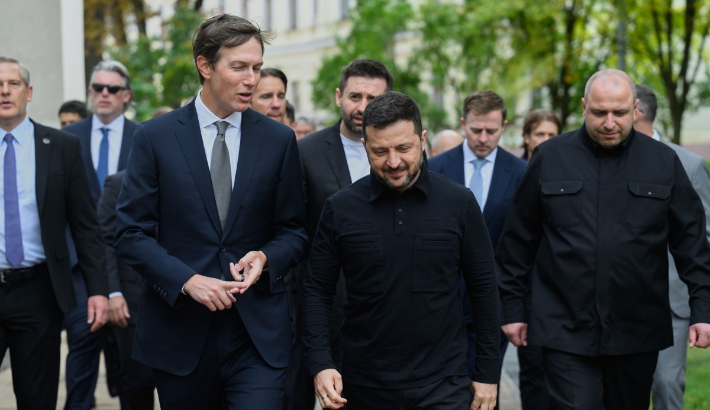
Steve Witkoff and Jared Kushner touched down in Kyiv on June 6 after a meeting with Vladimir Putin the day before. Three hours of talks with Volodymyr Zelensky followed, along with a side session involving security advisors from Britain, France, and Germany. The result, according to nearly every report, was exactly what nobody wanted to hear: nothing decisive.
Witekoff called it “substantial and significant” and “very encouraging.” Kushner said he hoped the visit would lead to “newly advanced proposals.” Zelensky’s office insisted the ideas on the table were “not the same as before” and “more effective.” Yet within days, the picture that emerged was one of a war grinding on, a president warning that fighting could continue through winter, and a diplomatic process moving at the speed of great-power convenience rather than battlefield reality.
What happened in Kyiv matters beyond Eastern Europe. It matters for Seoul.
The Korean Angle Nobody Is Naming
South Korean coverage of the Ukraine war has, for the most part, been cautious and measured. Yonhap News reported the Kyiv meeting with standard factual neutrality — who met whom, what was said, what was not. But the very restraint in Korean reporting is itself a signal. Seoul has spent three years balancing American expectations against the risk of provoking Beijing and Moscow, and the Ukraine peace process is testing that balancing act in real time.
The Korean media framing is revealing in its silence. There have been few editorials linking the Kyiv talks to Korea’s own security calculus. Almost no analysis has asked what a US-Russia deal over Ukraine’s head means for the Korean Peninsula — where Washington similarly negotiates with Pyongyang and Beijing without consulting Seoul.
That silence is the story.
Who Wins, Who Loses, Who Waits
The immediate winner in the current dynamic is whoever controls the tempo of the talks. The United States, sending envoys rather than the president himself, is signaling a transactional approach: manage the conflict, don’t necessarily resolve it. Russia gains time and international fatigue as ammunition. Europe, present at the Kyiv meeting but clearly not driving it, is reduced to the role of observer in a process it helped start but no longer directs.
Ukraine loses the most tangible thing: agency over its own survival. Zelensky’s comment that the war may continue through winter is not just a military assessment — it is a plea for continued support in a landscape where the guarantors of that support are now negotiating behind his back.
For Korea, the loss is more abstract but no less real. Seoul has positioned itself as a responsible middle power — supporting Ukraine with non-lethal aid, coordinating with NATO partners, avoiding direct confrontation with Russia. But the Kyiv talks demonstrated something uncomfortable: middle powers do not get a seat at the table when the principals decide the terms. Korea’s diplomatic positioning, so carefully constructed, depends entirely on the continued willingness of the United States to include it in strategic conversations. There is no guarantee that willingness persists.
The Energy Question That Connects Everything
One detail in the reporting deserves more attention than it has received. Ukraine is reportedly seeking not only enhanced air defense systems but also American liquefied natural gas supplies as part of a broader package. Energy is no longer a secondary concern in the peace negotiations — it is becoming central.
This matters for Korea because South Korea is one of the world’s largest LNG importers. Any shift in global energy flows triggered by a frozen or ended Ukraine conflict will hit Seoul’s economy directly. A Russia-sanctioned territorial settlement that unlocks new energy corridors, or conversely a prolonged war that keeps European gas prices volatile, both carry implications for Korean industry and household budgets that few outlets are tracking closely.
The Middle-Power Dilemma in a Multipolar Shift
What the stalled Kyiv talks expose is the structural vulnerability of middle-power diplomacy in an era of great-power competition. Korea’s foreign policy has long rested on a simple premise: align firmly with the United States, maintain workable relations with China, avoid escalation with North Korea and Russia. The framework assumed that alliances were predictable and that American leadership, however fluctuating, would remain the anchor.
The Ukraine process is undermining that assumption in real time. Envoys from a future Trump administration are traveling between Moscow and Kyiv without a clear Korean briefing process. European allies are present but peripheral. The negotiation architecture being built now will shape the post-Ukraine order, and Korea’s voice in that architecture is not guaranteed.
This is not a new problem for Seoul. It has surfaced repeatedly — in negotiations over North Korea’s nuclear program, in trade disputes with the United States, in the delicate dance of joining or avoiding US-led sanctions regimes. But the Ukraine case is different because the stakes are existential for another country, and because the precedent it sets will echo across East Asia.
If the United States can negotiate over Ukraine’s territory and future without demanding Korean consent, what stops it from doing the same regarding Taiwan or the Korean Peninsula? The answer, uncomfortably, is nothing structural. Only goodwill and alliance loyalty — neither of which is reliable enough to build foreign policy on.
What Happens Next
Zelensky has said winter is coming and support must continue. The US envoys have returned to Washington with stories of progress that may or may not materialize. Putin has reiterated his position on Donbas. The European advisors have agreed to meet again.
For Korea, the practical question is whether to deepen engagement with the Ukraine process or step back and focus on regional contingencies. The cautious path — the one most likely taken — is to offer conditional support while quietly preparing for scenarios in which great powers reach settlements without Korea’s input. That is the middle-power strategy: stay visible, stay useful, stay ready to adapt when the table is already set.
The harder truth is that visibility and usefulness are not the same as influence. Ukraine is learning that now. Korea should be watching closely.