A Korean Astronomer Just Challenged the Nobel-Approved Death of the Universe
Yonsei professor Lee Young-wook spent 15 years arguing that the accelerating expansion of the universe isn't what we thought. His latest paper directly counters Nobel laureates. What happens next could rewrite cosmology.
The Nobel Prize Is Wrong About the Universe. Or Maybe It Isn’t.
For 28 years, the textbook answer has been simple: the universe is expanding faster and faster. Stars dying in distant galaxies provided the proof, and three scientists won the 2011 Nobel Prize in Physics for finding it. The implication was stark — dark energy is real, and the cosmos is doomed to expand forever.
Lee Young-wook thinks they got it wrong.
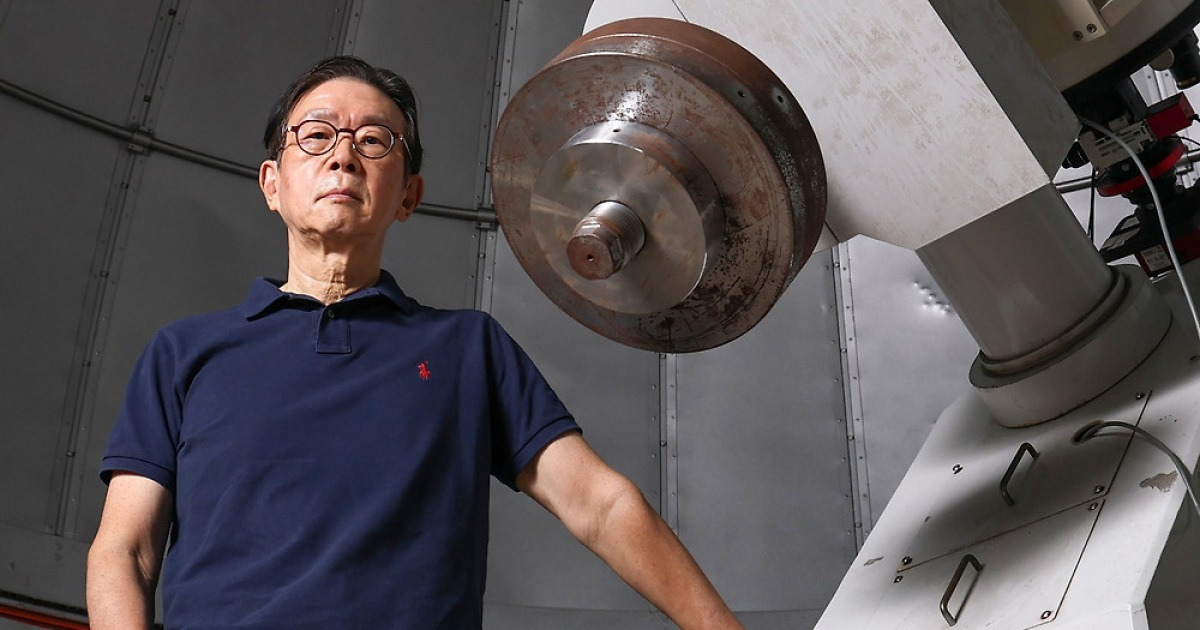
A professor of astronomy and space sciences at Yonsei University, Lee has spent over a decade and a half arguing that a single variable was overlooked in the original supernova measurements: stellar age. His conclusion flips the entire narrative. The universe is still expanding, but the acceleration may be slowing. In the far future, it could even reverse.
His recent paper, published last month in the Monthly Notices of the Royal Astronomical Society under the title “Still Not Accelerating,” is a direct response to a June rebuttal from 17 mainstream researchers, including Nobel laureates Adam Riess and Brian Schmidt, who published their own counter-argument under the title “Still Accelerating.” Both papers appeared in the same journal. This is not a whispered disagreement in a conference hallway. It is a public, documented dispute between two competing readings of the same data.
What Exactly Is Disputed
The controversy centers on Type Ia supernovae — the standard candles of cosmology. When massive stars reach the end of their lives, some explode with a remarkably consistent peak brightness. By measuring how dim they appear from Earth, astronomers can calculate their distance. In 1998, Riess, Schmidt, and their teams found that distant Type Ia supernovae were dimmer than expected, meaning they were farther away than a constant-expansion model would predict. The logical inference: the expansion of the universe is speeding up.
Lee’s argument is deceptively simple. Younger stars produce supernovae that are intrinsically less bright than older ones. If the original calibration didn’t fully account for this, then the distance estimates — and therefore the conclusion about acceleration — could be skewed. A supernova that looks far away because it’s dim might instead be closer and simply come from a younger progenitor star.
He didn’t set out to overturn a Nobel Prize. He was originally a stellar astrophysicist studying star ages and evolution. While leading NASA’s Galaxy Evolution Explorer (GALEX) project, his work shifted toward galaxies and then cosmology. The supernova question emerged naturally from that trajectory.
“I didn’t start by trying to overturn Nobel-level research,” Lee said in an interview at his Yonsei research office. “But the more supernova-host galaxies I observed with overseas telescopes, and the larger my sample became, the clearer the contradiction grew.”
The Stakes Are Cosmological
This isn’t a minor adjustment to a formula. If Lee is right, the implications cascade through every pillar of modern cosmology.
Dark energy — the mysterious force invoked to explain acceleration — would need to be rethought. Models predicting a “Big Freeze” or “Heat Death” of the universe would lose their foundation. The timeline for the cosmos’s ultimate fate could shift from eternal expansion to a future contraction.
The 2011 Nobel Prize itself wouldn’t be “taken back,” but the interpretation of the data that earned it would be called into question. No Nobel-winning physics result has ever been reversed. That’s part of why Lee’s position is so provocative — and why the backlash from the mainstream camp was swift.
Riess and Schmidt’s rebuttal argued that Lee’s corrections don’t hold up under closer scrutiny. Lee’s response argues the opposite. The journal published both. Peer review, in this case, has produced a written duel rather than a settled consensus.
Why This Matters Outside Korea
Korean astronomy doesn’t often make headlines in global science coverage, and that’s precisely why this story deserves attention. Lee is not an outsider amateur posting on preprint servers. He earned his PhD at Yale, served as a NASA Hubble Fellow, led Korea’s first international joint research project with NASA, and published Korea’s first astronomy paper in Nature in 1999. His credentials are untouchable. The fact that he’s making this argument from within the establishment — not on the fringe — raises the stakes.
The broader lesson for global science coverage is about who gets to challenge consensus. Most cosmology debates play out at meetings like the International Astronomical Union symposia or in journals that English-language outlets rarely cover. A Korean professor publishing a direct counter to Nobel laureates in a prestigious British journal is unusual enough to warrant sustained attention, not a one-line mention.
What Comes Next
Lee says the data will decide. He points to the Vera Rubin Observatory in Chile, which began operations in its current form and is designed to survey the sky at unprecedented scale. When it starts delivering large numbers of supernova observations — likely within two to five years — the question should be answerable.
“In science, changing your mind when new evidence arrives isn’t a crime,” Lee said. “Even if you’ve won a Nobel Prize, if the evidence is insufficient, it should be questioned. In the end, it’s not authority that decides who’s right. It’s data.”
That’s the orthodox scientific stance. The uncomfortable truth is that science rarely works that cleanly. Nobel Prizes carry enormous gravitational weight. Institutional incentives favor consensus. And the person standing alone against that gravity — especially from a university outside the usual power centers of Harvard, Cambridge, or Caltech — faces a higher bar to be heard.
Lee has cleared that bar at least once. Whether the data ultimately sides with him or the Nobel winners remains the open question. But the fact that the question is being asked publicly, in a peer-reviewed journal, by a Korean researcher with a 15-year track record — that alone marks a moment worth watching.