Koreans Are Betting Double on NVIDIA — And It Says Something About AI Capital
Leveraged NVIDIA ETFs in Korea are surging as retail investors pile into AI exposure despite tariff headwinds. The move reveals a pattern of Asian capital chasing momentum even as policy risk mounts.
The Trade Isn’t What It Looks Like
NVIDIA closed at $227.98 on August 27 after surging 8.74% on the back of second-quarter results that obliterated Wall Street’s estimates. Revenue hit $96.2 billion — a 106% year-over-year jump that blew past the consensus forecast of $92.2 billion. The third-quarter guidance of $108 billion also topped the $104.6 billion IB estimate. And perhaps most provocatively, management projected fiscal 2027 revenue growth of 70%, nearly double what analysts were pricing in at 40–44%.
The stock moved. That is expected. What is more interesting is how Korean retail investors responded.
NVDL, the GraniteShares 2x Long NVDA Daily ETF, jumped 16.76%. NVDX, the TREX 2X Long NVIDIA Daily Target ETF, climbed 16.74%. These are not broad market bets. They are leveraged instruments designed to amplify daily moves — instruments that punish holding for extended periods and reward timing. A 16% single-day gain in a 2x leveraged fund is the kind of move that gets discussed in Korean investment forums and Telegram groups, not boardrooms.
This is where the story departs from a standard earnings reaction piece.
Who Wins and Who Loses Here
The winners are obvious: anyone who bought NVDL or NVDX before the report and held through the open. On a daily basis, the leverage works exactly as advertised. You double the gain, you double the pain.
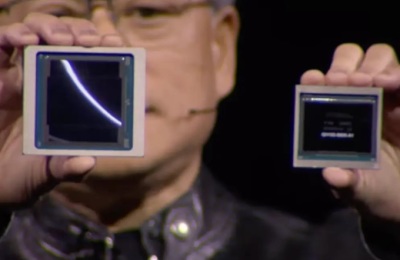
The less obvious winner is China. Not the Chinese government, not Huawei — Chinese cloud operators, training farms, and AI startups that source inference and training capacity through third-party providers who are likely scaling around NVIDIA chips regardless of export restrictions. The Blackwell GPU Jensen Huang held up on stage in the accompanying photo is itself a symbol: every chip that ships, every data center that fills, every model that trains adds to the infrastructure layer that makes AI accessible beyond the Tier-1 labs. Korea’s leveraged ETF traders may not be thinking about that. But the capital flowing into NVIDIA is flowing into that ecosystem.
The loser in this dynamic is the patient investor. Leveraged ETFs decay. Over a volatile quarter — which is exactly the kind of quarter tariff headlines guarantee — the compounding drag bites hard. An investor who bought NVDL three months ago and held through a 10% drawdown and a 12% rebound would not have captured the 2x return. They would have lost money. The math of daily-rebalancing leverage is brutal in choppy markets, and August has already been choppy.
Then there is the policy risk that no earnings report can outrun. The Trump administration has floated tariffs on semiconductors and discussed broader trade measures that could reshape how NVIDIA ships to key markets. Raymond James noted in a research report that annual revenue could hit $1 trillion by the fiscal year ending January 2029 — a claim that is ambitious and, frankly, speculative. But even if you strip away the target price bravado, the direction of travel is clear: demand for NVIDIA’s architecture is structural, not cyclical, and it is not going to be solved by a trade deal.
What This Reveals About Asian Capital Flows
Korean retail investors have long been the most active force in domestic ETF markets. The KOSPI is dominated by institutional flows, but the sidecar market — ETFs, leveraged products, thematic funds — runs on retail volume. When a fund like NVDL jumps nearly 17% in a day, it is not institutions rebalancing. It is individuals clicking buy.
This matters for a reason that goes beyond Korea. Asian retail capital has a pattern: it chases momentum aggressively, it tends to amplify existing trends rather than counter them, and it often moves before institutional flows catch up. In the context of AI exposure, this means Korean leveraged ETF demand is a leading signal, not a lagging one. When these funds surge, it usually means the retail base is convinced the thesis is unassailable — which, as any trader who has survived a tariff headline knows, is when the risk is highest.
But there is also a more structural story. Asia, and Korea in particular, has limited domestic opportunities for asymmetric tech upside. The KOSPI is heavy on conglomerates and export-oriented manufacturers. It does not have a homegrown NVIDIA. So when AI momentum builds, Korean capital flows outward — through ETFs, through ADRs, through leveraged products that offer the exposure domestic markets cannot. NVDL and NVDX are simply the most efficient vehicle for that impulse.
The Real Question Is Timing
Raymond James said $1 trillion in annual revenue is possible by early 2029. That is a target built on assumptions: continued demand growth, no catastrophic trade disruption, and no meaningful competitive erosion from AMD, custom silicon from hyperscalers, or regulatory constraints on chip exports. Any one of those assumptions breaking changes the picture dramatically.
The 2x leveraged ETF traders are not betting on 2029. They are betting on the next earnings call, the next guidance print, the next momentum surge. That is a different kind of risk entirely — and one that is harder to quantify because it lives in the psychology of the trade, not the fundamentals of the company.
What this episode reveals is not that Korean investors are irrational. It is that they are playing a game with different rules than the ones most Western analysts assume apply. Leverage is not a bug in this context — it is the point. The return profile is designed for volatility, not compounding. The investor who understands that is playing a completely different game from the one who treats NVDL as a long-term AI proxy.
NVIDIA’s numbers are real. The demand behind them is real. But the capital flowing into 2x leveraged ETFs on a single earnings day is a reminder that in Asia’s retail-driven markets, momentum is both the thesis and the trap.
The question for anyone watching this flow is not whether NVIDIA will reach $1 trillion. It is whether the investors piling into NVDL today can exit before the market decides leverage is no longer a feature — but a liability.