Korea's Chip Giants Just Rewrote Asia's Capital Rules
Samsung and SK Hynix are returning roughly 110 trillion won to shareholders — the largest payout in Korean corporate history. But the real story isn't the size. It's how two different corporate structures are reshaping global semiconductor investment.
The numbers that shouldn’t be possible
Samsung Electronics and SK Hynix together announced roughly 110 trillion won in shareholder returns this year and next. For context, that is the single largest payout in Korean corporate history — and it comes from two companies that have spent decades defending the principle that retained earnings were the backbone of national industrial policy.
Half a trillion dollars is not pocket change. It is a signal. And the signal is this: the era of the chaebol hoarding capital for capex-led expansion is over. AI demand has turned memory chip margins into something resembling monopoly-level returns, and management is finally answering to shareholders instead of just growth.
But looking at the headline total obscures something more interesting. The two companies arrived at this moment through almost opposite mechanisms. Understanding those mechanisms tells you what comes next for semiconductor investment in Asia.
SK Hynix’s American arbitrage
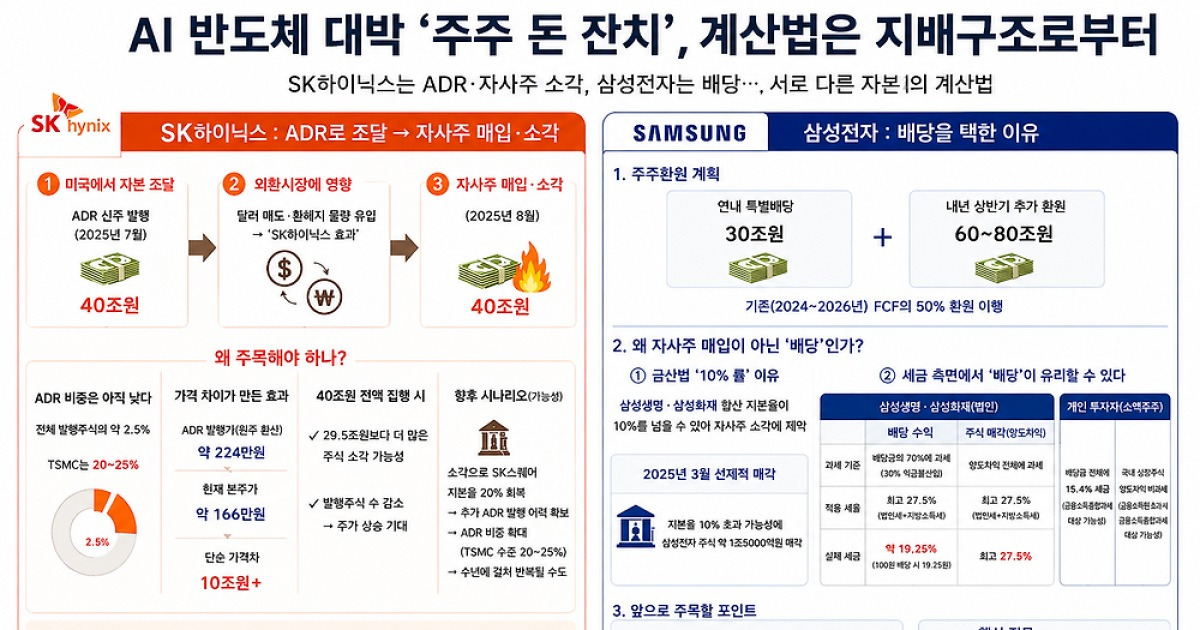
SK Hynix raised 40 trillion won through American Depositary Receipts in July. One month later, it committed to buying back and cancelling an equivalent amount of its own shares. The press call called it a shareholder return. The mechanics looked more like a structured trade.
The ADR issue added roughly 2.5 percent to SK Hynix’s total share count. By contrast, TSMC’s ADRs represent 20 to 25 percent of its outstanding shares. The gap is not accidental. Under South Korea’s Fair Trade Act, SK Square — the holding company — must maintain at least a 20 percent stake in listed subsidiary SK Hynix. The July ADR push brought that ownership to the regulatory line.
Here is the part most English-language readers miss: treasury share cancellation is not just a dividend substitute. It is also a key. Cancel shares, and the denominator shrinks. SK Square’s ownership percentage rises. That creates room to issue more ADRs without breaching the 20 percent floor.
If the ADR continues trading above the domestic share price — and recent pricing suggests it does, with the ADR-implied price around 2.24 million won per share versus roughly 1.66 million won for the local stock — the economics work in SK Hynix’s favor. The company could issue new ADRs in New York at one price and retire domestic shares at another, closing the gap while expanding its U.S. capital base.
Repeat this cycle and SK Hynix could gradually build an ADR footprint approaching TSMC’s scale. That is a long runway. But the first repurchase already opened the door.
Whether SK Hynix actually walks through it depends on management’s conviction, not just the math. The company did not even disclose an estimated payout figure for this year’s results, a notable gap compared with Samsung’s specificity.
Samsung’s dividend workaround
Samsung chose a different path. It announced a 30 trillion won special dividend this year, with a further 60 to 80 trillion won expected in the first half of next year. All of it sits within Samsung’s existing policy to return at least 50 percent of free cash flow to shareholders.
The choice of dividend over buyback is structural, not sentimental. South Korea’s Financial Services Commission and Securities Act impose a 10 percent limit on combined share ownership by financial affiliates — in Samsung’s case, Samsung Life Insurance and Samsung Fire & Marine Insurance.
When Samsung cancelled treasury shares in March, both insurers’ combined stake in Samsung Electronics breached that threshold. They sold roughly 1.5 trillion won worth of shares preemptively to stay compliant. A repeat buyback would trigger the same squeeze.
Dividends sidestep the problem entirely. They do not change the number of outstanding shares, so the insurers’ ownership percentages stay put. And there is a secondary benefit most international observers overlook: tax treatment.
Under South Korea’s Corporate Tax Act, dividends received from a domestic holding company in which a taxpayer holds less than 20 percent of voting shares qualify for a non-taxable income inclusion of 30 percent. Samsung Life and Samsung Fire both fall below that threshold. The effective corporate tax rate on Samsung’s dividend income is therefore closer to 19 percent than the top statutory rate of 27.5 percent.
Sell the shares instead, and capital gains tax applies to the full appreciation — and Samsung’s insurers acquired their positions decades ago at prices far below current levels. The gain would be enormous, and heavily taxed.
Individual retail investors face the opposite calculus: capital gains on listed Korean stocks are currently tax-free, while dividends are subject to withholding. The structural incentive is clear — Samsung’s payout design favors institutional holders over retail, and that is by legal design, not accident.
The missing variable
Both companies frame their returns around free cash flow. SK Hynix committed to returning 50 percent or more of cumulative three-year FCF. Samsung says its announced payouts comply with a 50 percent FCF target. The language sounds transparent. The arithmetic is not.
FCF equals operating cash flow minus capital expenditures. You can back-calculate past capex from cash flow statements. You cannot project future capex without management guidance. And neither company provides the kind of annual capex range that U.S. technology firms routinely disclose alongside earnings.
SK Hynix’s own capital plan makes the opacity sharper. In June and July, it announced a “3 Mega Project” totaling 1,100 trillion won in medium- to long-term investment — 600 trillion won in Yongin, 400 trillion won in the Southwest Region, and 100 trillion won in Cheongju. The headline number is staggering. The annual breakdown is absent.
Samsung’s pattern is similar. Over the past two years, it deployed roughly 63 percent of operating cash flow into tangible and intangible assets. SK Hynix deployed about 52 percent. The trailing numbers are visible. The forward trajectory is not.
This matters because AI hyperscalers now dictate the pace of memory spending. Every quarter, Nvidia’s guidance, Google’s procurement signals, and Microsoft’s data-center roadmap move semiconductor stocks. Investors who want to model Samsung’s or SK Hynix’s future FCF need to know how much of the revenue tailwind is being reinvested — and neither company gives them that answer with sufficient granularity.
Transparency is not a corporate social responsibility checkbox. It is the price of capital. The larger the promised payout ratio, the more credible the guidance must be. Right now, the payout side is loud. The investment side is quiet.
What this means beyond Korea
The 110 trillion won return is not an isolated event. It is the first full expression of a new chapter in Asian semiconductor strategy. Korea’s two memory giants are profitable at a scale that makes their domestic peers look modest. The AI cycle has handed them pricing power that did not exist even two years ago.
The question is whether this model migrates. Taiwan’s TSMC already returns massive sums through dividends and buybacks, but its ADR structure and lower effective tax drag on cross-border capital flows make the mechanics cleaner. Japan’s Rapidus is still burning cash. China’s SMIC faces export controls that limit both its upside and its ability to distribute freely.
What Korea is testing — and possibly pioneering — is whether a chaebol-linked semiconductor company can sustain high shareholder returns while funding trillion-won capex cycles simultaneously. Samsung and SK Hynix are attempting exactly that. Their legal and tax architectures differ, but the underlying bet is the same: that memory profitability will outlast the current cycle.
If that bet holds, the 110 trillion won figure becomes a floor, not a ceiling. If it does not, the payout commitments will face the same pressure that has squeezed return ratios elsewhere in Asia during downturns.
The mechanics of how Samsung and SK Hynix reach that outcome — ADR arbitrage on one side, dividend structuring on the other — are distinctly Korean. The investment implication is not.
What happens next
Three developments to watch in the coming months.
First, whether SK Hynix issues a second ADR tranche. The regulatory room exists if treasury cancellations raise SK Square’s ownership above 20 percent. A follow-on offering would be the clearest signal that management is treating the ADR market as a permanent capital source, not a one-time liquidity event.
Second, whether Samsung revises its payout mix next January. The board has not yet finalized the balance between dividends and buybacks for next year. Any shift toward repurchases will test the 10 percent affiliate rule in real time and likely trigger another insurer disposition if ownership thresholds are breached.
Third, and most important, whether either company begins issuing annual capex ranges in line with U.S. peers. The FCF pledge is meaningful only if investors can verify the denominator. Without forward investment guidance, the 50 percent commitment remains partly theatrical — a promise framed in a language investors cannot fully audit.
The money is real. The structure is inventive. The transparency is not yet there. That gap is where the next move will be made.