Koreas Retail 'Ant Army' Is Dropping the Leveraged Chips Bet
Korean retail investors are walking away from 3x leveraged bets on US semiconductor stocks after a regulatory crackdown. The 'second balloon effect' never arrived — and neither did the frenzy.
The regulatory hammer didn’t break the antenna — it just changed the signal.
When South Korea’s financial regulators raised the basic deposit requirement for single-stock leveraged ETFs and ETNs from ₩1 million to ₩3 million on July 31, the immediate fear was predictable. Demand would simply migrate offshore, sliding into 3x-index products like SOXL and TQQQ — leveraged funds that track broad indices rather than individual stocks and thus escaped the new rules. Market watchers called it the “second balloon effect.” Trading data over the next three weeks told a different story.
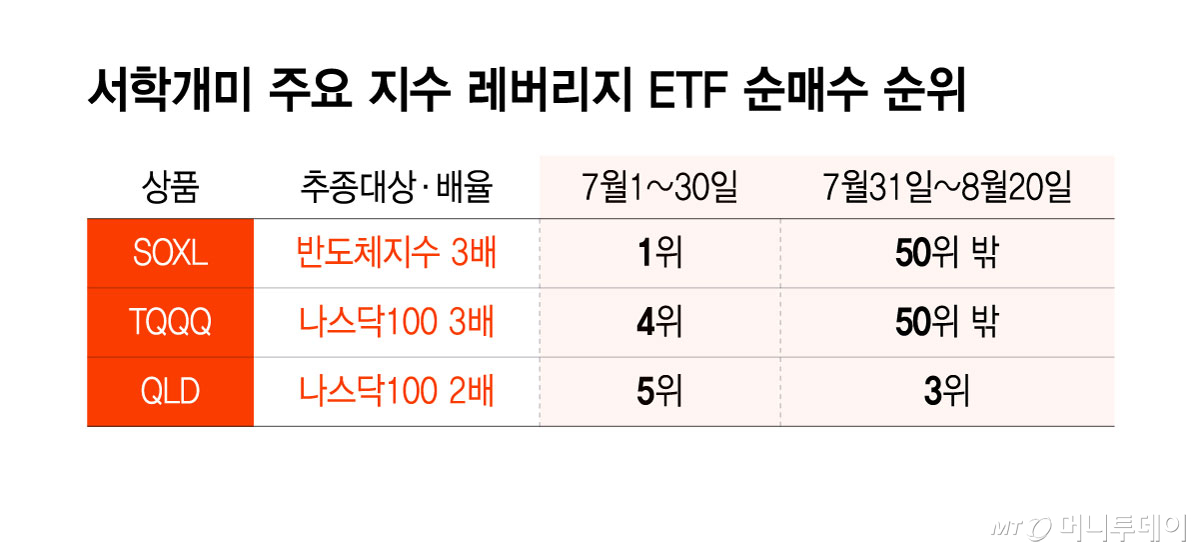
Neither SOXL nor TQQQ appeared in the top 50 most-purchased US stocks by Korean retail investors between August 1 and August 20. That stands in sharp contrast to January through July 30, when SOXL was the single most-purchased US stock by net settlement value at $3.33 billion and TQQQ ranked fourth at $326 million. The extreme leverage bets that defined the 서학개미 — the so-called “ant army” of Korean retail investors — have not found a replacement vehicle. They’ve largely stopped betting.
What the numbers actually show
The collapse in leverage activity is stark. Single-stock leveraged trading volume fell from ₩12.4 trillion on July 30 to just ₩70 billion by August 11, according to industry estimates. Overall Korean retail net purchases of US stocks dropped 82.9 percent — from $4.67 billion in the first half of July to $796 million over the August 1–20 period.
But the shift isn’t just about leverage products going dark. Individual stocks have taken their place. SpaceX led the new top 50 at $233.8 million in net purchases, followed by Alphabet ($219.6 million), Amazon ($156.5 million), Bloom Energy ($154.9 million), and Tesla ($120.9 million). Even a 2x Nasdaq-100 fund, QLD, registered $157.9 million in net buys and cracked the top three — suggesting some appetite for leveraged exposure remains, just at a more moderate multiple.
What’s notable here is the direction of rotation. The ant army isn’t simply exiting US equities. It’s moving from hyper-leveraged ETFs into actual companies. That’s a behavioral shift, not a disappearance of demand.
Why this matters beyond Seoul
Korean retail investors have become one of the most watched forces in global markets. Their enthusiasm for American tech and semiconductors has helped drive sentiment and liquidity in certain names. When they pile into SOXL — a 3x tracker of the Semiconductor Select Sector Index — it’s usually a signal that domestic retail conviction is running hot. When they abandon it, the signal matters too.
The key question is whether this is a temporary regulatory pause or a structural change in how Korean retail investors approach US stocks. The answer likely sits somewhere in between.
The ₩3 million minimum deposit for single-stock leveraged products is a meaningful barrier. For a retail investor who previously parked ₩1 million to take a leveraged position, tripling the requirement changes the economics of small-bet gambling. It doesn’t eliminate the appetite — it redirects it. The rotation into individual stocks rather than index leveraged products suggests that appetite remains, just expressed differently.
The second balloon that never inflated
Before the July 31 rule change, analysts warned that the ant army would simply shift to broader leveraged products that tracked indices instead of single stocks. SOXL and TQQQ were expected to become the vessels for leveraged demand that the regulation had displaced from names like Samsung, SK Hynix, and domestic chip makers. This predicted migration — what some called the “second balloon effect” — never materialized.
The data is unambiguous. Between August 1 and August 20, neither product appeared in the top 50 most-purchased US stocks. This is particularly striking because TQQQ, which tracks the Nasdaq-100, had been a consistent favorite during the earlier leverage-fueled buying sprees. Its absence from the post-regulation rankings signals something deeper than a simple product substitution.
A retail investor base at a crossroads
The 서학개미 have always operated differently from their Western counterparts. Korean retail investors tend toward momentum strategies, often chasing stocks that have already moved higher. This herding behavior created self-reinforcing cycles: buying drove prices up, which attracted more buyers, which pushed prices higher still. The leverage products amplified these cycles, creating explosive moves that drew attention from traders worldwide.
Now that regulatory framework is forcing a reckoning. The higher deposit requirements mean that the casual leveraged bets — once made with ₩1 million or less — are no longer economically viable for many participants. Some investors are simply stepping back from US markets altogether. Others are recalibrating their strategies, looking for exposure without the triple-digit risk.
What emerges is a more sophisticated, if smaller, cohort of retail participants. The rotation into individual stocks like Tesla, Alphabet, and SpaceX suggests that investors still want direct exposure to high-growth American names. They’re just getting there through a different door.
Winners and losers in the new equilibrium
For semiconductor stocks specifically, the loss of the SOXL retail bid removes a source of speculative demand that amplified price moves in either direction. That’s a modest factor in a market driven by institutional flows and AI capex narratives — but it’s not nothing. Korean retail investors were among the most reliable buyers of leveraged chip exposure, and their absence may reduce some of the volatility premium that certain names were carrying.
For regulators, the data vindicates the decision to extend the collateral rules to overseas-listed products as well. The feared second balloon effect didn’t materialize. If anything, the opposite happened: total US stock purchasing activity contracted sharply rather than shifting to an unregulated loophole.
For the ant army itself, the move may reflect growing sophistication — or simply a recognition that triple-leverage products are unforgiving in sideways or declining markets. Both interpretations are plausible, and the data doesn’t distinguish between them yet.
What happens next
The most important variable to watch is whether this rotation into individual stocks sustains itself once the regulatory shock passes. If Korean retail investors begin accumulating large positions in names like Tesla, Alphabet, and SpaceX, that could create a new kind of demand dynamic — one less explosive than leveraged ETFs but more durable, since it’s tied to company fundamentals rather than beta multiples.
On the semiconductor side, the absence of SOXL retail demand won’t move the needle for major players like Samsung or SK Hynix, which are driven by institutional and corporate buyers. But for smaller names and ETFs that previously benefited from the retail leverage flow, the landscape has subtly shifted.
One thing is already clear: the era of Korean retail investors using triple-leverage products as their primary vehicle for US stock exposure is on hold. Whether it returns remains to be seen.