Koreas State-Led Overhaul Rewrites the Rules of Infrastructure
Seoul is splitting, merging, and shelving reforms across its flagship public agencies in a rare three-pronged restructuring. The moves expose how state-capital dynamics in Korea are shifting — and what it means for infrastructure and energy markets across East Asia.
The three-solution bet on state giants
The Ministry of Land, Infrastructure and Transport is simultaneously splitting one monster agency, merging another, and shelving a third plan — a rare triple maneuver that reveals how tightly Seoul is calibrating its relationship with the public-sector behemoths it inherited decades ago.
The Land and Housing Corporation, or LH, is being carved into two separate entities: a development corporation that will chase land projects and housing construction revenue, and an asset corporation that will take on social housing and strategic asset reserves. Development profits flow through the housing fund back into the asset corporation, creating a closed-loop subsidy mechanism. The Korea National Railroad, or KORAIL, and its high-speed rail rival SR formally merged on June 1. Meanwhile, the proposed merger between Incheon International Airport Corporation and Korea Airports Corporation has been paused indefinitely.
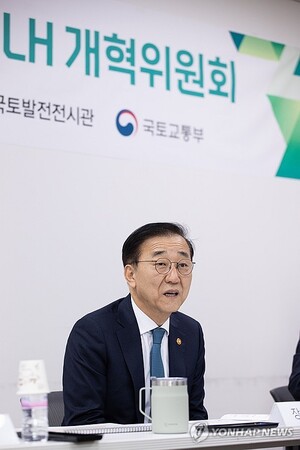
“Separate, integrate, postpone” is how Minister Kim Yoon-deok described the calculus. But the real story is what each decision says about where Seoul thinks state power should concentrate — and where it should step back.
The LH split: efficiency engineering with a social mandate
The LH breakup is the most structurally interesting move. The government concluded that a single organization trying to do mega-site development and vulnerability-group housing assistance at once was generating inefficiency on both fronts. The logic is clean: let one entity compete in the market and generate returns, let the other focus purely on social infrastructure without the profit motive muddying its objectives.
The circulating-fund design — development gains channeled through the housing fund into social housing — is an attempt to solve the perennial Korean problem of how to make public welfare financially self-sustaining without relying entirely on general taxation. It echoes ideas seen in China’s local government financing vehicle reforms, where revenue-generating assets are explicitly ring-fenced to subsidize non-market functions.
But the post-earthquake shaking is already visible. Jinju, where LH’s headquarters sits, is mobilizing fierce opposition. The city argues that splitting the corporation risks a brain drain of talent and functions toward the capital region, dealing a fatal blow to Gyeongsangnam-do’s largest public employer. Jinju’s position — that both successor entities must remain headquartered there — is a negotiating stance that could delay implementation or force awkward dual-hQ arrangements.
For the housing market, the split signals that the government sees development speed as the binding constraint. If the development corporation can operate with clearer profit incentives and less bureaucratic friction, new supply should accelerate. That matters in a market where housing affordability remains a live political issue.
The rail merger: operational efficiency swallowed by debt gravity
KORAIL and SR’s merger, effective June 1, resolves a long-running inefficiency: two parallel high-speed rail operators managing separate seat inventories, fare structures, and mileage programs. Unified operations should reduce the booking friction and vehicle-idling that have plagued the dual-operator model.
The debt picture, though, tells a cautionary tale. KORAIL carried more than 22 trillion won in liabilities as of last year. SR’s debt-to-equity ratio hit 200 percent. The merged entity does not erase either balance sheet — it absorbs them. Analysts warn that the immediate financial burden of inheriting SR’s obligations, layered on top of KORAIL’s existing public-service cost structure including fare discounts, could blunt any near-term synergy gains.
This is the structural problem with Korean public-sector mergers: the operational case is usually sound, but the balance sheet integration is where value gets trapped. The same dynamic has appeared in Japanese national railroad restructuring and in China’s railway debt consolidations. Operational unification delivers quick wins; financial unification is a multi-year slog.
For international investors tracking Korean transport infrastructure, the merged KORAIL-SR entity will be a larger but more leveraged counterparty. The question is whether the efficiency gains compound fast enough to change the risk profile, or whether the debt overhang dominates for years.
The airport pause: hub politics and the limits of consolidation logic
The Incheon-Korea Airports merger was perhaps the most obvious consolidation play on paper. Incheon generates strong operating profits as a global hub; the 14 regional airports overseen by Korea Airports Corporation run chronic deficits. Merging them would let Incheon’s surplus subsidize regional connectivity — a textbook cross-subsidy model used in aviation worldwide.
So why the retreat? Multiple forces converged. Regional airport activation now takes priority over institutional consolidation, according to the ministry. An airport strategy council will be formed to develop localized improvement plans before any merger talk resumes. And then there is the political reality: Incheon’s newly elected mayor, Park Chan-dae, opposed the merger outright, citing competitiveness concerns and local sentiment. Labor resistance from both sides added further friction.
This pause is significant because it marks a departure from the assumption that bigger is always better for public airports. The government is essentially admitting that financial logic alone doesn’t override political and competitive realities. For the region, it means Incheon’s hub strategy will continue on its current trajectory without the uncertainty of a merger hangover — but also without the capital reallocation that a combined entity might have enabled.
What this means beyond Korea
Korea’s restructuring is not happening in isolation. The pattern — split profit-generating arms from social-mandate functions, merge for operational scale while wrestling with inherited debt, pause when political costs exceed financial logic — mirrors reforms playing out across East Asia’s state-capital ecosystem.
China’s provincial investment platforms face similar tension between commercial development and social mandates. Japan’s railway reforms show how debt absorption after merger can stifle short-term performance gains. Taiwan’s airport corporation debates echo the Incheon stall. The Korean case is distinctive in its simultaneity: three different responses to three different institutional problems, all announced within the same policy cycle.
For infrastructure and energy markets, the takeaway is concrete. The LH split could accelerate housing supply if the development corporation faces real market discipline — or entrench inefficiency if the subsidy loop becomes a fiscal black hole. The KORAIL-SR merger will test whether operational integration can outpace balance-sheet drag. The airport pause signals that even seemingly inevitable consolidations bow to local politics.
Seoul’s three-pronged approach reveals a government that no longer treats public institutions as monoliths. The question is whether the精细化管理 (fine-tuned management) approach is sustainable — or whether the next wave of restructuring will be driven not by policy design but by the fiscal realities these very reforms leave unresolved.