Korea's 5000 Line Fall Is a Policy Failure, Not Just a Market Event
South Korea's KOSPI breaking below 5,000 has triggered a fierce political backlash against the Yoon administration's market-stabilization strategies, including the Future Response Fund. The opposition demands the fund be scrapped, arguing it only deepened market fragility rather than solving it.
When 5,000 Stops Being a Number
The KOSPI breaking below 5,000 is not just a technical level crossed. In South Korea, it carries the weight of a broken national promise — the first time a major psychological threshold has fallen, and the opposition parties are treating it like a reckoning.
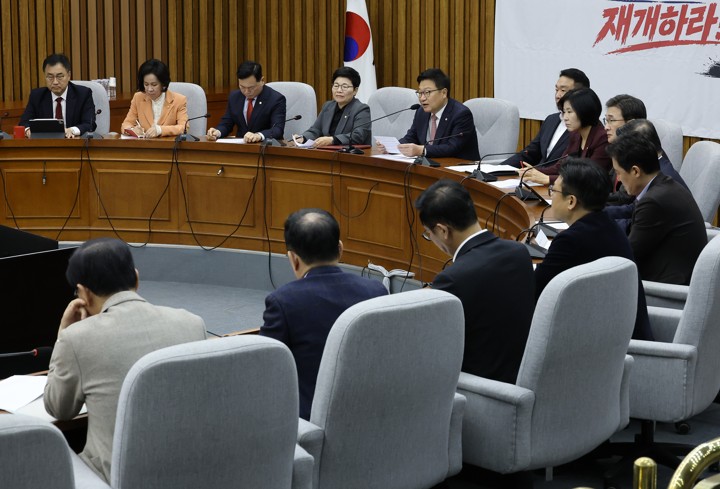
The People Power Party convened an emergency meeting immediately after the breach and made two demands at once: activate circuit breakers to halt the panic, and scrap the government’s Future Response Fund entirely. Their argument is blunt. The fund, designed to stabilize markets during crises, would only deepen the fragility by injecting money into a system already seen as fundamentally broken.
“It will just prop up the stock market and create more instability and uncertainty,” said Jang Dong-hyuk, a senior party figure, on YouTube. He argued the government’s preparation was inadequate from the start, and that blaming US midterm election outcomes ignores a broader truth: every market worldwide faces similar pressures. The failure, he insisted, is domestic.
What makes this moment distinct from previous KOSPI corrections is the velocity with which blame has migrated from macroeconomic analysis to personal indictment. Within forty-eight hours of the 5,000 breach, the opposition had built an entire narrative arc suggesting the ruling party engineered an artificial rally and then abandoned investors when it became unsustainable.
Who Gets the Blame
The accusations are moving quickly from market critique to personal indictment. Jeong Jeom-sik, the party’s floor leader, framed it as a moral question: citizens saw their stock assets turn to waste paper while the ruling camp pushed forward with legislation to review President Lee Jae-myung’s trial. The implication is not subtle — political survival is being prioritized over public wealth.
Im I-ja, the party’s policy chief, went further, calling the KOSPI 5,000 an illusion built on “forced stock price support and a temporary semiconductor boom.” She argued the government should redirect excess tax revenue toward national debt repayment instead of market intervention, noting that Korea’s fiscal space was already constrained by pandemic-era spending and structural subsidies to chaebol conglomerates.
Han Dong-hoon, the former prosecutor general turned independent politician, delivered what may be the sharpest line of the day. The KOSPI 5,000 was a commitment the Lee administration set as a national governance target. “A number broken after it was promised is worse than a number never reached,” he wrote. “Because national blood and tears are inside it.”
The rhetorical escalation matters because it reveals a deeper fracture. This is no longer a debate about market mechanics. It is a dispute over who told the truth — and who built their political credibility on a number they could not sustain.
The Pension Question
One of the more consequential claims emerged from Han Dong-hoon’s statement: the government directed the National Pension Service to increase its domestic equity allocation, concentrating heavily in Samsung Electronics and SK Hynix. The logic was supposed to be straightforward — support blue-chip Korean companies, boost the index, and create a virtuous cycle. What happened instead suggests the strategy confused scale with stability.
If retirees’ savings have been funneled into a narrow basket of semiconductor and tech stocks, the fallout from this breakdown extends far beyond portfolio statements. It touches the most politically sensitive topic in Korea: whether ordinary citizens’ retirement security has been gambled on speculative plays managed by a government unwilling to acknowledge risk.
The National Pension Service manages approximately 320 trillion won in assets — roughly 25 percent of Korea’s GDP. Its equity allocation had risen steadily over the past two years, pushing it toward levels that portfolio theorists would call dangerously concentrated. When the KOSPI fell, the NPS did not merely lose paper gains. It lost the confidence of a population that had been told, through official channels, that this strategy was prudent.
Yoo Seong-min, a former party heavyweight now operating outside its structure, did not mince words. He called for investigations into those who encouraged mass retail borrowing to invest in stocks and those who “squandered” the pension fund, demanding legal accountability. His demand has already spawned a bipartisan push for a special investigative committee, though the ruling party has resisted, arguing that premature legal action could destabilize markets further.
What This Means Beyond Korea
A KOSPI breakdown of this magnitude reverberates through Asian supply chains, not just stock screens. Samsung Electronics and SK Hynix dominate global memory chip production. When their market valuations contract sharply, it signals demand concern, margin pressure, and investor retreat from Chinese and Korean tech exposure simultaneously.
The ripple effects are already visible. Japanese electronics manufacturers saw their order books shift as downstream customers delayed procurement decisions. Taiwanese semiconductor firms tracking Korean inventory data reported softer-than-expected guidance. Even Chinese display panel producers, historically competitors, felt the whiplash as their own valuations adjusted to reflect regional risk repricing.
The 9,000-level KOSPI era — built on the semiconductor supercycle narrative — is now being re-examined with suspicion. Im I-ja’s characterization of that period as artificial helps explain why this fall feels more painful than previous corrections. When investors believe a rally was engineered rather than organic, they exit faster and harder when the facade cracks.
Retail investors, who had flooded into equities during the peak years using margin debt at historically elevated rates, are now facing margin calls that compound the selling pressure. Data from the Korea Exchange shows that individual investor selling accelerated in the weeks leading up to the 5,000 breach, suggesting that even domestic retail participants sensed the turn before the official breakdown.
The Fund Debate
The Future Response Fund is the policy flashpoint right now. Its supporters argue it is exactly the kind of tool needed during market stress. The opposition says it is a bandage on a wound that needs surgery — a mechanism for propping up prices without addressing the structural dependence on semiconductor cyclicality, the concentration risk in national pension allocation, and the lack of fiscal credibility.
Lee Jun-seok of the Reformation Party offered a different angle: during periods of rising uncertainty, fiscal policy should prioritize fiscal health. His warning, framed as a fable, urged the government not to choose the grasshopper’s path over the ant’s. The metaphor landed because it tapped into a widely held Korean cultural anxiety about short-termism — the fear that the country had bet its future on a single cycle and failed to prepare for what came after.
Both sides agree on one thing — the status quo is unacceptable. The question is whether the response will be another temporary intervention or a recalibration of how Korea manages the intersection of market stability, pension policy, and industrial strategy.
The Longer Arc
What distinguishes this episode from every KOSPI correction since 2008 is the political crystallization around it. Previous market declines generated grumbling but rarely produced coordinated opposition demands for institutional reform. The 5,000 breach changed that calculus. It gave dissenting voices a concrete number to anchor their criticism, and it transformed abstract economic concerns into a visceral political narrative.
The Lee Jae-myung administration faces an unusual problem. Han Dong-hoon’s critique lands with particular force because the 5,000 target was publicly stated as a government goal. Broken promises carry different political weight than missed forecasts. Investors may forgive a miscalculation. They punish a lie — or the appearance of one — with disproportionate severity.
Central bank responses will matter here. The Bank of Korea has already signaled willingness to provide liquidity, but monetary policy alone cannot repair institutional trust. If the pension fund allocation remains unchanged and the Future Response Fund continues operating without transparency reforms, the market may absorb the shock but the political damage will compound across election cycles.
The next few weeks will determine whether this episode is remembered as a market correction or a turning point in how South Korea’s financial architecture is trusted. The 5,000 line has fallen. What rises from the废墟 will define the administration’s legacy — and possibly the country’s economic trajectory for a generation.