Leipzig drones expose Germany's thin civil-air defense
Three drones and military explosives at Leipzig/Halle airport point to a coordinated operation. Germany's ad-hoc response to hybrid threats against civilian infrastructure is failing to keep pace.
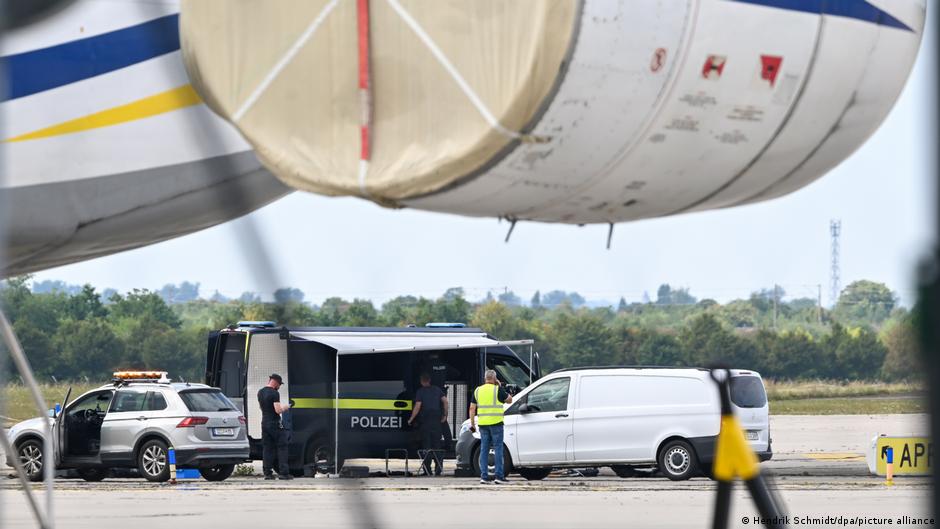
The third drone was the one that should not have been found at all.
Ten days after an explosives-laden drone was discovered near a Ukrainian cargo plane at Leipzig/Halle airport on August 4, investigators turned up a second device nearby. Then, on August 14, they found a third — along with roughly 50 grams of a substance suspected to be hexogen, a military-grade high explosive.
This is not the residue of a single botched operation. This is evidence of a planned sequence, a deliberate setup that extended over time and across a geographic area around one of Central Europe’s busiest cargo airports.
German Chancellor Friedrich Merz did not mince words when speaking about the incident before a cabinet retreat in Brandenburg. He said authorities would soon identify those responsible and made clear the government views this as part of a broader pattern.
“Attackers are increasingly prepared to accept serious property damage, and even injuries and deaths, without scruple,” Merz said.
The implication is stark: Germany is no longer just observing hybrid attacks from a distance. They are arriving at its doorsteps — at airports, rail lines, and communication hubs — and the infrastructure meant to protect them was designed for a different era.
What happened at Leipzig is a case study in operational planning.
An explosives-laden drone was directed toward a Ukrainian Antonov cargo aircraft on August 4. That plane was used to transport military supplies, a detail that places this squarely within the logic of hybrid warfare — strikes designed to disrupt logistics supporting Ukraine without triggering a formal act of war.
Investigators also believe a second drone may have collided with a DHL cargo aircraft shortly after the airport was temporarily closed. Whether that was an attempt to destroy property, create confusion, or test response protocols remains unclear. But the pattern is legible: multiple devices, multiple targets, one facility.
Security sources cited by German media suspect Russian intelligence involvement. Russia has denied any role. The investigation is ongoing, and until Merz’s government makes its findings public, speculation will fill the gap. What matters more than attribution right now is what the physical evidence reveals about capability and intent.
The hexogen matters more than the drones themselves.
Hexogen, also known as RDX, is not something you pick up at a hardware store. It is a military explosive used in shaped charges, torpedoes, and specialized munitions. Its presence at a German airport — in a quantity small enough to be covertly transported but large enough to cause meaningful damage — signals access to channels that run deeper than anything a domestic extremist could muster.
That distinction is important. Domestic terror plots tend to rely on improvised explosives. This involved pre-packaged ordnance and drones designed, presumably, to carry them to specific targets inside an active airport perimeter.
Germany’s response is already underway, but it is late.
The government is establishing a new drone defense center in Magdeburg. That is a real step — the kind of institutional response that ought to exist before incidents like Leipzig occur. But it also confirms what critics have been saying for years: Germany woke up to the drone threat too late.
Civil aviation defense across Europe remains fragmented. Airports are regulated at the national level, but drones do not respect borders. A facility can install radar and jamming equipment, yet the regulatory and operational coordination with neighboring states, NATO, and the EU still lags behind the technology itself.
The Stuttgart railway sabotage investigation — where cables were cut along a line near Backnang, disrupting both train services and communications — appeared around the same time as the Leipzig reports. The state security division has taken it over as a suspected sabotage case. Whether the two incidents are linked is not yet known. But the proximity in time and the shared targeting of critical infrastructure is impossible to ignore.
What this means for Europe’s supply chains is immediate.
Leipzig/Halle is not a regional airport. It is one of Germany’s most important cargo hubs and also serves as a military logistics node. Disruptions here ripple through supply chains that span the continent — parts for automotive factories, medical supplies, components for industry.
The August 4 incident forced a temporary closure. Had the drone detonated, the consequences would have been far worse. A successful strike on cargo operations could have sent shockwaves through European logistics networks already strained by geopolitical uncertainty and economic headwinds.
The political dimension is unfolding in real time.
Merz’s upcoming announcement about who is behind the attack will carry weight beyond the immediate investigation. If the government identifies Russian intelligence, as security sources suspect, it will force a recalibration of Germany’s security posture and likely accelerate EU-wide discussions on collective drone defense.
But attribution is only part of the story. The deeper issue is systemic: European airports, rail networks, and communication infrastructure were built and defended for a world in which the primary threats were conventional — state armies, terrorist cells, smugglers. They were not built for a world in which low-cost commercial drones can be weaponized and directed at precision targets with military explosives, operated by actors who face little risk of capture.
The takeaway is uncomfortable.
Three drones. Military explosives. Targeting a Ukrainian cargo plane at a German airport. A second device possibly striking a DHL aircraft. A sabotage incident at railways hours later.
These are not isolated events. They are indicators of a campaign that is already active on German soil — one that tests defenses, gathers intelligence on response times, and probes for weaknesses in critical infrastructure. And the fact that a third drone was found ten days later, rather than being intercepted or disrupted before launch, suggests the current defensive posture is not adequate.
Merz is right that Germany is increasingly a target. The question now is whether the institutions designed to protect it can adapt fast enough.