LG Display's FMM-Free OLED Could Redefine the IT Display Market
LG Display is betting that its metal-mask-free OLED process, called FLiPP, can open up the IT display market with better efficiency, higher resolution, and lower cost than Samsung's dominant FMM approach. The implications stretch far beyond panel specs.
The Real Story Behind LG Display’s FLiPP Reveal
LG Display is attempting something quietly ambitious: it wants to build a new market rather than fight for slices of one.
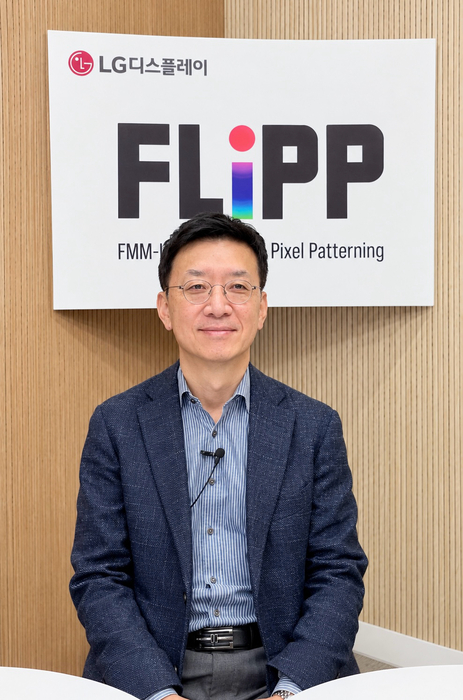
At an online technology seminar on October 8, CTO Choi Young-seok unveiled what the company calls FLiPP — a metal-mask-free organic light-emitting diode manufacturing process that abandons the fine metal mask (FMM) technique Samsung Display has relied on for years. The pitch isn’t just about incremental improvements. It’s about reshaping the economics of OLED production in a way that could tilt the competitive balance in Korean display manufacturing.
The timing matters. The IT display segment — laptops, monitors, and similar form factors — is where LCD-to-OLED conversion is accelerating fastest. Unlike smartphones, where OLED penetration is already saturated, this is an open battlefield. And LG Display is arriving with a process that, if it scales, changes the calculus for everyone downstream.
What FLiPP Actually Does
To understand why this matters, you need to understand what FMM does — and what it costs.
The conventional FMM process works by depositing RGB organic materials through a fine metal mask onto a glass substrate that has been halved (“half-cut”) to reduce waste. The mask itself is expensive, degrades over time, and takes up physical space between pixels. The result: aperture ratios around 42 percent, meaning nearly six in ten pixels of the display surface are blocked by infrastructure that isn’t emitting light.
FLiPP flips the script. It deposits RGB organics across the full 8.5-generation glass substrate — no cutting, no mask — then uses photolithography, the same precision patterning used in semiconductor fabrication, to define pixels. A UV light step selectively removes unwanted material, and an encapsulation layer seals the structure.
The numbers LG Display is citing are significant:
- Aperture ratio rises from 42 percent to 65 percent — a 55 percent improvement
- Brightness can increase 1.6 times, or device lifespan can extend 2.4 times, or power consumption can drop 13 percent
- Panel yield on a 23.5-inch panel jumps from 75 percent to 93 percent
- Organic material efficiency nearly doubles, from 40 percent to 74 percent
- Deposition cycle time shrinks by roughly 40 percent
And theoretically, FLiPP could push pixel density to 1,000 pixels per inch — a threshold that has been nearly unreachable with FMM on rigid substrates.
Who Wins, Who Loses
The obvious winner, on paper, would be buyers of OLED laptops and monitors. Higher brightness, lower power draw, better color accuracy, and the possibility of sharper screens at competitive prices — that’s a compelling value proposition for a segment where many consumers are still choosing between OLED and mid-range LCD.
But the structural shift is who benefits between Samsung Display and LG Display.
Samsung’s OLED dominance in smartphones is built on FMM. Its entire manufacturing ecosystem — equipment suppliers, process know-how, capital expenditure — is optimized around that architecture. FLiPP doesn’t attack Samsung head-on in phones. Choi acknowledged as much: LG Display will keep using FMM for smartphone production for the foreseeable future because the existing infrastructure is too mature to abandon overnight.
Instead, LG is creating a parallel track. The IT display market is large enough to sustain a separate technology platform, and it’s growing fast enough to make that bet worthwhile. If FLiPP delivers on its promises at volume, LG Display gains a cost and performance advantage in exactly the segment where Samsung has less entrenched process specialization.
That’s the quiet threat here. It’s not a direct assault on Samsung’s smartphone stronghold — it’s a side channel aimed at the next growth frontier for OLED adoption.
The Platform Play
Perhaps the most interesting element of the FLiPP roadmap is the “one platform” ambition. Because FLiPP uses the full 8.5-generation substrate without cutting, the same production line can, in theory, serve everything from a 1-inch smartwatch display to a 100-inch-plus TV to AR and VR headsets.
That’s an operational advantage that conventional FMM lines cannot match. Samsung would need separate production investments for each form factor. LG Display’s vision is a single, flexible manufacturing stack that covers the spectrum.
Whether that vision holds at scale is an open question. Photolithography on curved or flexible substrates introduces challenges that semiconductor fabs have wrestled with for decades. Transferring that precision to large-area display manufacturing is not trivial. LG Display hasn’t published independent validation of yield rates beyond its own claims, and the path from prototype to high-volume production is always where these announcements meet reality.
Why This Matters Beyond Korea
For English-language tech desks, this story lands in a blind spot. Korean display news is typically filtered through smartphone coverage — OLED vs. LCD debates, Apple supplier dynamics, Samsung’s market share. FLiPP doesn’t fit that frame. It’s not about a phone screen.
But the implications are wider. The IT display market is where the next billion-dollar wave of OLED adoption is expected to happen. Laptop and monitor shipments represent tens of millions of units annually, and the OLED penetration rate in that segment is still in the low double digits. A manufacturing breakthrough that meaningfully improves cost and performance at that scale could accelerate adoption across global PC and monitor supply chains — including for brands like Dell, HP, Lenovo, and Apple’s external displays.
If FLiPP delivers, it also creates a new question for the broader semiconductor equipment industry: photolithography-based OLED patterning is an entirely different capital equipment category than FMM deposition tools. Suppliers like ASML, Nikon, and Canon could find a new demand vector, while the established FMM equipment ecosystem faces long-term displacement risk.
What Happens Next
The first FLiPP panels are targeted for laptops and monitors, with wearable and large-TV applications following as the market matures. LG Display hasn’t announced a specific volume production date or a named customer win beyond general “demand-based” language.
The competitive test will come when early adopter products ship and independent reviews measure real-world brightness, power consumption, and color performance against Samsung’s latest FMM OLED panels. If the lab numbers hold in product form, the IT display market could see a genuine process-level competition for the first time in OLED — not just marketing tiers, but fundamentally different manufacturing architectures vying for the same customers.
That’s the pivot point. Until then, FLiPP is a promise written in aperture ratios and deposition cycles. But in a sector where the gap between prototype announcements and mass-production reality is often where breakthroughs either validate or collapse, this one is worth watching closely.