Why Korea's Record Chip Profits Couldn't Stop the Stock Selloff
Samsung posted a record 107 trillion won profit, yet Korean stocks still crashed 5.39%. The disconnect reveals a structural shift in how foreign investors view Korea — and what it means for the global chip supply chain.
The Paradox of Record Profits and a Crashing Market
Samsung Electronics announced its third-quarter operating profit on Oct. 8: 107.4 trillion won, up 782.5% from a year earlier. It was the largest quarterly profit by any Korean company in history, with a profit margin of 55.1% — also a record. By any conventional metric, this should have been a triumph.
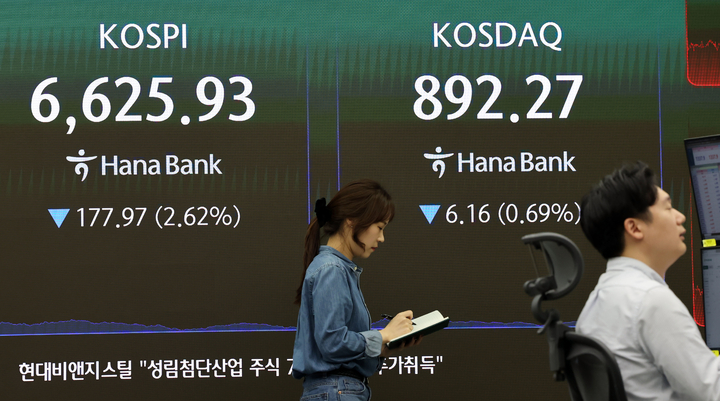
Instead, the KOSPI fell 2.62% that same day. Samsung’s own shares dropped 2.42%. Over the preceding three trading days — from the Oct. 6 reopening after the National Liberation Day holiday through Oct. 8 — the index shed 5.39% and slid to 6,625.93. The sell-off didn’t discriminate between strong and weak performers. It swept through the entire market.
The headline number to watch isn’t Samsung’s earnings. It’s the trading data behind them. Foreign investors sold 6.47 trillion won worth of Korean securities across those three days. Domestic institutions added another 2.39 trillion won in net selling. The only buyers were individual Korean retail investors, who absorbed 6.36 trillion won in net purchases — essentially picking up whatever the professionals threw away.
SK Hynix alone accounted for 3.64 trillion won of the foreign outflow. That single name represented more than half of all foreign selling. Samsung followed at 884 billion won. The pattern is unmistakable: foreign money is exiting Korean semiconductors aggressively, even as those companies post the strongest results in decades.
Why the Disconnect
Three forces collided this week.
First, US Treasury yields surged to levels not seen since the early 2000s. When risk-free rates climb, emerging-market equities suffer disproportionately. Korea’s market is uniquely exposed because it is so heavily weighted toward semiconductors — a sector already under pressure from valuation concerns and shifting global trade dynamics. Higher yields don’t just make Korean stocks less attractive; they make them mathematically harder to justify at current prices.
Second, the broader AI narrative frayed. Reports emerged that OpenAI’s annualized revenue as of late September sat around $500 billion, falling short of the $700 billion threshold that many investors had priced in. The Philadelphia Semiconductor Index dropped 3.39% on Oct. 8 and slid another 0.41% the next day. Even though later reports suggested the revenue discrepancy stemmed partly from accounting methodology and that OpenAI targets exceeding $700 billion by year-end, the damage to sentiment was immediate. The market had bet on AI profitability arriving faster than it materialized.
Third, specific Korean catalysts spooked investors beyond the macro. Samsung’s decision to terminate its share buyback program raised eyebrows. Rumors circulated that SK Hynix might list its US subsidiary, Solidigm, on an American exchange — a move that could dilute the value proposition of holding SK Hynix shares in Seoul. Both events fed into a broader sense that Korean chip companies are reaching a point where even stellar operational results may not sustain their stock valuations.
What Foreign Selling Actually Means
The foreign exit from Korean semiconductors carries implications that extend well beyond Seoul’s trading floor.
Korea produces roughly half of the world’s memory chips. When foreign investors sell Samsung and SK Hynix shares, they’re not just reducing exposure to two companies — they’re expressing doubt about the profitability trajectory of the most critical component in the AI supply chain. Memory prices have rebounded sharply from their 2023 lows, but the question now is whether that rebound can sustain the valuations that have accumulated over the past year.
The fact that foreign investors were simultaneously buying certain Korean names — LeeSu Fetais, Samsung SDI, DB Hitek, LG Energy Solution, HD Korea Shipbuilding & Offshore Engineering — suggests their selling isn’t a blanket rejection of Korea. It’s a selective rotation away from the mega-cap semiconductors that have become the market’s primary anchor. Money is moving toward battery materials and industrial players, away from the chips that have driven the rally.
This matters globally because the semiconductor allocation shift in Korea often foreshadows shifts in global capital flows toward chip stocks more broadly. When foreign money leaves Korean semiconductors, it typically seeks yields elsewhere — sometimes in US-based chip names, sometimes in other Asian markets. The direction of that flow is a leading indicator for the sector.
The Road Ahead
The next week holds several data points that could determine whether this sell-off stabilizes or deepens. On Oct. 14, the US releases its September consumer price index and the Federal Reserve’s Beige Book. October 15 brings the producer price index and retail sales data. October 16 includes industrial production figures. If inflation continues to cool and employment data shows further deceleration — as some signals suggest — pressure on Treasury yields could ease, potentially removing one of the main headwinds weighing on Korean equities.
The OCP Global Summit in San Jose, running Oct. 12–15, will be closely watched. The conference focuses on AI server and data center efficiency, but the underlying question everyone is asking is whether the massive capital expenditures flowing into AI infrastructure are translating into revenue fast enough to justify the spending. Samsung and SK Hynix are the primary suppliers for that infrastructure. If the AI profitability story weakens further at the summit, Korean chip stocks will feel it directly.
Domestic retail investors have absorbed 6.36 trillion won in three days of foreign selling. Retail dominance in a market like Korea’s tends to amplify volatility — both up and down. If foreign selling resumes and retail investors show signs of fatigue, there may be few buyers left to catch the falling knife.
Samsung’s record profit was a genuine operational milestone. But the market’s reaction proves that in the current environment, operational excellence alone no longer guarantees investor confidence. The combination of rising US rates, AI revenue skepticism, and sector-specific concerns has created a moment where even the best numbers in Korean corporate history cannot arrest a sell-off. That’s the structural shift behind this week’s numbers — and it’s likely just the beginning.