Why Robot DRAM Demand Could Fuel a Second Semiconductor Supercycle
Humanoid robot memory needs are projected to grow 20-fold by 2030, creating a transformative new demand source for Samsung and SK Hynix — but the power constraints mean it favors LPDDR over HBM, reshaping the memory mix.
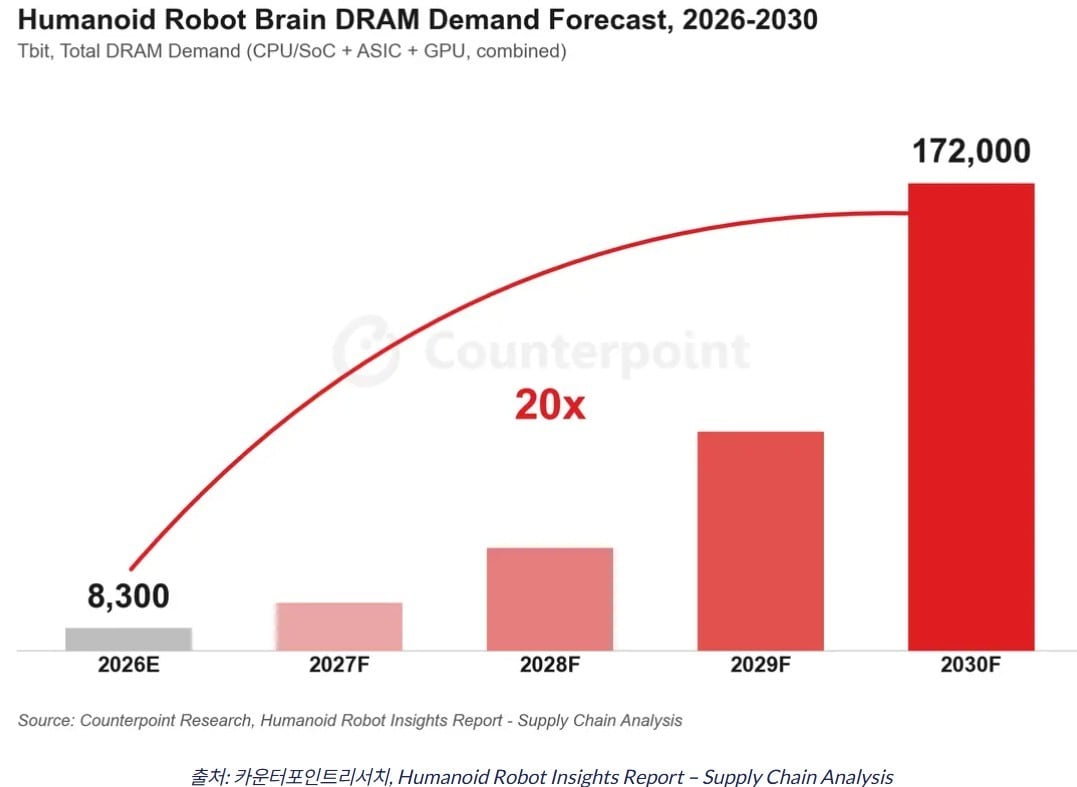
A second supercycle is arriving — and it runs on LPDDR, not HBM
The memory industry has spent the last two years riding a wave driven by data centers and AI training. But a new demand source is forming that could redefine the next decade of semiconductor growth: humanoid robots.
According to Counterpoint Research, global DRAM demand for humanoid robots is projected to surge nearly 20-fold between 2026 and 2030 — from approximately 8,300 terabits to roughly 172,000 terabits. That sounds abstract until you apply it to a single unit. Each robot is expected to carry a blended DRAM load that doubles from 19 GB in 2026 to 39 GB by 2030.
This is not a speculative fringe prediction. It reflects a structural architectural shift in how robots process information, and it matters for Samsung Electronics and SK Hynix specifically because they are the two companies best positioned to supply it.
The brain is changing — and it needs more memory fast
Robot architectures have historically been hierarchical: separate modules handled vision, navigation, and motor control independently. The trend is moving decisively toward end-to-end systems where multimodal inputs — camera feeds, LiDAR point clouds, tactile sensor data — are fused into a unified representation space and directly mapped to action outputs.
This shift eliminates intermediate processing overhead but multiplies on-chip memory requirements. Every sensor stream must be buffered simultaneously; every inference must happen in real time without the luxury of offloading to a cloud server.
Then there are world models — internal simulations of how the physical world responds to action. Deploying and running these models demands both storage and compute capacity that existing robot designs do not yet support. Adding a world model to a robot’s stack is the difference between reacting to the present and anticipating what comes next. That anticipation costs memory.
The power problem: why HBM is not the answer here
Here is where the conventional wisdom about AI memory demand breaks down. Data center AI relies on HBM — high bandwidth, but extremely power-hungry. A humanoid robot, by contrast, runs on a battery.
Sanjay Mehrotra, Micron’s CEO, made this point clearly during Micron’s Q4 FY2026 earnings call on April 30. He noted that Level 4+ autonomous vehicles typically require over 200 GB of memory and multiple terabytes of storage, and he expects humanoid robots to land in a similar range.
But the implication he did not spell out is equally important: battery-operated systems cannot sustain HBM’s power envelope. The robotics market will pull LPDDR-series DRAM and high-capacity NAND far more aggressively than HBM — at least through 2030.
This is a meaningful distinction for Samsung and SK Hynix. Both have invested heavily in HBM as their premium growth bet, but LPDDR remains a core competency with different margin dynamics and a more forgiving competitive landscape. If robotics becomes a volume driver rather than a specialty one, it rewards the companies that can ship reliable LPDDR at scale.
Some analysts are already flagging 3D DRAM as a longer-term vector in this space. Whether that materializes depends on yield and cost — but the direction of travel is clear.
What this means for Korea’s memory giants
Samsung reported third-quarter operating profit of 107.4 trillion won ($76 billion), up 782.5% year over year, on revenue of 195 trillion won. The operating margin hit approximately 55.1%. SK Hynix, reporting its Q3 results on May 28, is tracking toward consensus estimates of 98.5 trillion won in revenue and 77.2 trillion won in operating profit — implying an operating margin near 78.3%.
These numbers are extraordinary, and they are largely attributable to DRAM price increases fueled by AI data center demand. But robot-grade memory demand would add a second upward pressure on volumes that is structurally different from AI training clusters.
Data center memory demand is lumpy and concentrated in a handful of hyperscalers. Robot memory demand would be distributed across thousands of manufacturers — Boston Dynamics, Figure AI, Agility Robotics, Hyundai’s Hyundai Mobis, and a growing roster of Chinese and Japanese entrants. Diversified demand is less vulnerable to a single customer’s capex cycle.
It is also recurring in a way data center procurement is not. A robot manufacturer buying DRAM for one prototype unit eventually transitions to steady-state volume production. The customer base compounds.
Who wins, who loses, and what comes next
Samsung and SK Hynix win most directly. Both have deep LPDDR portfolios and the fab capacity to absorb additional volume without major capital expansion beyond ongoing node transitions. Their Chinese competitors in the DRAM space remain distant; Yangtze Memory Technologies and ChangXin Memory Technologies are focused on NAND and older-process DRAM, not the advanced LPDDR nodes that robot manufacturers will specify.
Micron, too, benefits from the overall memory upcycle, but it faces a narrower window in the robotics segment. Its relationship with Western robot developers like Figure and Boston Dynamics gives it a foothold, yet the power-constrained nature of the application means it will compete on LPDDR delivery more than HBM differentiation.
The risk for Samsung and SK Hynix is execution. A 20-fold demand increase sounds dramatic, but the absolute base in 2026 is still small — 8,300 Tbit is a rounding error against the combined annual output of both companies, which exceeds 20,000 Tbit per month at peak. The real test comes in scaling production, maintaining yields on novel process nodes, and pricing competitively against an industry already running hot.
The timeline is tighter than it appears. Counterpoint’s 2026-to-2030 window aligns with when humanoid robots are expected to move from laboratory demonstrators to factory-floor deployments at scale. That transition will not be gradual. It will be abrupt once a few flagship use cases prove economic viability — warehouse logistics, hazardous-material handling, elder care assistance.
The memory market’s second act may not arrive in the form investors expect. It will not be HBM-powered AI clusters dominating the narrative. It will be millions of battery-powered machines, each carrying 39 GB of LPDDR, asking for memory in a pattern that looks more like automotive and consumer electronics than data center infrastructure. The companies that recognize this shift early — and adjust their product roadmaps accordingly — will define the next cycle.
Samsung and SK Hynix are already there. The question is whether they stay ahead.