Light Beams Just Defied Atmospheric Chaos — Telecom Could Never Look Back
A world-first experiment in South Africa proved that light can carry data through turbulent air without losing information. The trick is topology — not better equipment. The implications for fiber optics, space comms, and rural internet are enormous.
The atmosphere just lost an advantage it held for decades.
For as long as engineers have been trying to beam light through the air, they’ve been fighting the same enemy: a messy, chaotic atmosphere. Warm pockets rise. Cold air sinks. Wind shears distort whatever shape a laser beam tries to hold. The result has always been the same — either accept the corruption or spend enormous computational power and expensive hardware trying to undo it.
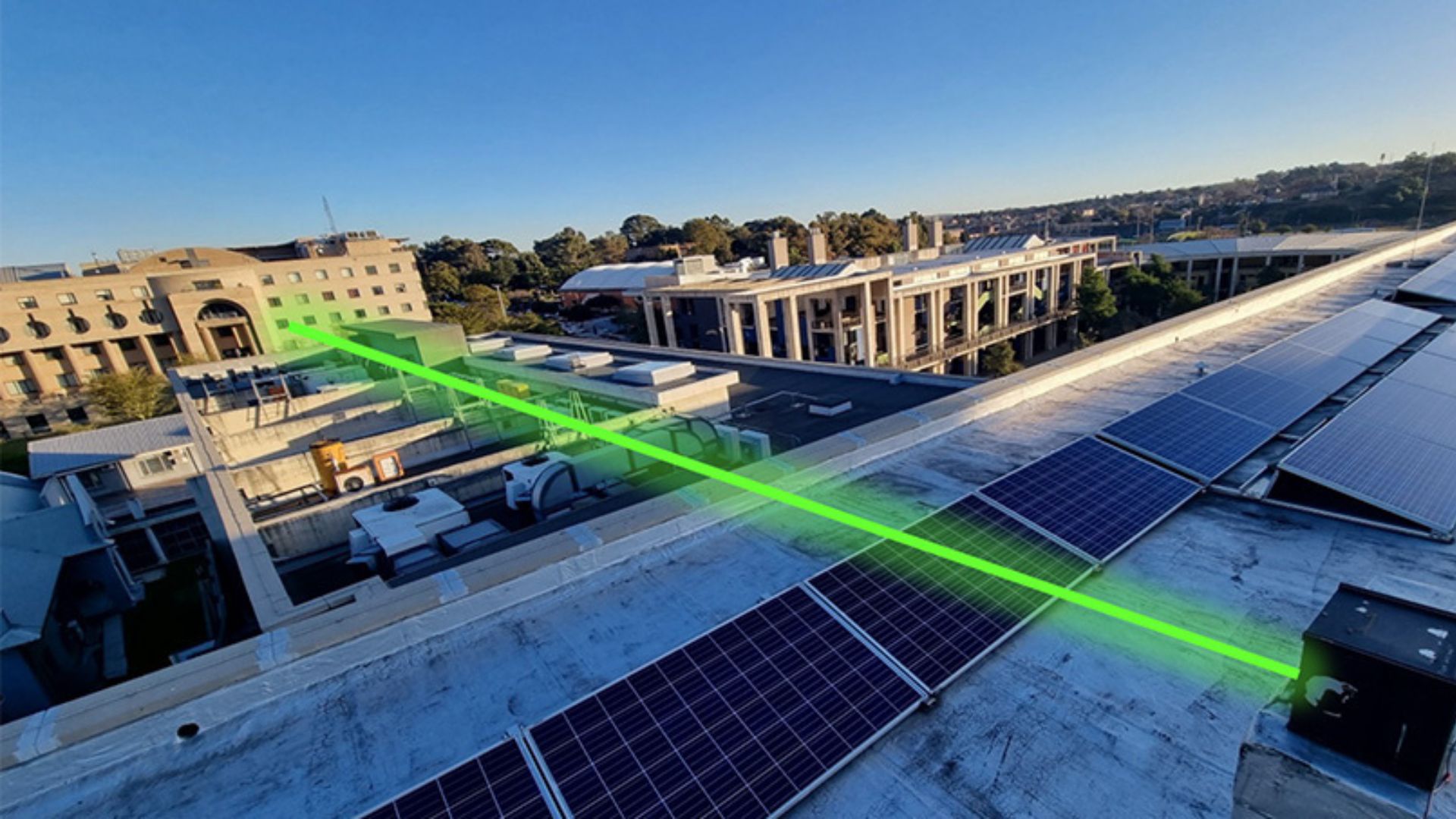
A team at Wits University in Johannesburg and the University of Bordeaux in France just demonstrated a method that does neither. They sent data through open air across a 270-meter gap on the Wits West Campus. The beam arrived mangled beyond recognition. But the information it carried? Intact. Over 98 percent fidelity under normal conditions. Even under extreme turbulence, the number held at 86 percent.
The paper, published in Science Advances, describes a world-first experiment. And the secret wasn’t better adaptive optics or faster processors. It was topology — the mathematics of shapes that stay constant even when you twist, stretch, or distort them.
Coffee mugs and doughnuts
Professor Andrew Forbes, head of the Structured Light Lab at Wits, put it this way: a coffee mug and a doughnut are topologically identical. Both have a single hole. You can deform one into the other without tearing or merging anything fundamental. The property survives the transformation.
The researchers applied that logic to light itself. They encoded data into skyrmions — exotic, particle-like magnetic structures carried within the light beam’s topological profile. Think of it as wrapping your information in armor that doesn’t depend on brightness, color, or polarization. Those traditional properties get shredded by atmospheric turbulence. Topology doesn’t.
When the beam hit the receiver, the shape of the light was utterly destroyed. The topological information underneath survived untouched. The receiver could read the payload directly, with no correction step required.
What this replaces
Free-space optical communication has been around for years. The limitation has always been the same: the atmosphere corrupts everything. Current systems rely on real-time recalculations. Receivers measure the distortion and fire dynamic hardware corrections to clean up the signal. That requires complex adaptive optics, significant energy, and processing overhead that scales poorly over distance.
This new approach eliminates the correction layer entirely. The data survives because it’s encoded in a property of light that turbulence simply cannot alter. That means less hardware. Less power. Lower cost. Fewer points of failure.
The immediate applications are clear. Deep-space missions are among the strongest candidates — signals traveling millions of kilometers pass through increasingly unstable environments, and every bit of recovered data counts. High-speed satellite downlinks face similar problems. Quantum cryptography, where signal integrity is literally the security guarantee, benefits from a method that doesn’t require active correction at the receiver.
Closer to home, the work could reshape how rural and isolated communities connect to the internet. Laying fiber-optic cable across difficult terrain is prohibitively expensive. Beaming high-speed data through the sky via free-space optics has been promising but unreliable. If this topology-based method holds at scale, the equation changes.
The numbers that matter
Let’s be specific about what 98 percent fidelity looks like in practice. For a data stream transmitted across 270 meters of turbulent Johannesburg air, that error rate is low enough that basic error-correction codes could handle the remaining 2 percent without any active atmospheric compensation. At 86 percent under extreme turbulence, the gap is wider but still manageable for many applications — certainly narrower than what existing free-space systems achieve under comparable conditions, which often drop into single-digit percentages without aggressive correction.
The test distance of 270 meters is modest by communications standards. The research team hasn’t yet demonstrated scaling to kilometer-range links or orbital distances. That’s the next question. Whether the topological protection holds over longer paths, through thicker atmospheric columns, and across greater differences in refractive index remains unproven. The physics suggests it should — the topology isn’t distance-dependent, only turbulence-dependent — but proving it experimentally will take time and infrastructure that a university campus doesn’t provide.
Who wins, who loses
The winners are anyone who has been paying for the corrective hardware that free-space optical systems currently require. Adaptive optics arrays, real-time wavefront sensors, and the computing power behind them represent a significant portion of FSO system cost and complexity. Remove that layer and the economics shift dramatically.
Fiber-optic cable companies aren’t immediately threatened. Fiber still offers far more bandwidth per strand, far greater range without repeaters, and far more consistent performance. But the two technologies serve different markets. Fiber is the backbone. Free-space optics has always been the patch — for places where digging trenches makes no sense, for satellite links, for temporary or rapidly deployable infrastructure. This breakthrough makes the patch more reliable, not the backbone obsolete.
The losers are the companies selling adaptive optics solutions for free-space optical communication. Their value proposition shrinks if the market standard shifts toward topology-encoded transmission that doesn’t need correction in the first place.
What happens next
The Wits-Bordeaux team will now face the inevitable next phase: scaling the experiment. A 270-meter campus link proves the principle. A kilometer-scale trial proves something closer to commercial viability. An orbital demonstration proves everything.
The physics is sound. The math of topology doesn’t change depending on distance. The turbulence encountered in a laboratory atmosphere is orders of magnitude less severe than what a signal would face traversing the full thickness of the atmosphere on its way to or from space. If the method works in a chaotic urban environment, it should work anywhere.
But working in principle and working at scale are different things. The receiver also needs to reliably decode the topological state from a distorted beam. The experiment showed that decoding is possible. It didn’t demonstrate what happens when the distortion is severe enough to fold the beam into structures that overlap or interfere with neighboring skyrmions. That regime — where topological features could begin to merge or annihilate — hasn’t been tested.
This is a genuine scientific advance. The question now is whether it becomes a practical one.