Memory Peakout: Why AI's Next Bottleneck Isn't Chips — It's Supply
Elon Musk and Apple are flagging a looming memory chip glut by 2028 as China ramps production. The AI infrastructure buildout faces a hidden bottleneck that could reshape the entire semiconductor landscape.
The Peakout That Could Rewire AI
Elon Musk did something unusual last week. He didn’t tweet about a car launch or a Mars timeline. He talked about RAM.
On March 11, Musk posted that the real problem blocking AI progress is memory supply — not compute chips. Two days later, he flagged China’s ability to ramp production rapidly once it masters the manufacturing tech. By March 13, he was comparing Micron’s pricing directly against Samsung and SK Hynix, calling the latter’s memory prices “absurdly high.”
The remarks sent shock waves through an industry already bracing for a different kind of disruption. Memory chips — the workhorses behind every AI training run and inference task — are heading toward what analysts call a peakout: a cycle peak followed by a steep demand drop. And the timing, according to the consensus, is around 2028.
Why 2028 Is the Year Everyone Is Watching
The peakout fear isn’t abstract. It’s built on concrete capacity numbers.
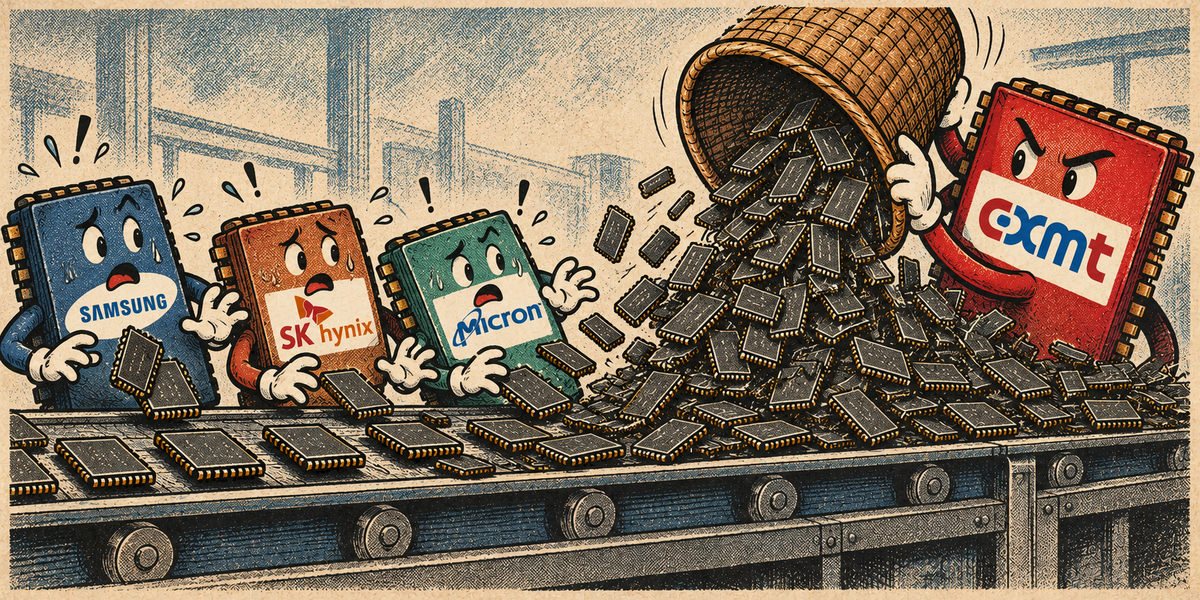
China’s CXMT — widely reported as an Apple supplier — has begun bidding for equipment to build a new fab in Shanghai. Production is scheduled to start in Q4 of this year, with additional fabs coming online in Hefei and Beijing. Industry estimates place CXMT’s DRAM capacity at roughly 200,000 wafers per month this year, climbing past 300,000 by year-end. If the buildout proceeds as planned, the company adds 70,000 to 80,000 wafers of monthly capacity every year through 2028.
Some Wall Street analysts project CXMT could reach 500,000 to 600,000 wafers monthly by late 2028 — roughly the third-largest DRAM capacity globally, compared with Samsung’s ~700,000 and SK Hynix’s ~600,000.
NAND flash tells an even sharper story. China’s YMTC captured 16.5 percent of global NAND shipments in Q2, according to Counterpoint Research, closing fast on SK Hynix at 19 percent and trailing only Samsung at 28 percent. The technology gap in NAND is estimated at roughly one year, down from the three-to-five-year gap that still exists in DRAM.
CXMT’s revenue is already surging — third-quarter figures are expected to rise 589 to 619 percent year over year — and the company has signaled it will ship a server-grade DRAM using a next-generation 4F² structure before year’s end.
Who Wins, Who Loses
The immediate winner of a memory peakout is whoever controls the pivot. Samsung and SK Hynix have ridden the AI memory supercycle hard. HBM (high-bandwidth memory), the specialized DRAM that powers Nvidia’s GPU clusters, has been an enormous revenue driver. But a peakout would compress margins across the board, and the Chinese entrants are positioning to capture the volume segment first.
Apple’s involvement changes the geometry. Tim Cook told Time magazine that memory supply constraints represent an “absolute crisis” and that the company is considering all options. That statement — widely interpreted as a nod toward Chinese memory suppliers — puts pressure on Samsung and SK Hynix to justify their pricing, not just their performance. If Apple shifts even a portion of its DRAM or NAND orders to CXMT or YMTC, the Korean giants lose both revenue and a credibility signal to the rest of the market.
For Nvidia, the dynamics are subtler but no less consequential. The peakout doesn’t affect GPU demand directly, but it affects the cost curve of AI infrastructure. If memory becomes cheaper after 2028, training and inference costs drop, which accelerates deployment across industries — and expands the total addressable market for Nvidia’s hardware. Conversely, if supply tightens before the peakout because Chinese capacity is delayed or blocked by export controls, the cost curve stays elevated and AI adoption slows.
The China Question Nobody Is Answering Straight
The most important variable in this equation isn’t technology or capacity — it’s policy.
Chinese memory expansion assumes relatively unrestricted access to advanced lithography and fab equipment. The U.S. has been tightening controls on semiconductor equipment exports to China for years, but enforcement has been inconsistent, and Chinese companies have found workarounds. Whether CXMT and YMTC can sustain their buildout at the projected pace depends heavily on whether those restrictions hold through 2028.
Musk’s comments suggest he believes China will succeed in scaling production regardless. That belief carries weight because it aligns with what US tech companies want: cheaper memory. But it also reflects a broader tension in the industry between geopolitics and economics.
What This Means for the AI Cost Curve
The memory peakout isn’t just a semiconductor story. It’s an AI economics story.
Memory is the component that scales least efficiently with compute. A training run doesn’t just need more GPUs — it needs proportionally more HBM to feed them. When memory supply tightens, AI project timelines stretch and budgets blow out. When memory supply floods — as it could post-2028 — the marginal cost of deploying another AI model drops sharply.
This is why the timing matters. If the peakout arrives as expected in 2028, we could see a window where AI infrastructure costs fall faster than they’ve fallen at any point since the early days of cloud computing. But if the peakout is delayed or blunted by geopolitical friction, the cost curve flattens instead, and the industry faces a prolonged period of expensive memory — which disproportionately hurts smaller AI companies and pushes development further toward well-capitalized incumbents.
The Strategic Choice for Korean Memory Makers
Seoul’s memory giants are at a crossroads that goes beyond pricing.
Professor Kwon Seok-jun at Sungkyunkwan University warned that the real risk for Korean memory isn’t just Chinese competition — it’s relying on existing structural knowledge without adapting to new architectures. The lesson from the NAND space is clear: YMTC closed a one-year technology gap quickly because it was willing to pursue alternative cell structures rather than simply iterate on Samsung’s approach.
Samsung and SK Hynix still lead in HBM, the segment most critical to AI. But leadership in HBM today doesn’t guarantee leadership in whatever comes next. The companies that survive the peakout will be the ones that invest aggressively in next-generation memory structures now — while the supercycle profits are still flowing.
The Bottom Line
The memory peakout is a real risk, but it’s not a simple bear case for the semiconductor industry. It’s a structural inflection point. Chinese capacity coming online around 2028 will compress DRAM and NAND prices, accelerate AI infrastructure deployment, and force Korean manufacturers to choose between defending legacy positions and investing in the next architectural leap.
Musk’s comments are a signal flare. The market should listen.