Messi's Last Tango: What His Exit Means for Global Football
Lionel Messi ended his legendary international career with a 3-0 win over Benin in Buenos Aires. But his final Tango matters far beyond Argentina — it signals the end of an era for fans worldwide.
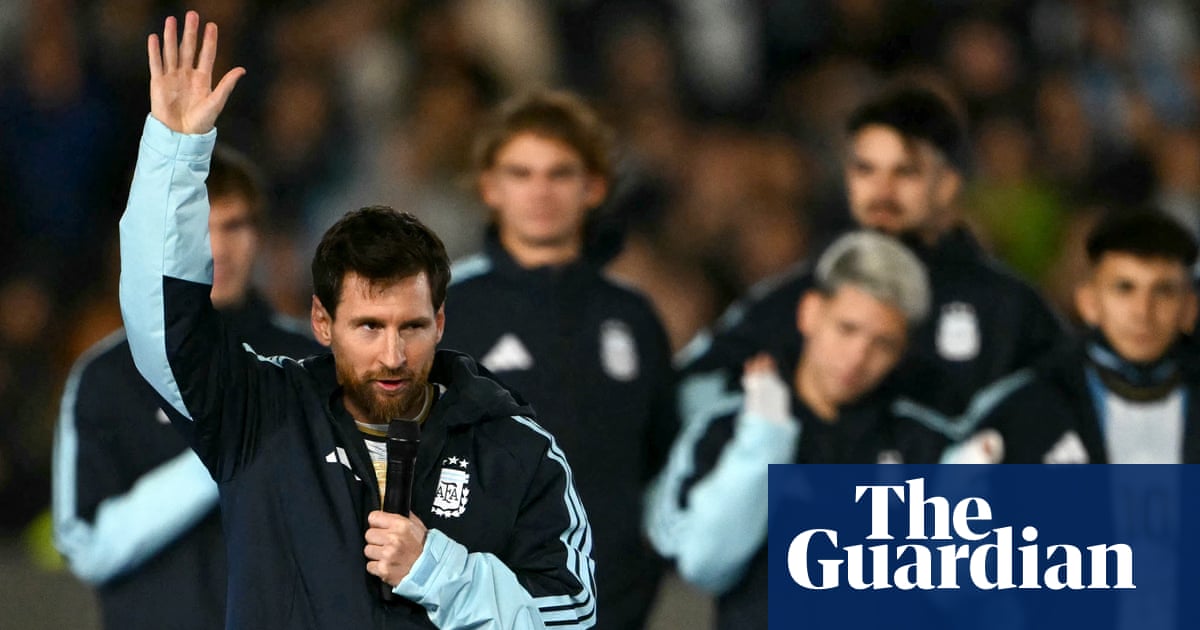
The Last Tango in Buenos Aires
Lionel Messi walked out onto the Monumental Stadium pitch on Tuesday night alongside his three children, receiving a standing ovation from 85,000 fans who had come to witness the end of something unprecedented in international football. The 39-year-old scored his 126th and final goal for Argentina, provided an assist, and played through 90 minutes of what was billed as The Last Tango — his swan song after 21 years and 208 caps.
The match against Benin ended 3-0, but nobody was watching the scoreline. This was always about closure.
What happened next revealed how far Messi has transcended sport. A drone display illuminated the Buenos Aires sky with his image. Fabio Santana, a Falklands War veteran, sang the national anthem beside a banner reading “The Malvinas are Argentine” — the same banner players had held after beating England in the 2022 World Cup semi-final. The University of Buenos Aires had awarded him an honorary doctorate that afternoon. Former Barcelona teammate Neymar posted a tribute on X that read simply: “The world thanks you.”
But the real story wasn’t in Buenos Aires. It was in Seoul, Tokyo, Dubai, Cairo, Mumbai, São Paulo, Lagos, and Jakarta — wherever fans watched on screens and marked the end of an era.
Who Misses What Nobody’s Talking About
Western media coverage of Messi’s retirement has followed a predictable pattern: retrospective greatness, career statistics, quotes from legends. But the emotional geography of Messi’s departure looks very different depending on where you sit.
In Latin America, Messi’s exit carries layers that English-language desks rarely unpack. He succeeded Diego Maradona as Argentina’s football messiah — a role that comes with almost unbearable expectations. Cecilia Adriano, a 52-year-old fan quoted by AFP, put it bluntly: “He gave everything, absolutely everything, so it doesn’t bother me at all that he’s leaving. He has more than earned it, let him enjoy himself, let him rest.”
That tone — relief mixed with reverence — echoes across the continent. Messi won the 2022 World Cup, ended Argentina’s 36-year wait for a third title, and captured Copa America in 2021 and 2024. Two runner-up finishes at the World Cup (2014 and 2026) and two Copa America triumphs rounded out a career that redefined what South American football could achieve.
But behind the trophies lived a man who cried after losing the 2026 World Cup final to Spain in New Jersey. He said, “I gave it my all; I have nothing left to give.” That vulnerability — rare in the hyper-masculine world of South American football culture — is why millions felt personally invested in his journey.
Asian Fans Marking a Different Kind of Loss
In East Asia, Messi’s retirement lands with a different weight entirely. Japan and South Korea have spent the past decade building football cultures around the idea that Asian players can compete with the world’s best. Messi represented something those nations had never truly possessed: a homegrown generational talent who carried a national team to the pinnacle of the sport.
For Japanese fans, Messi’s career mirrors their own ambitions — small-nation excellence on the global stage. Japan’s recent World Cup performances have drawn comparisons to Argentina’s trajectory, and Messi’s farewell coincides with a period when Asian football is experiencing genuine global relevance. The J-League’s investment in marquee signings like Lionel Scaloni’s former players and the K League’s growing international profile mean Messi’s exit arrives as Asia is rewriting its football narrative.
Korean fans approach Messi’s retirement with particular poignancy. They watched their own star, Son Heung-min, carry national hopes during Messi’s final tournaments. The contrast between Messi’s decorated exit and South Korea’s group-stage World Cup elimination in 2026 underscores how timing and talent converge to create legends — and how fleeting such moments are.
Middle Eastern fans have their own relationship with Messi. Qatar’s 2022 World Cup hosting rights were partly justified by the tournament’s global appeal, and Messi’s presence made it unmissable. Since then, Saudi Arabia’s Professional League has signed several aging superstars seeking final contracts — but none carried Messi’s gravitational pull. His departure leaves a vacuum in Middle Eastern football marketing that no amount of salary inflation can fill.
The Post-Messi Football World
Messi remains under contract with Inter Miami until 2028, though he revealed after his father Jorge’s death two months ago that he may retire from club football sooner than expected. That uncertainty hangs over his final years like a question mark.
But internationally, the transition is already underway. Argentina faces the same problem every post-Messi generation faces: replacing irreproducibility. Nico Paz scored in Tuesday’s match. Nicolás Otamendi, the veteran defender who opened the scoring with Messi’s assist, represents a bridge between eras. But the next generation — Julián Álvarez, Alejandro Garnacho, Enzo Fernández — will carry enormous expectations without Messi’s safety net.
Globally, the implications stretch further. Messi’s career coincided with football’s most digitized era. His final match was watched by hundreds of millions across streaming platforms, social media clips, and traditional broadcasts. When he retires, a cultural infrastructure built around his persona — from video games to fantasy leagues to social media moments — will need recalibration.
What Comes After the Drifts
Tuesday’s ceremony in Buenos Aires was meticulously orchestrated. The “Gracias” jersey laid out on the pitch. The minute-long ovation in the 10th minute. The drone show painting his face across the night sky. It was football as cathedral, and Messi as its most visited pilgrim.
But the real test of his legacy won’t come from stat sheets or Ballon d’Or counts. It will come in the years ahead, when young fans in Buenos Aires, Seoul, Riyadh, and São Paulo discover football without Messi as their constant reference point. The game moves on — it always does — but the emotional geography of its fandom changes permanently when a player of his magnitude departs.
Argentina won 3-0 against Benin. The real victory, for Messi and for everyone who watched him play, was leaving nothing unfinished.