Messi's Exit Leaves a Vacuum No One Is Ready to Fill
Lionel Messi's international retirement clears the pitch for a football ecosystem built around a single player. The World Cup, media rights, and the next generation of superstars all face a reckoning.
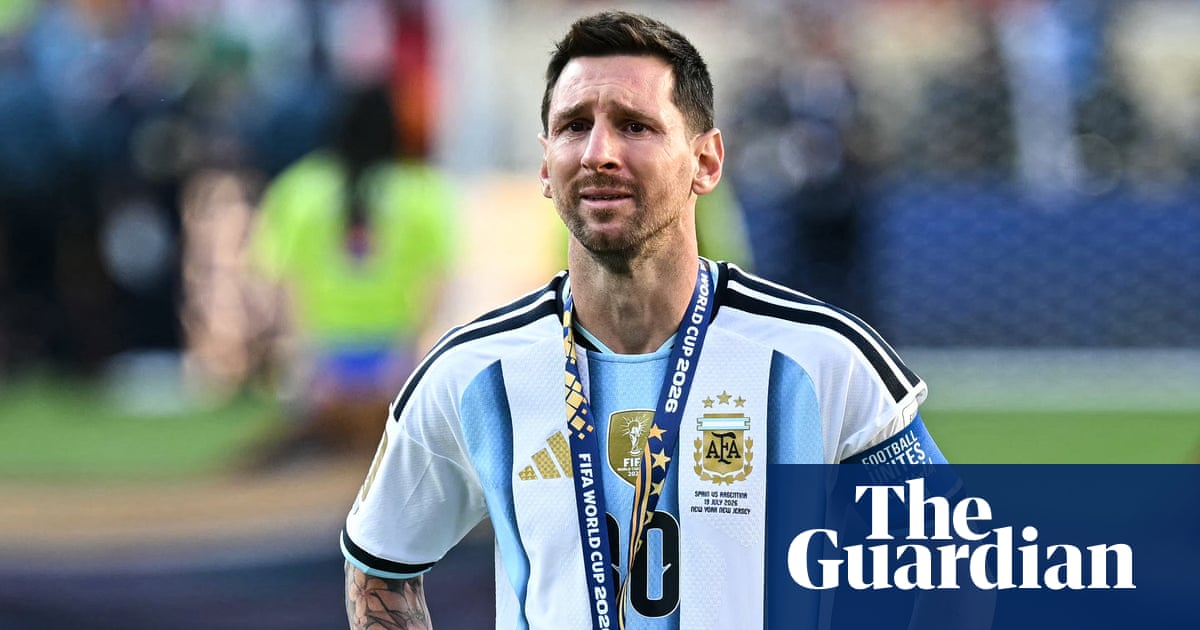
The Empty Throne
Lionel Messi has retired from international football. At 39, after 207 caps, a World Cup triumph, two Copa América crowns, and a career that has defined an era, he steps away from the Argentina jersey he wore since his 2005 debut.
The headlines will focus on the emotion — the quote about it hurting deep down, the death of his father Jorge confirming the timing, the admission that his legs simply could not go on after Argentina’s World Cup final loss to Spain. All of that matters. But the larger story is structural.
Messi was not just a player. He was the single gravitational force around which the global football ecosystem orbited. His retirement leaves a vacuum that no one is prepared to fill.
The World Cup Without Its Anchor
The 2026 World Cup already happened. Argentina lost to Spain in the final. Messi played through pain he described in raw terms — “my legs couldn’t go on any more” — and still helped carry his team to the ultimate match. That tournament’s commercial architecture, like every tournament since 2022, was built on a Messi premise.
Broadcasters paid premium rates for rights partly because Messi guaranteed audiences. Sponsors attached themselves to FIFA’s calendar because his face — whether in an Argentina kit or on a billboard — moved numbers. The sport’s most expensive property was underwritten by one man’s ability to make people watch.
That contract is now expired. The next World Cup cycle begins without its primary marketing asset. Networks will look at rights negotiations with different calculus. Some markets — particularly in Asia and North America where Messi’s personal brand carried disproportionate weight — will recalibrate their commitment. The question is whether football can sustain its commercial peak without a singular global figure commanding the center of attention.
Who Inherits?
The empty throne is the most important question in world football right now, and the answer is: nobody clear.
Erling Haaland is the closest thing to a successor in raw scoring output, but his appeal is narrower. Kylian Mbappé carries a different kind of baggage — talent undiminished, but an international career shadowed by France’s internal dysfunction and his own dramatic exits. Jude Bellingham has charisma but is still a work in progress at the highest level. None of them project the same global saturation that Messi achieved over two decades.
This is not a temporary gap. Messi’s combination of longevity, consistency at the peak, and crossover appeal — he was as recognizable in Mumbai and São Paulo as in Madrid and Milan — is likely unmatched in the history of the sport. The players who follow will be extraordinary. They will not be Messi.
The consequence is a flattening of football’s cultural hierarchy. When one player dominates the conversation for so long, the sport becomes more concentrated. Remove that concentration and the spotlight scatters. That is good for competition. It is harder for the sport’s commercial machinery.
The Argentine Aftermath
For Argentina, the emotional weight is immediate. Messi became, over his final years, almost synonymous with the nation itself. His performances in 2022 and 2024 made him larger than sport. The retirement of a figure who carried that much national meaning creates a genuine cultural aftershock.
There is also a practical dimension. Argentina’s current generation — Julián Álvarez, Alexis Mac Allister, Enzo Fernández, Rodrigo De Paul — inherited a team built around sustaining Messi’s twilight. Their identities are now unmoored. The next coach will face the task of constructing an identity that does not orbit a single player, a rare exercise in modern football where every successful team is built around one irreplaceable figure.
Inter Miami and the MLS Gambit
Messi’s club career continues. His Inter Miami contract runs through 2028. He scored four goals in a 7-1 rout of CF Montreal last Saturday, proving that his domestic game remains potent even as his international body gave out.
This is the paradox of Messi’s retirement: it strengthens his club position while weakening his global sporting significance. MLS, which bet everything on the Messi migration in 2023, now has a player whose international retirement removes the distraction of Argentina duty and allows him to focus entirely on club football for the first time in years.
The league’s growth trajectory was already set in motion. Messi’s international retirement does not accelerate it dramatically, but it does change the narrative. MLS is no longer a side quest for the greatest player in the world. It is, for better or worse, his final destination.
What Comes Next
The retirement of a player of Messi’s magnitude produces second-order effects that will take years to fully register. Youth academies across Latin America and Europe will adjust their development philosophy — the Messi prototype shaped coaching for a generation. Sponsorship deals tied to international tournaments will be renegotiated. Fan bases that formed around his international career will seek new anchors.
The most honest assessment is that football will adapt. It always does. But the adaptation will involve a period of commercial and cultural recalibration that the sport has not experienced since before the turn of the millennium.
The throne is empty. The question is whether anyone is close enough to sit on it — or whether the sport must learn to function without one.
The Human Story
Beneath all the structural analysis, there is a 39-year-old man who grew up in Rosario, debuted for Argentina as a skinny teenager with Growth Hormone Deficiency, and carried a nation’s hope for two decades. He told the truth when he said this decision hurt. He told the truth when he said he has nothing left to give.
The numbers — 207 caps, four World Cup appearances, three major tournaments as a captain — tell one story. The fact that he announced his retirement just two days after a World Cup final loss tells another. The body breaks before the will does.
That is the part no one is quantifying yet. The rest will follow.