Mini-brains Remember Time Even When Shattered, Study Finds
Human brain organoids cultured for over five years retain traces of their shared history even after being broken apart—a finding that pushes the boundaries of what we think memory requires and opens a fresh ethical line of questioning.
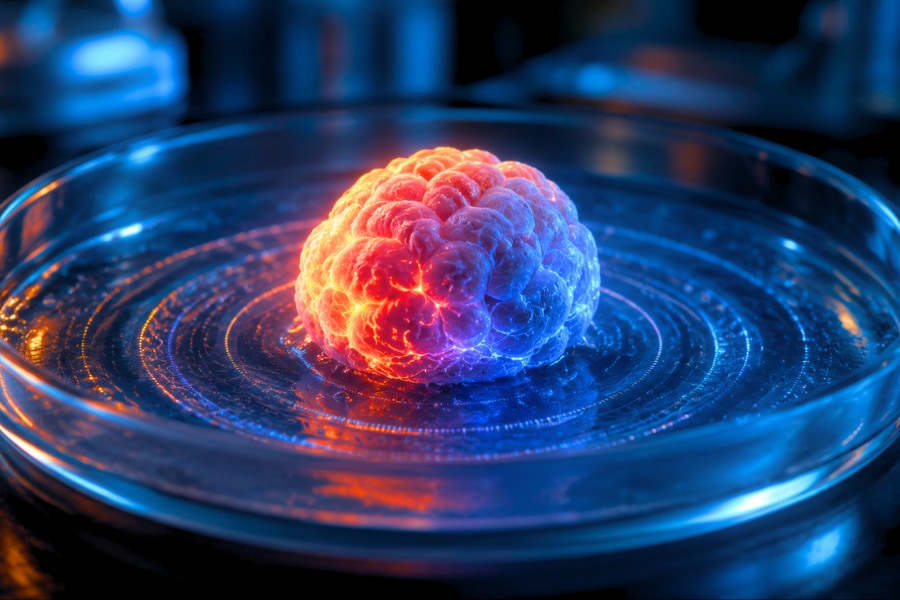
The head inside the box doesn’t keep secrets anymore.
For decades, the human brain has been the most stubborn black box in biology. Unlike a tooth or a bone, you cannot cut a cross-section and read off how much time has passed. Teeth leave rings. Bones accumulate wear. The brain grows inside a skull and then keeps growing in silence for nearly two decades, and no one has been able to watch that process at the cellular level except in fragments.
That is why brain organoids—small clusters of human brain cells grown in a dish from stem cells—have become such a big deal. They are the size of a lens bean. Each one packs more than a million cortical neurons. For the first time, scientists could observe human brain development outside the womb, at the scale and pace that animal models simply cannot replicate. Mice mature too quickly. Zebrafish brain architecture differs fundamentally. The organoid was supposed to be the proxy.
But the proxy kept dying.
The real breakthrough was not longevity—it was continuity.
Until recently, organoids survived for months and then stalled out, frozen in a state roughly equivalent to early fetal brain tissue. The neurons within them also went silent over time. They lost their spontaneous electrical firing—the very activity that keeps circuits alive. Without that firing, the cells degrade, much like a muscle atrophies without use. So the standard culture media were failing at the most critical point.
A Japanese research team changed the recipe. They designed a culture medium that preserved and encouraged spontaneous neural firing. The difference was stark. In conventional media, the synchronized electrical bursts that characterize developing neural networks disappeared within about a year. In the new medium, those bursts remained strong and consistent.
Then the team did something extraordinary. They kept the organoids going for more than five years.
Breaking the mini-brain did not erase it.
This is where the finding gets strange. The researchers dissociated 110 organoids down to the single-cell level—more than 420,000 individual cells. If you were to scatter a flock of birds mid-flight and then try to reconstruct what formation they had been flying in, most of the information would be lost. That is what you would expect from neural networks that have been physically separated.
But the data suggested otherwise.
Using an epigenetic clock—one that reads DNA methylation marks stamped on in age-dependent patterns—the team calculated the molecular age of every cell. The clock was calibrated against real human brain tissue, not blood or skin, which age differently. The result: the epigenetic age of the organoid cells matched the actual chronological age of the culture almost exactly. The cells had been aging in real time, at the same pace as the brains they were modeling.
Cells taken from year one of culture already showed markers characteristic of the postnatal human brain. The sequence of glial cell appearance—the supportive cells that myelinate neurons—matched what happens inside a developing human head. Gene activation timelines followed the same schedule. A dish, without blood vessels, without sensory input, without a body, had kept its internal calendar in sync with the living brain it was designed to imitate.
What does it mean that fragmented organoids “remember”?
The Japanese headline frames this as memory—specifically, that organoids retain a record of time spent together even after being torn apart. The underlying mechanism is almost certainly epigenetic. Methylation patterns are chemically stable. Once laid down, they persist through cell division and, to a degree, through dissociation. The cells carry their shared history in their DNA tags. That is not memory in any experiential sense. It is a biochemical archive.
But the distinction matters less than the implication. If a dispersed population of neurons still bears the molecular signature of a collective developmental timeline, then something about the network’s shared history is durably encoded—not just in the wiring, but in the chemistry of the cells themselves. That changes how you think about what memory is, and where it lives.
Who wins, who loses, and what happens next.
The winners are clear. Regenerative medicine investors will see this as validation that organoids can reach developmental stages previously thought impossible to model in vitro. If you want to study neurodegenerative diseases that unfold over decades—Alzheimer’s, Parkinson’s, Huntington’s—you now have a system that actually ages. Drug screening pipelines that previously relied on immortalized cell lines or short-lived organoids may get a serious upgrade. Companies building organoid platforms will compete on how long they can keep cultures alive and functional.
The losers are harder to name but easier to identify. Researchers who built careers on the assumption that organoids plateau at fetal stages will need to pivot. The assumption that the gap between fetal and adult human brain development was insurmountable in a dish is now gone. The competitive advantage of labs that moved early on extended culture protocols—particularly Japanese teams given the source of this work—will widen.
But the real question is ethical, and it is arriving faster than most labs are ready for it.
The ethics problem no one wanted.
If organoids continue to develop along human-timed schedules for years, and if their neural activity remains coordinated and complex, at what point do the old objections to organoid research stop being abstract? The concern has always been: could these things ever feel anything? Five years ago, the answer seemed safely no. The organoids were too small, too primitive, too far from anything resembling awareness.
Now they are keeping time with real brains. They are following the same developmental script. Their cells remember where they have been. The bar for what counts as a biologically meaningful nervous system has moved.
This is not a claim that the organoids are conscious. No one is making that claim. But it is a claim that the floor beneath the ethical debate has shifted. The epigenetic clock proved that these cultures are not just persisting—they are progressing along a human developmental trajectory. That makes the old dismissal of organoid research as “just cell clusters” increasingly difficult to sustain, even if the right answer is still unknown.
What to watch.
The immediate next step will be vascularization. An organoid this old, this active, still lacks blood supply. The team has not yet reported perfusing these cultures. Until that happens, the ceiling on size and complexity remains. Any lab that cracks sustained vascular delivery for multi-year organoids will effectively unlock adult-stage human brain modeling—and that is where the real clinical applications live.
A second question is whether the epigenetic clock remains accurate beyond five years. Does it drift? Does it accelerate? Without an external reference point beyond the calibration data the team used, no one knows yet. That uncertainty is itself a research opportunity.
And the third question—unavoidable—is regulatory. If organoids can be shown to track human developmental timelines accurately, governments will need to decide whether they fall under existing stem cell research frameworks or require new ones. Japan’s own regulatory posture on organoid research will be closely watched by the rest of the world.
The takeaway.
The mini-brain in a dish is no longer a fetus frozen in time. It is an aging system. And like everything that ages, it carries evidence of its own passage through time—in chemical marks on DNA, in patterns of gene activity, in the synchronized firing of neurons that once belonged to a collective whole. That history survives disruption. That may be the closest thing to memory this research has produced. But it is enough to make the next five years of organoid science far more interesting, and far more complicated, than anyone anticipated.