Mitsubishi's New Pajero Is a Signal About What Japanese SUVs Still Mean
Twenty years after the previous generation disappeared, Mitsubishi has resurrected the Pajero as its global flagship. The move reveals more about how legacy Japanese automakers are thinking about off-roading, electrification, and the emotional power of a nameplate than any spec sheet could.
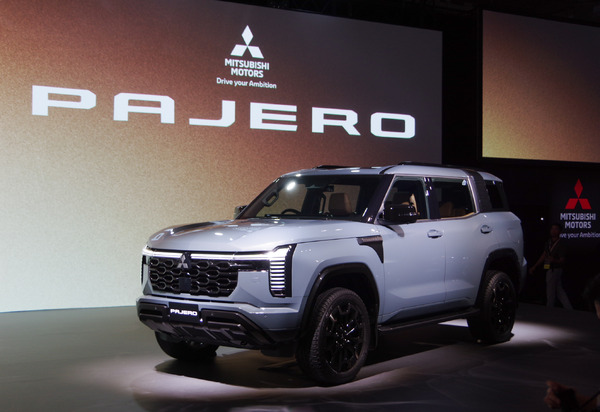
The Pajero Is Back. That Matters More Than You’d Think.
Mitsubishi revealed a new Pajero on September 2, 2026 — the first full model change in twenty years. The timing is deliberate. The company chose to launch its flagship SUV at a moment when the global auto industry is still arguing about whether rugged vehicles belong in an electric future.
The answer Mitsubishi is giving is: they do, at least for now, and they will continue to be central to Mitsubishi’s identity.
The previous-generation Pajero ended production in 2020. Its absence left a gap that consumers in Australia, Southeast Asia, the Middle East, and South America noticed immediately. There was no direct replacement in Mitsubishi’s lineup. The Outlander filled some of the family-SUV space, but it is a unibody crossover built on car platforms, not a body-on-frame 4WD built for anything beyond paved roads.
What Mitsubishi is presenting now is a genuine continuation of the original 1982 machine — the vehicle that, alongside the Toyota Land Cruiser and the Nissan Patrol, defined what a “true” off-roader meant for three decades.
How Big Is This?
The numbers are worth noting. The Pajero nameplate has moved 3.29 million units across four generations since 1982, sold in more than 170 countries. That is not a niche product. It is one of the best-known SUV names on the planet, even among people who have never sat inside one.
Production begins in Thailand in fiscal 2026 — Mitsubishi’s most important manufacturing hub in Asia — before reaching Japan and Australia later that year. The rollout then expands to roughly 100 markets across ASEAN, Latin America, and the Middle East over the following years. The sequencing tells you where Mitsubishi sees its core customers: places where long-distance travel, poor road conditions, and genuine off-road use are part of daily life, not weekend hobbies.
The dimensions support that positioning. At 4,920 mm long, 1,925 mm wide, and 1,910 mm tall with 20-inch wheels, this is a substantial vehicle. The 2,870 mm wheelbase and 230 mm ground clearance are competitive with the latest Land Cruiser 300. Approach and departure angles of 30.4 and 25.8 degrees signal that this is not a showroom SUV wearing an off-road costume.
The Powertrain Is a Statement
Mitsubishi is equipping the new Pajero with a dedicated 2.4-liter clean-diesel engine featuring a wide-range single VGT turbo, producing 480 N·m of torque, paired with a newly developed eight-speed automatic with a sport mode. That is a diesel. In a world where European manufacturers are abandoning internal combustion and many Japanese rivals are pushing hard on electrification, choosing diesel for a flagship off-roader is a conscious stance.
It is also a realistic one for the markets Mitsubishi is targeting. In parts of Southeast Asia, Africa, and Latin America, diesel remains the preferred fuel for high-mileage, heavy-use vehicles. Charging infrastructure for EVs is sparse in many of those same regions. The decision signals that Mitsubishi is prioritizing where its customers actually are over where regulators in Tokyo and Brussels wish them to be.
The Super Select 4WD-II system remains, offering two-wheel drive, four-wheel high, and four-wheel low with a center differential lock. Mitsubishi has added S-AWC — Super All Wheel Control — which integrates traction, stability, and braking management across all four wheels. Drive modes cover normal, eco, gravel, snow, mud, sand, and rock. This is not a gimmick. It is the same philosophy that made the Pajero legendary: selectable configurations for surfaces where automatic systems would struggle.
The Interior Is Where Nostalgia Meets Strategy
Mitsubishi has done something interesting with the cabin. The centerpiece is a dual 14.3-inch display — what the company calls a Monolith Display — flanking a reimagined three-gauge cluster that retains the Pajero’s heritage instrument layout while adding digital readouts for altitude, compass, temperature, and vehicle pitch. It is a design choice that says: we remember who we are, but we are not stuck in the past.
Soft materials on the dash and door trims use a stitching technique inspired by Japanese “kumiko” woodwork. The exterior colors — Armor Copper Metallic and Phantom Blue Metallic — are named to reinforce the rugged identity. Yamaha has co-developed a premium audio system with twelve speakers and dual amplifiers. These are small details, but they add up to a product that wants to feel premium, not utilitarian.
The cabin seats seven across three rows. The second row slides 150 mm and tumbles forward. Three-zone automatic climate control and ventilated seats are included. These are features aimed squarely at families in markets where the Pajero has historically served as both workhorse and weekend warrior.
Safety tech includes Mitsubishi’s first-ever SRS center airbag, bringing the total to eight. Collision mitigation braking, emergency lane-keeping assist, and forward cross-traffic alert are standard. A highway driving assist system called MI-PILOT is also included — a named system that positions the Pajero closer to the technological expectations of buyers who are also shopping against Toyota and Nissan.
What This Reveals About Mitsubishi’s Strategy
The most important thing about the new Pajero is not any single specification. It is what its existence tells us about Mitsubishi as a company.
Mitsubishi has been through significant turbulence in recent years — the fuel-economy scandal, governance problems, shifting ownership structures. The company’s survival has depended partly on maintaining credibility in markets where its brands matter. The Pajero is a credibility asset. Bringing it back signals that Mitsubishi intends to remain a serious player in the global SUV segment, not just a producer of compact crossovers for urban buyers.
The decision to stick with diesel rather than pursue an electric Pajero as a launch strategy reflects a pragmatic assessment of where demand actually exists. It also means Mitsubishi is not treating electrification as the only path to relevance — at least not for its flagship off-roader. That is a message to competitors: there is room for multiple approaches, and the market may reward patience over haste.
Thailand as the production anchor is another strategic signal. Thailand has emerged as a regional manufacturing hub for pickups and SUVs, benefiting from established supply chains and government incentives. Placing Pajero production there rather than in Japan reduces costs while keeping output close to key growth markets in ASEAN.
Who Wins and Who Loses
Mitsubishi wins by reclaiming a nameplate that carries enormous emotional weight in its core markets. Australian buyers who mourned the Pajero’s retirement now have a reason to reconsider. Middle Eastern customers who kept their old Pajeros running out of necessity now have a legitimate upgrade path. Southeast Asian buyers who needed a capable seven-seater with genuine ground clearance have a domestic-production option that may undercut imported competitors on price.
Toyota and Nissan lose slightly — not because the new Pajero will outsell the Land Cruiser or Patrol, but because the Pajero’s return restores a competitor that had gone quiet. For years, the Land Cruiser has faced less direct pressure in the hardcore SUV segment. The Pajero’s presence forces those rivals to defend ground they had grown comfortable holding.
The broader ecosystem of Japanese automotive suppliers may also benefit. A revived Pajero means continued demand for components from companies that have been waiting for volume to return — suspension manufacturers, diesel engine suppliers, four-wheel-drive system producers. That ecosystem has been shrinking as the industry pivots toward electric platforms.
What Comes Next
Mitsubishi has confirmed a phased global rollout. The question now is whether the Pajero will eventually receive an electrified variant. The company has not ruled it out, but the current generation is clearly positioned as an internal-combustion flagship. If and when Mitsubishi introduces a plug-in hybrid or battery-electric Pajero, it will likely arrive in a later lifecycle stage rather than at launch.
The pricing, availability, and real-world performance of the new Pajero will become clear as deliveries begin in Thailand and Japan later in 2026. Until then, the reveal itself is the story: Mitsubishi is telling the world it still believes in the rugged SUV, and it still has the commitment to build one.
That belief, however conditional, is worth watching.