Mladic's Hero Funeral Exposes the EU's Hollow Core in the Balkans
Ratko Mladic received a state-level funeral in Belgrade just weeks after dying in a Dutch prison. The spectacle is not just Serbian nationalism on display — it is the EU admitting it can no longer enforce its own values abroad.
The General Who Never Lost
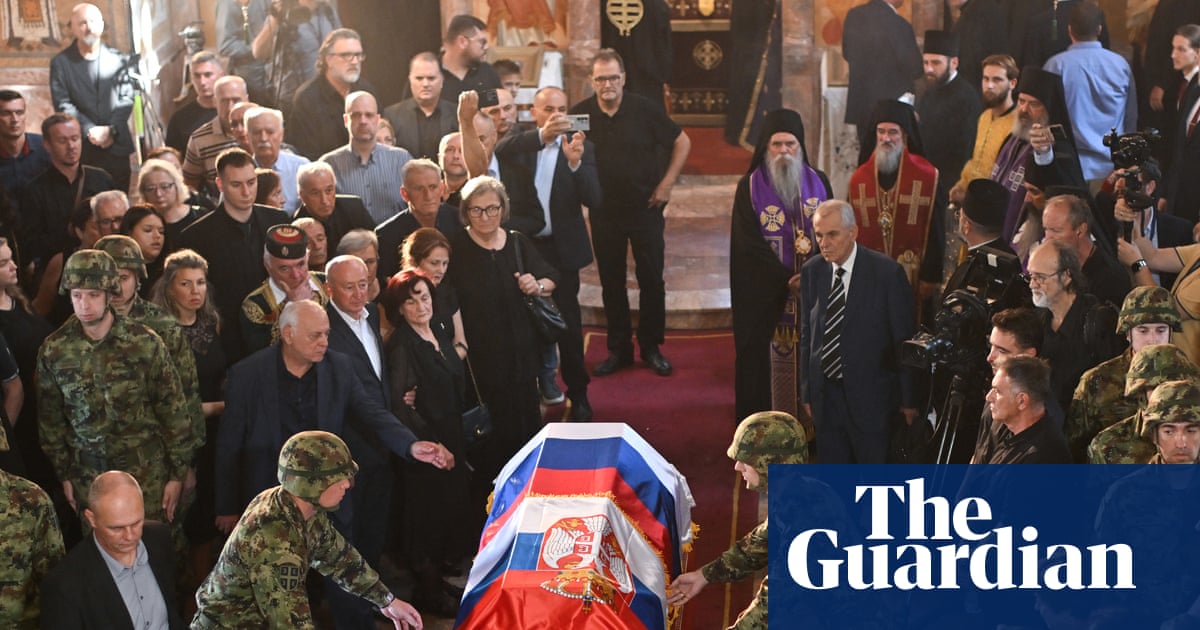
Ratko Mladic died on August 27 at age 84 in a Dutch prison where he had been serving a life sentence for orchestrating the siege of Sarajevo and the Srebrenica genocide. Within days, his body was flown to Belgrade on a government plane, draped in Serbian flags, and given a funeral that turned a convicted war criminal into a national martyr. Thousands gathered outside the small Church of St. Luke. A banner across the street read: “Welcome, General, thanks be to your mother for bearing a hero.” His signature military cap and a ceremonial sword rested on his casket. Armed soldiers stood guard.
Marta Kos, the EU enlargement commissioner, responded by canceling a planned visit to Serbia. She was right to object. But her protest also revealed something more uncomfortable: the EU had run out of tools.
What the Funeral Actually Signals
The spectacle in Belgrade is not simply a resurgence of Serbian nationalism. It is evidence that the post-Yugoslav accountability architecture — built over three decades by the International Criminal Tribunal for the Former Yugoslavia, the Dayton Agreement, and generations of diplomatic pressure — has eroded to the point where a convicted genocidaire can receive state-level honors and no meaningful consequence follows.
Mladic was one of the principal architects of ethnic cleansing during the Bosnian War. His forces subjected Sarajevo to a 1,460-day siege that killed more than 10,000 civilians through daily shelling and sniper fire. In July 1995, he commanded the operation that murdered at least 8,000 Bosniak men and boys in Srebrenica — the worst mass killing in Europe since the Second World War. He was filmed handing out candy to children before rounding them up for execution, telling them their town was being “given to the Serb people as a gift.”
He evaded capture for sixteen years. When he was finally arrested in 2011 and sentenced to life in 2017, there was a brief moment when it seemed the machinery of justice might actually work. Instead, twenty-nine years later, his remains were returned to Belgrade in a ceremony that looked remarkably like a victory parade.
The Vucic Calculus
President Aleksandar Vucic occupies a space that no serious analyst should mistake for simplicity. He has spent years positioning Serbia as a European candidate, opening accession negotiations in 2014, court Brussels with reform rhetoric, and simultaneously cultivating nationalist sentiment at home that makes him indispensable to large segments of the electorate. The Mladic funeral was not an accident. It was calibrated.
Vucic knew Kos would cancel her visit. He knew the EU would issue statements. He also knew the statements would not be followed by sanctions, tariff adjustments, or suspension of negotiation chapters. Serbia has been negotiating EU membership for over a decade. The process has stalled repeatedly — not because Brussels lacks leverage in theory, but because it has chosen not to exercise it when doing so would risk destabilizing a partner it considers strategically important against Russian and Chinese influence in the region.
That is the real story here. The EU is trapped between its own foundational values and its geopolitical convenience. Every time it chooses the latter, the choice compounds. Mladic’s funeral is not an isolated event. It is the logical endpoint of a strategy that has treated Balkan reform as checkbox diplomacy rather than a moral project.
Who Wins, Who Loses
The immediate winners are clear. Radical nationalist parties across the former Yugoslavia — in Serbia, in Republika Srpska, in Croatia’s nationalist corners — now have a template. A convicted genocidaire can die in a foreign prison and return home to honor. The precedent weakens every victim advocacy group, every survivor organization, every institution built around the principle that atrocities must not be forgotten.
Srebrenica survivors and their families deserve the sharpest language here. For them, this is not abstraction. It is the repeated violation of a wound that has never healed. The Dutch battalion assigned to protect the UN-declared safe haven failed to stop the massacre. The world watched and did nothing. Twenty-nine years later, the same world watches again and does almost nothing.
The losers extend beyond the Balkans. Every candidate country watching from North Macedonia to Georgia to Ukraine learns the same lesson: EU membership promises moral alignment, but enforcement depends entirely on whether the member state in question is useful enough to overlook. The normative power project that defined the EU’s post-Cold War identity fractures further with each compromised principle.
The Revisionism Cascade
What happens in Belgrade rarely stays in Belgrade. Mladic’s return coincides with an accelerating wave of war-crime revisionism across the region. In Bosnia and Herzegovina, the Republika Srpska entity led by Milorad Dodik has spent years systematically dismantling state institutions, mocking ICTY verdicts, and promoting the false narrative that Srebrenica was a fabricated crime. Croatian nationalist circles have long resisted accountability for their own wartime actions. Even in Hungary, Viktor Orban’s government has softened its stance toward Serbian positions on the past, prioritizing energy deals and migration agreements over historical honesty.
Russia benefits from this environment in ways that go beyond nostalgia. A Balkans that cannot agree on its own history is a Balkans that cannot unify. Fragmentation serves Moscow’s strategic interest in keeping Europe distracted and divided. The Mladic funeral, whether orchestrated by Belgrade or simply permitted by it, feeds directly into that architecture.
What Comes Next
Kos’s cancellation was the only concrete action available. There are no remaining cards worth playing that carry real cost. Serbia’s accession negotiations are already frozen on political grounds that have less to do with rule-of-law benchmarks and more to do with the EU’s own internal paralysis. Expanding the list of stalled chapters would not change Vucic’s calculus. Sanctioning individual officials would anger partners and accomplish nothing measurable. The tool kit is empty.
That emptiness should trigger a reckoning inside the European Union about what enlargement actually means. If the process does not require genuine confrontation with the past, genuine reconciliation, and genuine respect for victims — as Kos stated Monday — then it is not an integration project. It is a club with no membership standards. And clubs without standards lose credibility the moment anyone notices.
Mladic’s funeral was meant to celebrate a general. What it actually demonstrated is how far the post-war European order has drifted from its own founding promise: never again.