Monster Hunter Wilds Is Nintendo's Switch 2 Anchor — and It Shows
Capcom and Nintendo are betting the Switch 2's early momentum on Monster Hunter Wilds, launching December 4 with a $62,000 yen console bundle. Here's why that matters far beyond Japan.
The Date That Shouldn’t Feel Like a Surprise
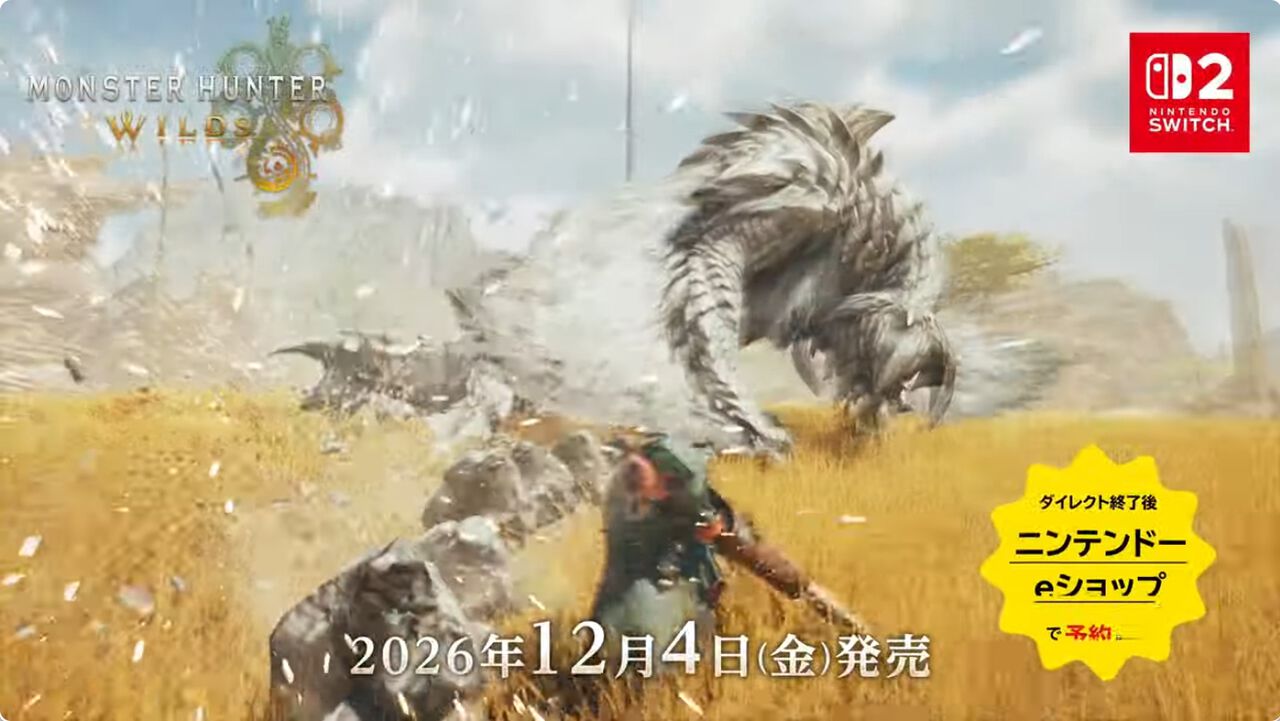
December 4. That’s the day Monster Hunter Wilds hits Switch 2. Not a vague launch window. Not a seasonal estimate. A concrete calendar date announced at the September 9, 2026 Nintendo Direct — and it follows a pattern Capcom and Nintendo have refined across three console generations.
In 2017, Monster Hunter: World preceded the Switch port by nearly two years. In 2021, Monster Hunter Rise launched alongside the Switch’s actual life — a rare simultaneous relationship that turned the hybrid console into a sales phenomenon. Now, with Switch 2, Capcom is reverting to the pre-launch anchor model: a major title arrives first, building an installed base before the hardware truly opens up.
This isn’t accidental. It’s strategic. And it tells you everything you need to know about where Nintendo stands in the current generation transition.
The pre-launch anchor model is not new to console history, but Nintendo has executed it better than almost any competitor. The N64 had GoldenEye 64. The Wii had Wii Sports. The Switch had Ring Fit Adventure and Mario Kart 8 Deluxe riding into maturity. Each time, a first-party or closely aligned third-party title carried the hardware through its most vulnerable months — the period between launch excitement and the flood of third-party support. Monster Hunter Wilds is that title for Switch 2, and the choice reveals something important: Nintendo is not assuming this generation will sustain itself on Mario alone.
The Bundle Price Speaks Volumes
The ¥61,980 (tax included) bundle — officially called the “Nintendo Switch 2 Monster Hunter Wilds Set” — includes all previously released title updates and local multiplayer support. Famitsu confirmed the details, and the numbers reveal what neither company wants to say out loud: the standalone console price remains unannounced as of this reporting, which means Nintendo is using the bundle as its primary pricing signal.
At ¥61,980, the bundle implies a console cost roughly in the ¥45,000–¥50,000 range if you back out the game value — putting Switch 2 firmly in premium territory compared to last-gen pricing. For context, the original Switch launched at ¥29,980 in Japan. The Switch Lite was ¥16,980. This isn’t a budget move. It’s a statement that Nintendo expects this hardware to compete on capability, not on being the cheapest option in the room.
Who wins? Nintendo gets a high-margin hardware bundle with built-in demand. Capcom gets a guaranteed volume driver for its flagship franchise on new hardware. The only clear loser in the short term is the consumer who wants a bare console without committing to a title they may not play — a segment that historically represents a significant portion of early adopter behavior. That consumer now faces either paying full price for the console separately or absorbing a game they might not want into a bundle they’re purchasing primarily for the hardware.
The pricing strategy also sends a second-order signal to retailers. Bundles like this create less margin flexibility for store-level discounting, which protects Nintendo’s branded pricing integrity. Where the original Switch saw deep retail discounts within months of launch — particularly during Black Friday cycles — Switch 2’s bundle structure makes price erosion harder to initiate organically.
Why December 4 Matters More Than the Calendar Suggests
A December 4 launch lands squarely in the holiday purchasing window — but more importantly, it positions Switch 2 as a fully viable system before the March fiscal year close for both Nintendo and Capcom. That matters for earnings reports. That matters for shareholder confidence. That matters for third-party developers deciding whether to port titles to a platform whose install base is still hypothetical.
The timing creates a compounding effect. Holiday sales generate initial install base data, which feeds into Q1 fiscal reports, which then influence whether third-party publishers commit resources to Switch 2 development. If Wilds performs strongly, the feedback loop accelerates. If it underperforms, the delay in third-party commitment lengthens — and that delay has real consequences for a platform trying to establish itself against established competitors.
Historically, Monster Hunter titles have been the single most reliable predictor of Switch-era sales longevity. The franchise has moved millions of copies on hardware that was never marketed as a performance machine. If Wilds can replicate even a fraction of Rise’s Switch trajectory — which sold over 14 million units on the original hardware — the argument for Switch 2’s early adoption becomes statistically defensible within quarters, not years.
There’s also a cultural timing element. Monster Hunter has deep roots in Japanese gaming culture, and a December release captures the year-end gift-giving season when family members purchase consoles for younger relatives. This demographic — younger players who discover Monster Hunter through gifting — represents the franchise’s most durable audience pipeline.
The Local-Multiplay Signal
Famitsu noted that the Switch 2 version supports local communication multiplayer. This is a deliberate choice. Monster Hunter’s social loop — forming parties, hunting cooperatively, sharing loot — is the franchise’s DNA. By highlighting local multiplayer at launch, Nintendo and Capcom are signaling that Switch 2 is still, fundamentally, a social console.
This differentiates Switch 2 from its competitors in a way raw specs cannot. The PS5 Pro and Xbox Series X compete on fidelity and frame rates. The Steam Deck and ROG Ally compete on portability and openness. Switch 2 competes on accessibility and togetherness — and Monster Hunter Wilds is the proof point.
The implications extend beyond marketing language. Local multiplayer support shapes how Nintendo designs its controller ecosystem, its online infrastructure priorities, and its retail display strategy. Store associates can demonstrate co-op play without requiring internet connectivity. Families can evaluate the system in situ. Every physical retail interaction becomes a potential conversion opportunity that competitors lacking this capability cannot replicate.
The Franchise Roadmap and What Comes Next
The source material mentions ¥Ascendance¥ as planned for 2027. While details are scarce, any new Monster Hunter IP landing on Switch 2 within its first year would reinforce the console’s positioning as a Monster Hunter destination — similar to how Rise’s success cemented that relationship on the original hardware. Whether ¥Ascendance¥ meets that threshold remains unclear, but the intent is visible.
One uncertainty: the standalone Switch 2 price has not been confirmed. Without it, we cannot fully assess whether the bundle represents a discount or a premium play. We also do not yet know if Wilds will receive future updates or DLC on Switch 2 equivalent to the PC/PS5/Xbox releases — an important question for long-term value assessment. If Switch 2 owners receive a diluted experience relative to other platforms, resentment could accumulate among the very audience Nintendo needs most: early adopters who paid a premium for hardware they hoped would remain relevant.
There is also the question of capacity. Monster Hunter titles are notoriously demanding — both in terms of player time investment and development resources. If Capcom is splitting focus between Wilds, ¥Ascendance¥, and potential DLC cycles across multiple platforms, the Switch 2 version risks becoming secondary in prioritization. That scenario would undermine the entire strategic logic behind placing Wilds as the launch anchor.
The Bigger Picture
Nintendo has survived generational transitions before. The Wii to Switch pipeline was seamless because titles like Mario and Pokemon carried the hardware into new cycles. Now, Monster Hunter fills that role — and December 4 is the first real test.
The franchise that defined the Switch’s mid-life sales spike is doing it again. But relying on a single third-party franchise to anchor a hardware transition carries risk that Nintendo has historically avoided. Mario, Zelda, and Pokemon are Nintendo-owned IP with infinite sequels and no external dependency. Monster Hunter belongs to Capcom. If Capcom’s development priorities shift, if internal conflicts arise, or if the franchise simply underperforms relative to expectations, Nintendo has no immediate fallback of equivalent scale.
The question isn’t whether Wilds will sell well. It’s whether Nintendo can sustain momentum through 2027 without another Monster Hunter anchor waiting in the wings — and whether the company has a second wave of first-party or exclusive third-party titles ready to fill whatever gap Wilds leaves behind. December 4 is the starting line, not the finish.