Myanmar's Genocide Verdict: The Enforcement Problem Is the Story
The ICJ has found Myanmar guilty of genocide for the first time. But the real test comes next — the court cannot enforce its own ruling, and the Security Council is already gridlocked.
The World Court Just Convicted a Government of Genocide. It Still Can’t Make It Stop.
The International Court of Justice delivered what may be its most consequential ruling in nearly a decade Thursday: Myanmar committed genocide against the Rohingya Muslim minority during a 2017 military operation that killed roughly 100,000 people and forced more than 700,000 across the border into Bangladesh. Nine judges voted yes. Six dissented. Either way, the verdict — the first time the world’s highest court has ever found a state responsible for genocide — carries legal weight but zero enforcement power of its own.
That is not a new design flaw. It is the point. The ICJ was never meant to police its own judgments. Its statute explicitly routes noncompliance to the U.N. Security Council, where five permanent members hold veto authority. And in this case, two of them — China and Russia — have already made clear they see Myanmar as a strategic asset worth shielding from consequences.
So what exactly changes? Not enough, perhaps. But the political terrain shifts in ways that will test whether the post–World War II order can adapt or will simply fossilize further under the weight of its own contradictions.
The Verdict Was Inevitable. The Reaction Is the Reality.
Myanmar’s interim government, led by President Min Aung Hlaing — the same commander who oversaw the 2017 operations — dismissed the ruling as “unfair,” pointing to the split vote. Khine Khine Soe, the president’s spokeswoman, told reporters in Naypyitaw that not all fifteen judges agreed. That framing is technically correct and strategically designed to create doubt where little exists among independent observers.
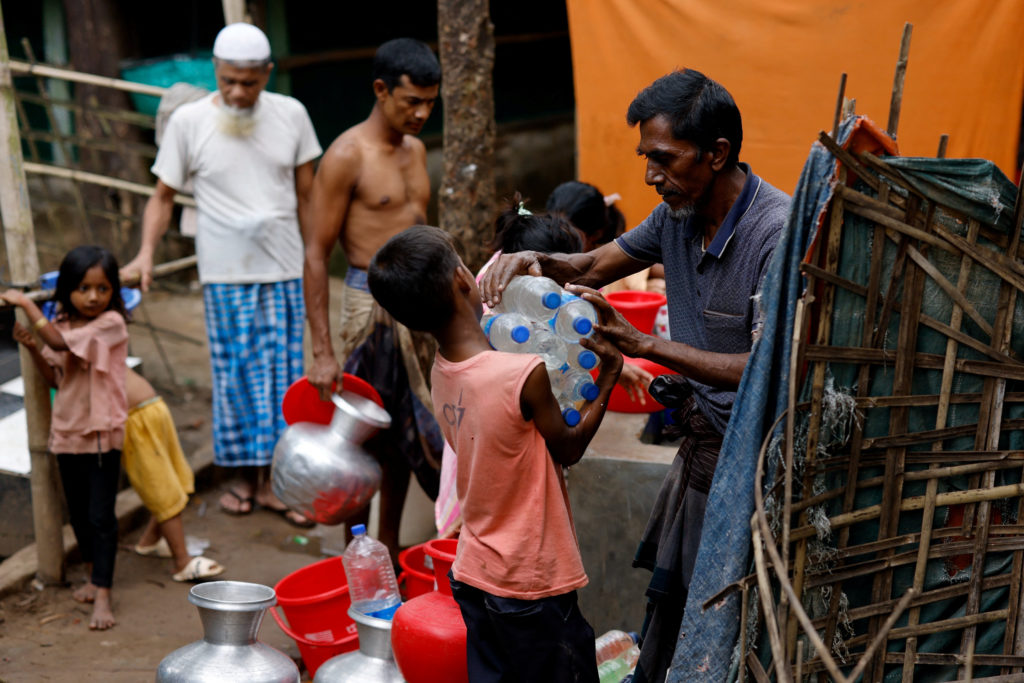
The evidence before the court was extensive: satellite imagery of burned villages, medical records documenting mass killings, testimonies from survivors and defectors, and internal military documents outlining orders for systematic清除 operations. The dissenting judges disagreed on thresholds of intent, not facts. That distinction matters internationally but means nothing to the 1.2 million Rohingya still living in overcrowded camps in Cox’s Bazaar, Bangladesh.
Daniel Forti at the International Crisis Group put it plainly: any Security Council action will be blocked by Beijing and Moscow. China has discouraged UN action on Myanmar since the 2021 coup, treating the country as part of its sphere of influence in mainland Southeast Asia. Russia shares that calculus, seeing Myanmar as a foothold in a region where Western leverage has been shrinking. The ICJ ruling changes neither government’s calculation.
Where the Pressure Could Actually Land
With the Security Council gridlocked, the campaign is redirecting toward softer but more creative vectors.
Gambia, the West African nation that brought the original case to The Hague in 2019, is now exploring a resolution at the 193-member General Assembly. While such resolutions lack the binding force of Security Council mandates, they carry diplomatic gravity and could establish an international monitoring framework — something Human Rights Watch and Justice for All are already advocating for.
Justice for All, a coalition of 38 U.S. and Canadian Muslim organizations active on Rohingya issues since 2017, outlined specific economic targets: Myanmar’s oil and gas sector, which generates critical revenue for the military’s coffers, and the networks supplying weapons and surveillance equipment to the junta. Amnesty International’s secretary general Agnes Callamard called for a full arms embargo and a referral to the International Criminal Court for individual criminal prosecution — though the ICC itself faces complicating factors, including U.S. sanctions on certain of its officials, which would trigger an automatic American veto on any Security Council referral.
There is a separate procedural track worth watching. ICC prosecutors requested an arrest warrant for Min Aung Hlaing in late 2024, alleging crimes against humanity. A decision from the ICC judges has not yet been publicly announced. The ICJ judgment on state responsibility should not legally affect those proceedings — the two courts deal with different questions — but it will undoubtedly add political pressure on the ICC bench to move.
ASEAN’s Uncomfortable Dilemma
Myanmar sits at the center of one of ASEAN’s most persistent embarrassments. The bloc’s consensus-based approach — famously encapsulated in its five-point peace plan after the 2021 coup — has produced almost nothing tangible. Member states like Thailand and Indonesia maintain unofficial but significant commercial and diplomatic channels with the Yangon junta, creating awkward friction with countries pushing harder accountability measures.
Bangladesh occupies a particularly fraught position. Its foreign minister, Khalilur Rahman, serves simultaneously as president of the U.N. General Assembly — a dual role that creates structural tension. Rahman visited Cox’s Bazaar on Friday, telling gathered Rohingya refugees “at this historic moment” that there must be action and pledging to amplify their voice in New York. That is meaningful symbolism, but Bangladesh also hosts over a million Rohingya on its soil and has repeatedly signaled it cannot sustain them indefinitely — making genuine repatriation a top priority that sometimes conflicts with hardline accountability demands.
Thailand, Vietnam, and Singapore face a different calculation entirely. None have formal diplomatic ties to the ICC — a complicating factor if individual prosecutions advance — and all maintain trade relationships that would suffer meaningfully under the kind of economic sanctions rights groups are proposing. ASEAN’s institutional inertia on Myanmar is not accidental; it reflects genuine divergence among members rather than mere collective indecision.
What Happens Next
Three scenarios seem plausible, none of them comforting.
First, the status quo softens into quiet marginalization. The verdict becomes a symbolic reference point — cited in parliamentary debates, invoked at human rights forums — while Myanmar’s military apparatus continues functioning essentially uninterrupted. This is the path of least resistance and historically the ICJ’s most common outcome when facing recalcitrant states.
Second, targeted sanction campaigns gradually chip away at specific military revenue streams. The oil and gas sector is vulnerable: Myanmar’s natural gas exports fund a meaningful portion of defense spending, and companies like TotalEnergies and Chevron operate concessions there. If the U.S. or EU were to impose sectoral restrictions — something rights groups are urging Washington to consider — the impact would be real but partial. The military economy is diversified and adaptable.
Third, a breakthrough emerges from an unlikely quarter. Gambia’s General Assembly push gains momentum. IndividualICC arrest warrants are executed against senior Myanmar officers traveling abroad. A coalition of affected states imposes unilateral sanctions that create enough economic pain to force negotiations. This path is not impossible, but it requires coordination that has proven elusive so far.
Yasmin Ullah, a Rohingya activist who listened to the ruling from The Hague, did not mince words: the judgment will only mean something if governments act on it. “Make Myanmar pay reparations,” she said. “Give us back our lives. Give us a future.”
Those are just words spoken in a courtroom. Until powerful governments decide they matter more than convenience, they will remain exactly that.
The ICJ has spoken. The question is whether anyone with the ability to enforce its words is willing to listen.