Why a Nausicaä-Inspired Minecraft Dimension Matters More Than You'd Think
Minecraft Dungeons II's new Sift dimension is the franchise's first new world in 15 years—and it's drawing inspiration from Studio Ghibli. What this means for Minecraft's global content strategy.
The 15-Year Gap Just Got a Little Shorter
Minecraft Dungeons II has a new dimension called Sift. That sounds like routine franchise expansion — until you realize this is the first brand-new dimension in Minecraft’s entire 15-year history. No, not a new biome. Not a new realm accessible through a portal that works exactly like every other portal. A genuinely new layer of reality for the franchise, one that its own developers admit they treated as absolutely critical from day one.
The announcement came alongside a TGS 2026 hands-on report from 4Gamer.net, and buried in the developer commentary was a detail that most Western wire desks will likely skip: Sift’s aesthetic DNA comes largely from Nausicaä of the Valley of the Wind.
That is not a metaphor. According to the development team, concept artists explicitly drew inspiration from Hayao Miyazaki’s 1984 manga and its 1984 film adaptation — the lush toxic jungles, the spore-filled valleys, the sense of a world that is simultaneously beautiful and fragile.
This is a moment worth paying attention to.
A Japanese-Aesthetic Injection Into the World’s Biggest IP
Minecraft’s dimensional logic has always been stark. The Overworld is home. The Nether is punishment — hostile,压抑, a place of lava and piglins where survival demands aggression. The End is empty — a final boss arena floating in void, devoid of atmosphere beyond the dragon.
Sift is described by the development team as the opposite of both. It is “rich and fertile, organic, full of souls” — a second Overworld rather than a dark mirror of one. The color palette avoids the aggressive reds and blacks of the Nether and the sterile purples of the End in favor of something closer to Nausicaä’s Valley itself: deep greens, soft blues, water that glows.
The enemies there are not native. They are corrupted versions of the dimension’s peaceful inhabitants, soul-tainted by the return of the Villager Council from the first game’s story. This is a narrative structure that mirrors Nausicaä almost precisely — a pristine world violated by external malice, requiring protection rather than conquest.
It is a striking creative choice for a franchise that has spent over a decade building its visual identity around blocky minimalism and binary moral geographies. Sift asks something different: can a Minecraft dimension feel gentle?
What This Means for the Main Game
The most important question is not what Sift does inside Dungeons II. It is what it does to the creative trajectory of Minecraft itself.
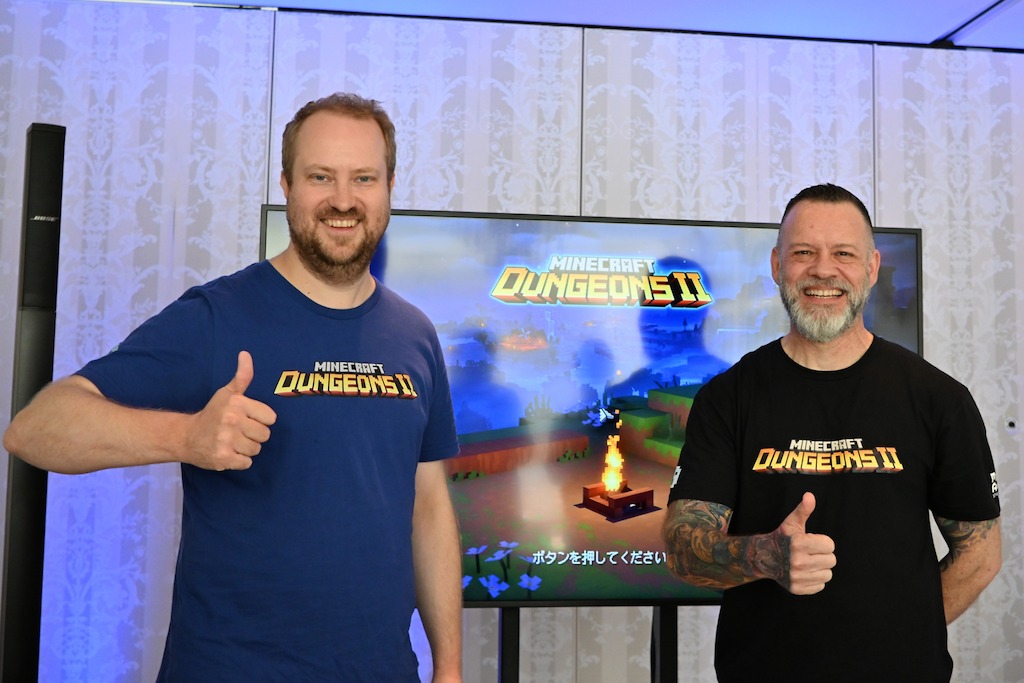
Mojang’s game director Mans Olson and production director Nathan Rose were present at TGS 2026 and spoke openly about the philosophy driving this release. The first game asked, “What is Minecraft Dungeons?” This one asks, “How do we expand what Minecraft means?”
That rhetorical shift is significant. Expanding meaning rather than repeating formula is how franchises survive their second decade. It is also how you make room for aesthetic sensibilities that have historically sat outside Minecraft’s design vocabulary.
If Sift’s organic, soul-centered worldbuilding proves viable in Dungeons II, the design patterns are portable. The guidance trail system — a light path that appears when you press the left stick to prevent getting lost in a hand-crafted sprawling environment — mirrors approaches seen in Japanese adventure games but applied to Minecraft’s spatial logic. The emphasis on peaceful exploration punctuated by focused combat encounters rather than constant hostility maps cleanly onto potential Overworld updates.
The Nausicaä influence specifically — the emphasis on ecological interconnection, on enemies as corrupted versions of something pure rather than inherently evil — could quietly reshape how future Minecraft enemies are conceptualized. Not every mob needs to be hostile. Some just need to be endangered.
The Structural Changes Players Should Note
Beyond the aesthetic, Sift introduces several mechanical shifts that distinguish Dungeons II from its predecessor and from the main game’s approach to progression:
Four armor slots instead of three, each conferring a passive buff. This is the first time Minecraft’s loot architecture has explicitly favored layered passive effects over single-stat upgrades.
Talismans — a new item category that operates outside the standard equipment framework. These are not weapons or armor; they are accessories that modify how your build functions rather than what it does.
Special rarity — a tier above Legendary that the developers confirmed will arrive post-launch. This signals an expansion of the loot curve that had been flatlining since the first game’s release.
No classes, only builds — your equipment defines your role. The demo featured four preset loadouts (Fighter, Archer, Tank, Mage), but these are templates, not restrictions. This design philosophy aligns closely with how Japanese ARPGs handle character progression and represents a subtle cultural inflection in a Western-designed franchise.
Jumping is now a core mechanic — the first time this action has been formally integrated into Minecraft’s dungeon framework. The community requested it; the developers delivered.
The Cross-Cultural Feedback Loop
What makes this story genuinely newsworthy is not the Nausicaä reference itself. It is the direction of influence.
For 15 years, Minecraft’s design vocabulary has flowed primarily from Western fantasy traditions and Scandinavian minimalism. The Nether borrows from Dante’s Inferno. The End echoes Lovecraftian isolation. Even the Overworld’s moral geometry — safe here, dangerous there — reflects a distinctly Western binary.
Sift reverses that vector. A Japanese animation masterpiece from the 1980s is now informing the creative direction of the world’s most-played game franchise. The developers at Mojang did not find this inspiration accidentally. They sought it out.
This is not the first time Western game studios have acknowledged Japanese aesthetic influence. But it is unusual for a franchise the size of Minecraft — with its own complete visual and narrative mythology — to open its dimensional blueprint to an outside creative tradition in this way.
The timing matters too. TGS 2026 is a Japanese event. The hands-on was conducted in Japanese. The developers chose to reveal Sift’s Nausicaä lineage to a Tokyo audience first. That is a deliberate positioning decision.
The Release and What Comes Next
Minecraft Dungeons II launches September 29 on PC, Nintendo Switch 2, PS5, Xbox Series X|S, and the original Switch. It will be available on Xbox Game Pass from day one.
The full Sift dimension has not been completely explored in public demonstrations. The TGS hands-on ended with the developers dropping the team into a late-game boss encounter in a hand-crafted dungeon within Sift — and the report notes the team was “soundly defeated.” Side quests remain undiscovered. The story’s resolution is undisclosed. How much of Sift is hand-crafted versus procedurally generated in its full form remains to be seen.
What is clear is that a new dimension in a 15-year-old franchise carries more weight than a typical expansion. And when that dimension draws its soul from a story about protecting a fragile world from its own corruption, it arrives at a moment when the gaming industry is asking exactly that question of itself.
The question now is not whether Sift will please Minecraft fans. It is whether the main game will notice.
This analysis is based on a TGS 2026 hands-on report published by 4Gamer.net. Developer commentary was provided by Mojang’s Mans Olson and Nathan Rose. No additional reporting was conducted beyond the source material.