Navi Pillay's Nobel Is a Shield for International Justice
The Nobel Committee's choice of Navi Pillay—former ICC judge and lead investigator of Israel's Gaza conduct—is both a tribute to a lifetime of legal courage and a direct challenge to the Trump administration's war on the International Criminal Court.
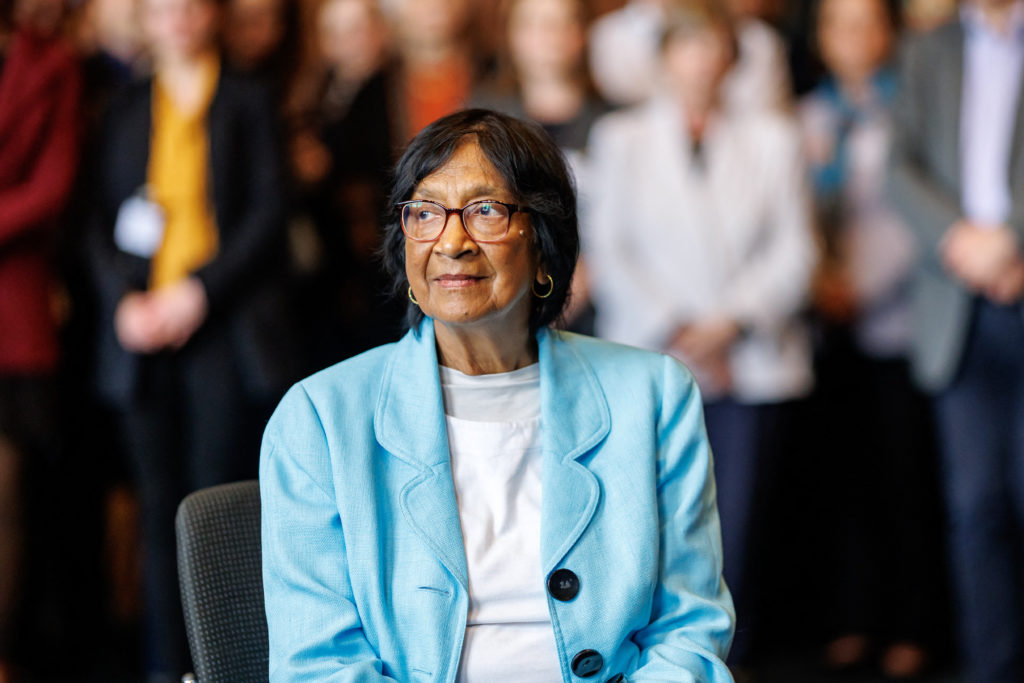
The timing was brutal. The point was unmistakable.
Navi Pillay accepted the Nobel Peace Prize at the Nuremberg Academy—in the very courtroom where the first Nazi war-crime judgments were delivered eight decades ago. Four hours later, the Trump administration announced sanctions covering every official at the International Criminal Court, the institution where Pillay once sat as a judge.
The Nobel Committee said it chose Pillay because institutions of international law are under political attack. It did not need to name the administration that made that so literal within the same working day.
This is not a coincidence. It is a confrontation.
Who Pillay is, and why the committee picked her
Pillay’s career predates most of the machinery she now symbolizes. Born into apartheid South Africa to a family of Indian descent, she rose through a system designed to keep her out. By the 1990s, she was presiding over the Rwanda Tribunal’s landmark media trial—the conviction of the hate-radio executives who helped orchestrate the genocide.
That judgment carried something even more consequential: it established, for the first time in international criminal law, that rape could be prosecuted as a crime against humanity. It also recognized that systematic sexual violence could constitute genocide when inflicted with the intent to destroy a group. Before Pillay’s bench, the prevailing assumption—across military cultures and legal systems alike—was that women’s bodies were collateral or spoils of war. She treated them as primary targets of criminal policy.
The Nobel Committee called her a legal pioneer. In the Rwanda context, that label is not rhetorical. The convictions her chamber produced created the legal architecture that later tribunals and the ICC itself now rely on.
More recently, Pillay led the U.N. Independent Commission of Inquiry that found reasonable grounds to believe Israel’s conduct in Gaza amounts to genocide. The finding is not a judicial determination—that requires a court. But it is the kind of threshold conclusion that triggers obligations for states under the Genocide Convention, including a duty not to remain passive.
The Trump administration’s response tells you everything
The sanctions announced hours after the Nobel declaration cover the entire ICC roster. This is escalation beyond the 2020 measures against then-Prosecutor Fatou Bensouda and now-Chief Prosecutor Karim Khan, which were narrowly targeted. The new round is institutional destruction by administrative fiat.
There is no pending ICC case against the United States. The only active situation involving a U.N. Security Council referral that touches a major power is the investigation into Israeli conduct in Gaza, and even that is stalled on jurisdictional questions. The sanctions are not about self-defense. They are about deterrence—making it too costly for any government to cooperate with the court.
Stephen Rapp, the Obama-era ambassador for war-crimes issues who was with Pillay when she learned she had won, put it bluntly: the administration is treating judges who uphold the rule of law as if they were terrorists. The logic—if there is one—is that if no state can safely interact with the ICC, the court becomes a hollow institution by default.
Israel’s fury confirms the prize’s sting
Israel’s Foreign Ministry statement was extraordinary even by the standards of diplomatic outrage. It called the Nobel “the biggest lie of the 21st century” and invoked Joseph Goebbels, the Nazi propaganda minister. The comparison is not just crude; it is historically illiterate—Goebbels built a regime that made the Holocaust structurally possible. Pillay spent her career building institutions designed to make such crimes punishable.
But the vitriol reveals something real: Israel’s government understands that Pillay’s Nobel elevates her findings from a U.N. commission report to a moral reference point that will be cited for decades. That is what the prize does. It transforms legal analysis into historical record.
Israel has a legitimate right to defend its actions in Gaza. The debate over proportionality, civilian protection, and military necessity is urgent and serious. But the Foreign Ministry’s response sidestepped the legal substance entirely and attacked the messenger. That is the instinct of a government that knows the facts are uncomfortable, not the posture of one confident in them.
What survives—and what doesn’t
Rapp acknowledged that the kind of top-down cooperation that created the Rwanda and Yugoslavia tribunals—the U.N. Security Council acting unanimously, superpowers aligned—is gone. Russia and China have made that clear with repeated vetoes. The great-power consensus that sustained the post-Cold War legal order has fractured.
But Pillay’s Nobel suggests an alternative path. It signals that a coalition of states—Canada, Germany, the Netherlands, others across the Global South—still believes in accountability. These are the countries whose courts already exercise universal jurisdiction over war crimes. These are the states that fund the ICC and enforce its arrest warrants domestically.
The court will not be destroyed by American sanctions alone. It survived the 2020 measures. It will survive these. What it cannot survive is indifference from the very allies whose legitimacy it depends on.
The real stakes: who gets tried
The Trump administration’s argument against the ICC is that the court is unaccountable. There is a factual basis for that critique—the court has no enforcement apparatus of its own and relies on state cooperation. But the more pressing question is whether accountability works both ways.
Pillay’s career answers that clearly. She prosecuted Rwandan perpetrators. She investigated Israeli conduct. She has applied the same legal standards to powerful and powerless states alike, which is precisely why both sides despise her.
The Nobel committee’s framing—that international legal institutions are under attack—was not abstract. It was a direct response to an administration that is actively dismantling the architectures Pillay helped build. The sanctions, the rhetoric, the refusal to engage: these are not the actions of a government that believes in selective accountability. They are the actions of one that believes accountability itself is a threat.
Pillay’s legacy is not that she will win every case. It is that she made it impossible to pretend some crimes do not count. That is a far more durable achievement than any single judgment.
And it is exactly why the people targeting her institution are afraid of what she represents.