Nepal blocks Korean rescuers from steep terrain — and what it reveals about disaster diplomacy
Nepal's military has barred Korean rescue workers from foot searches in near-vertical flood zones, limiting operations to drones and helicopters. The restriction exposes a quiet friction in Seoul's push to build humanitarian credibility in a region where Beijing holds deep infrastructure leverage.
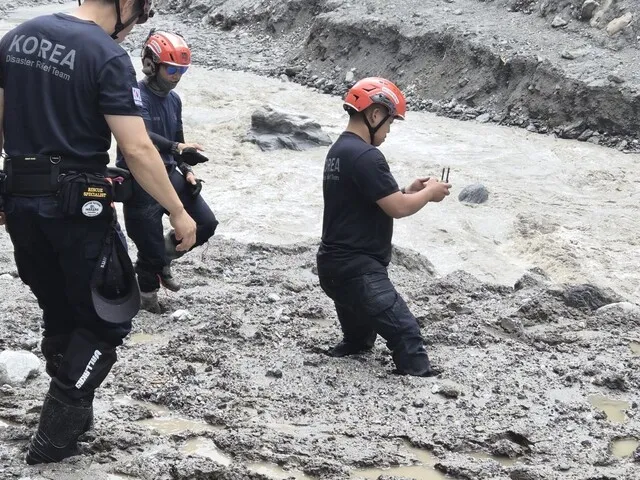
A steep wall between goodwill and ground access
Nine South Koreans are missing after catastrophic flooding in Nepal’s Bagmati Province. South Korea has sent its Disaster Relief and Emergency Response Team — the KDRT — with drones, helicopters, and the willingness to walk into terrain that locals describe as nearly vertical. Nepal’s military has said no.
The refusal is not ideological. It is not anti-Korea. It is, by all accounts, a genuine safety call: the slope from the Wi-e Dam to the nearby powerhouse is close to 90 degrees, and a foot patrol there would be reckless even for trained soldiers. But in a region where every disaster response doubles as a geopolitical signal, the boundary line drawn by Kathmandu matters beyond the immediate lives at stake.
Who wins, who loses — in real time
Korea loses visibility. The KDRT operators are in Nepal right now, working under a flag that says Seoul cares. They cannot reach the most dangerous zones on foot. Their options are limited to aerial sweeps and drone runs, which cover ground fast but miss what a human eye might catch — a stranded worker, a collapsed entrance, a trail that floodwaters have partially exposed. Each hour they spend waiting on the perimeter is an hour China’s rescuers or infrastructure contractors could be logging presence in the same valley.
Nepal’s military commands the narrative of operational control. By drawing the line at 90-degree terrain, they are also drawing a line around who gets to decide what constitutes acceptable risk on Nepali soil. That is sovereign posture — and it is a posture more easily maintained when the alternative is watching foreign humanitarian teams scramble over unstable ground without local supervision.
China, predictably, loses nothing by staying on the sidelines for now. But the longer the search drags on without Korean ground access, the more room there is for Beijing to step in with offers of heavy-lift capability, engineering equipment, or search teams equipped for exactly this kind of terrain. China already has thousands of kilometers of road and rail investment planned or underway across Nepal’s federal states. It also has military-engagement doctrine that treats disaster response as a core mission. The PLA’s engineering brigades do exactly this work in Pakistan, Myanmar, and Sri Lanka.
The hydropower corridor in the crosshairs
The search zone around the Wi-e Dam and its associated powerhouse sits in a corridor where geography and geopolyitics overlap uncomfortably. Nepal’s electricity exports are increasingly routed through India, but Chinese firms have spent years bidding for hydropower concessions and building access roads into exactly these kinds of river valleys. The infrastructure that brings rescuers in also brings competitors in — and the reverse is true as well.
No public record in the source material directly links Chinese contractors to the affected site. But the structural reality is hard to miss: Nepal’s major flood-risk terrain is the same terrain where Chinese engineering firms have the strongest footprint. When Kathmandu restricts Korean foot access, it is not just protecting workers from collapse. It is also protecting a search zone that, if opened to international teams, becomes a staging ground for multiple foreign actors to demonstrate capability side by side.
That is not a conspiracy. It is just the math of the region.
What Minister Cho Hyun’s trip can — and cannot — do
Foreign Minister Cho Hyun is traveling to Nepal on September 5–7, a window that overlaps with Nepal’s declared national day of mourning on September 7. He will meet his Nepali counterpart, Sishir Khanal, and press for expanded search access. He has already made the same request by phone twice, according to the report.
A ministerial visit does not change slope angles. But it does raise the political cost of refusing further cooperation. If Nepal denies ground access entirely, the optics travel fast: Seoul appears sidelined in a disaster that claims Korean citizens, while Kathmandu looks rigid. If Nepal grants limited access — perhaps allowing Korean teams to operate with Nepali spotters, in daylight, under strict routes — both sides gain.
The realistic outcome is a negotiated compromise, not a blanket opening. Expect conditions: Nepali military escorts, time-limited windows, and a prohibition on independent route-finding. That would give KDRT boots on the ground without surrendering operational control.
Why this matters beyond the headlines
South Korea has spent the past decade building its KDRT reputation as a reliable, apolitical response force — from Turkey to Pacific island nations. Each deployment is an investment in diplomatic goodwill that pays off when Seoul needs seats at tables where it does not yet belong. Nepal is not a traditional South Korean partner. It is, however, a country where India and China are already competing for influence, and where a middle-power response team can carve out a space that neither neighbor controls.
The restriction on foot searches is a reminder that humanitarian access is never free. It is negotiated, conditional, and sometimes blocked — even when the blocking party has every reason to welcome help. The lesson for Seoul is practical: future deployments should negotiate terrain access terms before boots leave the tarmac, not after they arrive.
What happens next
Nepal’s flood death toll exceeds 1,300. More than 5,600 people remain missing. The government has declared September 7 a day of national mourning. Among the rescues already reported are two Nepalis pulled alive from a tunnel after nine days — a miracle that underscores both the resilience of local responders and the desperate difficulty of reaching people trapped in these valleys.
The nine missing Koreans are still unaccounted for. Drone sweeps will continue through at least September 5. If Minister Cho secures even partial ground access during his visit, the KDRT gains a tactical edge and South Korea gains a diplomatic signal. If he returns empty-handed, the story will shift from rescue to rhetoric — and Beijing will be watching closely.
The mountain does not care about geopolitics. But the people who build roads through it do.