Nepal's Flood Death Toll Tops 900 — and the Hydropower Boom Behind It
Over 900 dead and 4,200 missing after a glacier collapse in the Himalayas. As rescue efforts stall, the disaster exposes a growing contradiction: Nepal is digging tunnels to harness flood-prone mountains for power.
The numbers are still climbing.
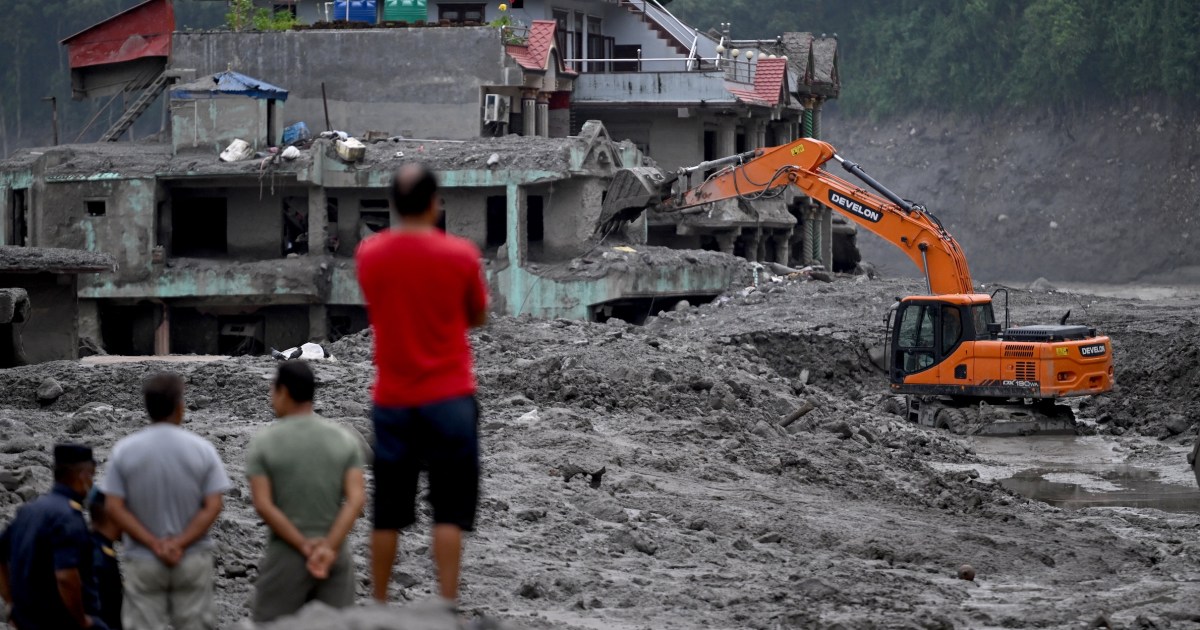
More than 900 people are dead. 4,247 are missing, nearly half of them foreigners. Morgues 125 miles from the disaster zone have been digging emergency graves in forests because they cannot process the bodies fast enough. Rescue teams are struggling to reach cut-off communities days after a glacier collapsed near Nepal’s border with China’s Tibet region on Wednesday.
The scale of the humanitarian crisis is clear. But the deeper story — the one English-language coverage has barely touched — is about what kind of country Nepal is becoming, and what this flood says about the future of Himalayan infrastructure investment.
A glacier gave way. The geography didn’t.
Chinese state television described the disaster as a sudden event caused by “glacier instability resulting from the long-term effects of climate warming.” The phrasing matters. This was not an unusual rainstorm. It was a structural failure — a glacier giving way under conditions that climate science has been predicting for decades across the entire Himalayan range.
Local residents in Rasuwa district described hearing a sound like thunder that lasted for minutes before the mountain itself seemed to exhale a wall of ice and rock. Within an hour, the Melamchi River — already swollen from early monsoon rains — became something else entirely: a churning slurry of boulders, uprooted trees, and debris moving at speeds that left no time for escape. By the time the flood reached the lower valleys, entire hamlets had been erased from maps.
China reported 16 deaths and 546 missing in its Tibet side. Nepal’s count dwarfs it. The two governments have not clarified how much their missing-person lists overlap, but the asymmetry tells its own story: Nepal’s southern foothills and river valleys, where populations cluster at the bottom of steep valleys, bear the brutal downstream consequences of events that begin in Tibetan glacial zones.
The disaster struck in a corridor that has become increasingly dangerous. The Rasuwa region sits along a well-documented fault line of glacial retreat. A 2023 study by the International Centre for Integrated Mountain Development (ICIMOD) mapped over 2,200 glacial lakes across the Nepal Himalaya, flagging more than 100 as potentially unstable. The lake involved in Wednesday’s collapse was not on that list — or if it was, no one in the districts below had been told.
The hydropower contradiction
Nepal has staked its economic future on rivers. The country has announced plans to more than double its installed hydropower capacity to 10,000 megawatts within the decade, drawing investment from India, South Korea, China, and increasingly private capital. Hundreds of tunnels have been carved into the Himalayas to divert water to turbines. Hundreds more are proposed.
This disaster, triggered by a glacial collapse in the Rasuwa corridor, is the kind of event engineers building those tunnels must now plan for — or admit they cannot.
Glacial lake outburst floods and ice-rock avalanches are not rare in Nepal. But they are becoming more frequent and more violent as permafrost thaws and glaciers destabilize at unprecedented rates. Every new hydropower tunnel bored through high mountain rock increases the fragility of the system. A blocked or damaged tunnel during a flood can become a pressure cooker, redirecting catastrophic volumes of water into valleys that were never supposed to see them.
The flood that hit Rasuwa and sent corpses downstream to Chitwan did not just carry water. It carried ice, rock, debris, and entire landscapes. Ferrin Cole of Crisis Response International put it plainly: “The flood that came down that mountain just wiped out cities.”
What makes this contradiction so sharp is that Nepal’s hydropower push is not driven by domestic demand alone. The country produces far more electricity than it consumes. The surplus is sold to India, its southern neighbor and primary buyer, under long-term power purchase agreements that bind Nepal’s energy exports to India’s growing grid. For the Nepali government, these deals represent a critical source of foreign currency and a cornerstone of national development strategy. Canceling or scaling back projects over risk concerns would send a signal that could spook the very investors the country is desperate to attract.
But the opposite choice — pressing ahead without updating risk models — is what produced Wednesday’s death toll. The same logic that justified building tunnels through active glacial zones is now being tested by the consequences of that decision.
Who is funding the next phase?
South Korea is one of the largest foreign investors in Nepal’s power sector. Korean firms have been building and financing transmission lines, dam projects, and grid expansion under agreements that predate this disaster. India has committed billions to cross-border hydropower projects, partly to secure clean energy and partly to extend strategic influence into a country that borders both India and China. China, too, has signaled interest in Nepal’s energy sector even as it controls the water upstream.
None of these investors have publicly revised their risk models to account for the kind of glacial collapse that killed 900 people this week.
The pattern is telling. Major infrastructure projects in the Himalayan foothills typically rely on environmental impact assessments conducted years before construction begins. These assessments are based on historical climate data and projected rainfall patterns that do not account for the accelerating pace of glacial retreat. When a project is approved, the risk calculations are effectively frozen in time — even as the mountains above the construction sites continue to change.
South Korea’s Korea Water Resources Corporation has been one of the most active foreign players in Nepal’s hydropower sector, financing and constructing multiple run-of-river projects along the Trishuli and Budhi Gandaki basins. India’s Power Grid Corporation and the Nepal India Friendship Hydropower Project have similarly expanded their footprint. Chinese state-owned enterprises, operating from the Tibet side, have also explored investments in Nepal’s eastern corridors. Each of these projects shares a common geographic logic: they chase the steepest gradients and the highest flows, which are also the most geologically unstable zones.
The U.S. has activated $3.6 million in humanitarian assistance and surged consular support through embassies in Beijing and Kathmandu, according to State Department spokesperson Tommy Pigott. Eighty-five Americans remain unaccounted for. Qatar, the UK, and Australia have also sent aid.
Humanitarian aid is necessary and insufficient. The real question is whether the investment community will treat this flood as a warning shot or merely another data point.
The second-order effects
The death toll will continue to rise. So will the economic and political consequences, many of them invisible in the immediate aftermath.
Nepal’s tourism industry — a sector that already generates less revenue than it did before the 2015 earthquakes — is likely to suffer a fresh blow. Trekkers and mountaineers from around the world are among the missing, and the image of a disaster zone stretching across some of the country’s most visited corridors will linger in travel advisories for months. The Rasuwa highway, the main artery connecting Kathmandu to the Tibetan border, remains partially blocked. Repair estimates have not been released, but any prolonged closure cuts off supply chains for entire districts.
Inside Kathmandu, the political fallout is already forming. Opposition parties have demanded emergency sessions of parliament and called for an inquiry into whether hydropower projects were approved in violation of environmental safeguards. The ruling coalition has not yet responded with specificity, but the pressure is mounting. This is a sensitive moment for a government that has built much of its recent credibility on the promise of development-through-infrastructure.
For the families of the missing, the uncertainty is almost worse than grief. With 4,247 people unaccounted for, many of them foreign nationals whose home countries must now navigate Nepal’s chaotic identification process, the humanitarian operation risks becoming a bureaucratic labyrinth. Dentistry records, DNA sampling, and consular coordination are the unglamorous tools that will determine whether the dead are returned home or buried in mass graves with no markers.
There is also a more quiet, longer-term effect: the erosion of trust between mountain communities and the institutions that claim to protect them. The people of Rasuwa did not ask for a glacier to collapse on their valley. But they live in a landscape that has been incrementally altered by tunnel boring, road building, and dam construction — changes that accumulated without their consent and without their having a say in whether the risk-reward calculation was worth it.
What happens next
Nepal’s government says it has mobilized all available resources. The Red Cross reports more than 90,000 people affected. Rescue operations will continue through the monsoon season, which makes mountain access even more dangerous. The U.S. Embassy in Kathmandu is operating around the clock. China’s state broadcaster says a landslide-dammed lake near the border is overflowing but that a complete breach is “relatively low” probability — a carefully measured claim that may well be wrong.
What is not in doubt is the trajectory. Climate-driven glacial instability is accelerating across the Hindu Kush Himalaya. Nepal’s hydropower expansion is accelerating too. The collision between the two is not a theoretical risk. It happened on Wednesday.
Investors who built their models on 20th-century climate data are now running into 21st-century reality. The deaths in Nepal are the human cost. The financial cost has not yet been calculated.
The logical next step should be straightforward, even if it is politically difficult: Nepal should pause new hydropower approvals in high-risk glacial corridors and commission independent geological reviews of existing projects. India, South Korea, and Chinese investors should update their risk frameworks to reflect accelerating glacial instability rather than extrapolating from historical patterns. International insurers and development banks should require updated environmental impact assessments as a condition of continued financing.
None of these steps are guaranteed. The momentum behind Nepal’s energy ambitions is too strong, and the geopolitical incentives for neighboring powers to keep investing are too urgent. But the alternative — treating this disaster as an anomaly rather than a preview — is a gamble with stakes measured in thousands of lives and the structural stability of an entire mountain region.
Nepal’s mountains have always been unforgiving. What has changed is the speed at which they are changing, and the fact that the country is now engineering itself deeper into the heart of that transformation. The flood of Wednesday was not the end of the story. It was the first chapter.