Nintendo's Zelda 40th Anniversary Is a Strategy, Not Just a Celebration
Nintendo's Zelda 40th anniversary Direct reveals more than nostalgia — it signals a calculated pivot toward leveraging legacy IP across games, film, and next-gen hardware. The Ocarina of Time remake and live-action film launch are pieces of a longer play.
The 40-Year Bet
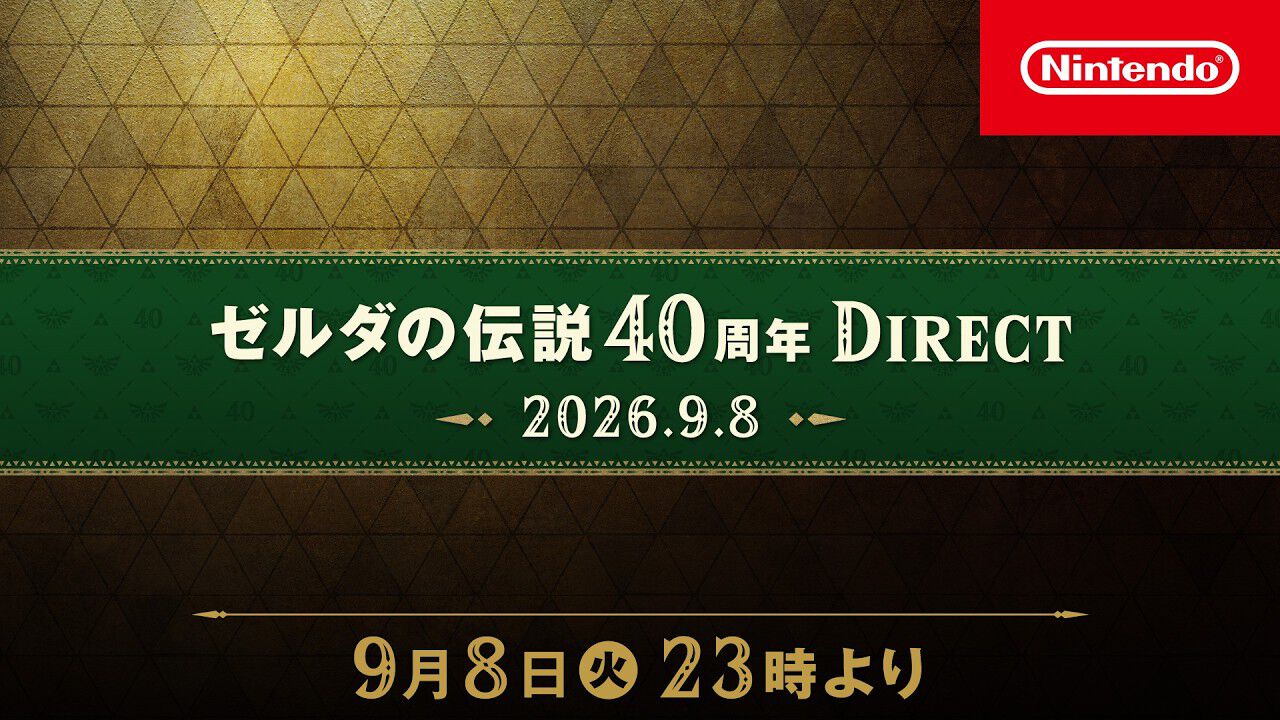
Nintendo announced its “Zelda 40th Anniversary Direct” for September 8, 2026 at 11 p.m. JST — a 30-minute feed streamed on YouTube and Nintendo Today!. On the surface, this is a franchise celebration. The math is straightforward: the original Legend of Zelda shipped for the Famicom Disk System on February 21, 1986. Twenty-six years later, Ocarina of Time would redefine 3D adventure gaming. Today, the IP spans video games, a live-action film hitting theaters on April 30, 2027, and theme park presence at Universal Studios Japan.
But reading between the lines of this announcement, a clearer picture emerges. Nintendo is using Zelda’s 40th anniversary not just to honor its past, but to anchor its future.
Why This Timing Matters
The Switch 2 launch is the elephant in the room. Famitsu’s article itself includes purchase links for the Switch 2 domestic version, and the timing of a major Zelda Direct just weeks before a likely holiday-season console push is no coincidence. Zelda has always been Nintendo’s flagship franchise — the series that defines what the hardware can do. Ocarina of Time on N64. Twilight Princess on Wii. Breath of the Wild on Switch. Each generation, Zelda announces the platform.
With the Switch 2 looming, Nintendo needs a tentpole. A refined Ocarina of Time remake demonstrates what the new hardware can handle — not just graphical upgrades, but a bridge between decades of player expectation and modern technical capability. It tells the story of the franchise while quietly selling the console.
There is also a demographic calculus at work. The core audience that bought Breath of the Wild in 2017 and Tears of the Kingdom in 2023 is now spanning late teens to early thirties — exactly the cohort that grows into families, into buyers of legacy titles for their own children, into players with purchasing power. An Ocarina of Time remake positioned as both a rediscovery and a rite of passage speaks directly to that migration.
The Remake Gamble
Nintendo has a mixed track record with HD remakes. The Ocarina of Time 3D release on 3DS was competent but unremarkable. The Wind Waker HD was widely praised. The Twilight Princess HD was serviceable. A full Ocarina of Time remake on a new console is a higher-stakes proposition — and a potential misstep if it fails to deliver something genuinely new beyond texture swaps and resolution bumps.
What makes this potentially different is context. The original Ocarina of Time is now nearly three decades old. A significant portion of today’s gaming audience has never experienced it in any form. A faithful but modernized remake could introduce the game to a generation that grew up on Breath of the Wild and Tears of the Kingdom without understanding where those designs came from. That educational angle — letting players trace the DNA of modern Zelda back to its source — is a value proposition none of the previous remakes had.
But the gamble cuts both ways. Ocarina of Time occupies a sacred position in gaming memory. Every frame, every transition, every ambient sound has been dissected, memed, and internalized by fans. A remake that alters even minor sequencing — a rearranged dungeon, a repositioned cutscene, a redesigned Z-targeting system — risks alienating the very core audience Nintendo needs to convert. Conversely, a remake that sticks too closely to the original without addressing its structural limitations (the lengthy dungeon progression, the dated combat pacing) may feel like an artifact rather than an experience.
The broader implication for Nintendo’s remake strategy is significant. If Ocarina of Time succeeds, expect Majora’s Mask, The Wind Waker, and potentially Twilight Princess all to follow on similar trajectories — not as incremental HD patches, but as ground-up recreations. The franchise’s back catalog becomes a multi-year pipeline rather than a single release cycle.
Beyond the Screen
The live-action film scheduled for April 2027 is the more surprising element. Hollywood has struggled with video game adaptations for years. Super Mario Bros.: The Movie succeeded as family entertainment but didn’t expand the brand’s cultural footprint meaningfully. A Zelda film that takes the source material seriously — or at least commits to a distinct tonal identity — could change how the franchise is perceived outside gaming circles.
This multi-platform approach signals something important: Nintendo is treating Zelda less as a game series and more as a transmedia property. The Direct, the remake, the film, the theme parks — each reinforces the others. A viewer who discovers Zelda through the film encounters a universe already rich with history. A player who plays the remake discovers a franchise with 40 years of content to explore.
The second-order effects extend into licensing and merchandise. Universal Studios Japan’s Epic Universe opening — now confirmed for 2025 — will almost certainly incorporate a Zelda land. This isn’t speculation; it follows the same blueprint that made Super Nintendo World one of the most successful theme park expansions in history. A dedicated Zelda area would generate annual revenue that far exceeds any single game release, while simultaneously reinforcing the brand’s presence in physical spaces where younger audiences encounter it for the first time.
Retail partnerships are another quiet beneficiary. The Zelda 40th anniversary has already spawned collector’s editions, art books, and soundtrack releases. A sustained multi-month campaign ensures that every major retailer — from GameStop to Amazon to regional chains in Europe and Asia — dedicates shelf space and promotional energy to the franchise during a period when console hardware is also competing for that same attention.
Who Wins, Who Loses
Nintendo wins if this strategy executes cleanly. The remake drives Switch 2 sales. The film expands the audience. The anniversary buzz sustains media coverage across multiple months. The franchise that has carried Nintendo through every hardware cycle continues to do so — now with a broader cultural reach than ever before.
Competitors benefit only tangentially. Sony’s Ghost of Tsushima and Horizon franchises occupy similar “prestige single-player adventure” space, but neither carries a 40-year legacy. Xbox lacks a comparable first-party IP with this kind of cultural penetration. The real risk for Nintendo isn’t competition — it’s stagnation.
There is also an internal risk worth noting. Nintendo has historically resisted the very transmedia expansion it is now pursuing. Miyamoto and his successors have maintained tight creative control over Zelda’s tone, design philosophy, and narrative. Adding film, theme parks, and merchandise introduces external stakeholders — studios, architects, licensees — whose priorities don’t always align with Nintendo’s. The Mario film’s success proved that third-party collaboration is possible, but it also required Hollywood-scale compromises. Replicating that for Zelda, which carries deeper emotional investment from its fanbase, is proportionally riskier.
The competitive threat that actually matters isn’t another studio’s adventure game — it’s audience fragmentation. The 40th anniversary campaign demands sustained attention across quarters, and every month spent on nostalgia is a month not spent marketing new intellectual property. If Metroid Prime 4, a new Pokemon title, or a surprise Animal Crossing spinoff land in the same window, the marketing overlap could dilute impact across all of them.
What Happens Next
The Direct itself is expected to run approximately 30 minutes and air on September 8, 2026. A follow-up Nintendo Direct is scheduled for September 9. Given the pattern, expect the remake’s release window, key gameplay features, and possibly new Zelda title announcements to dominate the broadcast.
The real test comes in 2027. If the film performs well and the remake sells strongly, Nintendo has proven that legacy IP can sustain a multi-platform strategy without cannibalizing new releases. If either underperforms, the question becomes whether 40 years of goodwill is enough to carry a franchise that needs fresh entries more than remastered ones.
Internally, Nintendo will be watching closely how player reception to the remake influences the design of future entries. If the Ocarina of Time remake introduces modern quality-of-life improvements — faster travel, streamlined inventory, accessibility options — those changes will likely bleed into the next numbered Zelda title. The remake becomes a testing ground for design philosophy as much as a revenue driver.
Externally, the industry will interpret this strategy as a signal. Other publishers with deep back catalogs — Activision with Diablo, Ubisoft with Assassin’s Creed, EA with The Sims — are watching whether Nintendo’s approach generates outsized returns relative to the investment. A successful model here accelerates industry-wide migration toward legacy IP as the primary growth engine, which carries implications for everything from studio acquisitions to hiring practices.
Nintendo has spent four decades building one of gaming’s most recognizable universes. This anniversary Direct isn’t just a party — it’s a reckoning about what that investment is worth in a market that increasingly demands constant innovation. The answer will shape not just Zelda’s future, but Nintendo’s.