North Korea's Hunchback Sub Marks New Phase in Underwater Deterrence
North Korea's first at-sea appearance of the Hero Kim Kun Ok submarine, paired with dual missile-launch tests, signals a meaningful step toward operational sea-based deterrence — and forces regional allies to recalibrate their anti-submarine defenses.
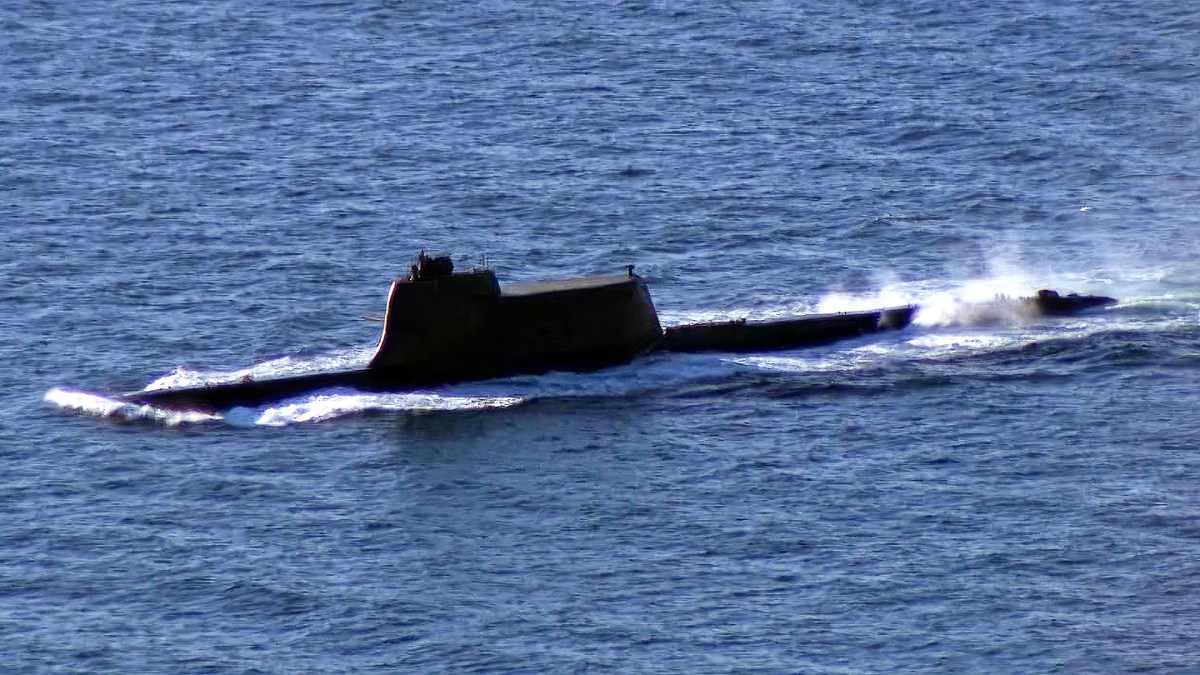
The Hunchback Emerges From the Fog
North Korea has finally shown its submarine doing what matters: sailing and firing. On October 14, state media confirmed that two types of submarine-launched strategic cruise missiles were test-fired off the country’s east coast, and released the first credible at-sea imagery of the vessel known as the Hero Kim Kun Ok. The photo is modest — a dark hull cutting through choppy water — but it carries a weight it would not have had a year ago.
For over a year after the submarine was unveiled with considerable fanfare in September 2023, questions about its status hung in the air. Was it actually seaworthy? Had it ever left the dock? Could it launch weapons while submerged, or was it merely a propaganda platform grafted onto a 1950s-era Romeo-class hull? The answers were missing. Now, Pyongyang is providing a more concrete picture, even if it controls every frame.
South Korea’s Joint Chiefs of Staff said it tracked the launches from pre-firing through terminal phases and confirmed that one missile came from a vertical launch system and another from a torpedo tube. That detail matters. It matches the design features visible in earlier imagery of the Hero Kim Kun Ok — ten launch tubes concealed in the boat’s distinctive raised “hunchback” structure aft of the sail — and it suggests North Korea is no longer just building the platform. It is testing the weapons system around it.
A Deterrent Taking Shape
The word “strategic” in North Korea’s description of these cruise missiles should be read with some skepticism. Pyongyang has applied that label freely to a range of weapons, and the actual range, accuracy, and warhead capability of these missiles remain unverified by open sources. But the broader trajectory is clear enough: North Korea is integrating submarine-launched cruise missiles and ballistics missiles into a coherent deterrent architecture that now includes land-based, sea-based, and increasingly hypersonic delivery options.
This is not a sudden leap. North Korea tested a submarine-launched cruise missile from the older 8.24 Yongung class in March 2023 and fired Pulhwasal-3-31 strategic cruise missiles from the same vessel in January 2024. The Yongung is a smaller, 2,000-ton boat with only one or two vertical launch tubes. The Hero Kim Kun Ok, at roughly 3,000 tons with ten concealed tubes, represents a step up in capacity — not a revolution, but a meaningful increment.
The more important question is what comes next. Analyst Shin Jong-woo of South Korea’s Defense and Security Forum suggested to Reuters that North Korea may now test a submarine-launched ballistic missile from the Hero Kim Kun Ok before it enters full service. That would be a significant milestone. North Korea has been developing SLBMs — including the Pukguksong-5 — for years, but lacked a suitable launch platform until now. A working SLBM on a seaworthy submarine is the closest thing to a credible second-strike capability that Pyongyang can field, and it is precisely the kind of system that complicates adversary defensive planning most sharply.
Why the Platform Matters as Much as the Missile
The technical reality of the Hero Kim Kun Ok is that it is a modified Cold War design, not a purpose-built attack submarine. Its diesel-electric propulsion limits its underwater endurance and acoustic signature compared to a nuclear-powered boat. In the waters around the Korean Peninsula, where South Korea operates one of the more sophisticated anti-submarine warfare networks in the region, an older Romeo-derived hull would be relatively easier to detect than a modern SSN.
But “easier” is not the same as “easy.” A submarine that can launch cruise missiles and potentially ballistic missiles from a submerged position introduces a new dimension of uncertainty. It does not need to surface. It does not need to operate from fixed coastal batteries. It can loiter in deeper water, move to less predictable firing positions, and force South Korea, Japan, and the United States to expand the area they need to surveil and defend.
That is the real shift. The Hero Kim Kun Ok is unlikely to be stealthy by contemporary standards. But it is large enough, armed enough, and mobile enough to raise the cost of any conflict calculation. Even a partially effective submarine force forces adversaries to plan for a wider set of scenarios.
The Diplomatic Signal
The tests also arrive against a backdrop of stalled diplomacy. North Korea has rejected an apparent opening from U.S. President Donald Trump, who sought to reduce tensions surrounding a joint U.S.-South Korean military exercise. Pyongyang continues to insist it will not abandon its nuclear weapons so long as Washington maintains what it calls a hostile policy, and it has dismissed suggestions that adjustments to allied exercises alone could change the relationship.
The submarine tests fit a pattern. North Korea has conducted a series of weapons demonstrations over the past months — reported hypersonic missile tests in September and early October, tactical ballistic missile launches, and now this. Each one serves a dual purpose: technical validation and political signaling. The message to Seoul, Tokyo, and Washington is straightforward. The arsenal grows regardless of whether diplomacy progresses.
What Comes Next
If the Hero Kim Kun Ok is indeed entering weapons validation ahead of deployment, as the South Korean assessment suggests, then the most likely near-term milestone is an SLBM test. That would close a critical gap in North Korea’s deterrent architecture and mark the first time a ballistic missile has been launched from a submarine operated by the regime.
There is also the longer-term question of nuclear propulsion. North Korea unveiled a nuclear-powered submarine project in March 2025, and while its timeline remains deeply uncertain, the pursuit itself signals that Pyongyang views sustained underwater operations as strategically essential. Any future boat of that class would be substantially harder to detect and track than the Hero Kim Kun Ok, and Russian technical assistance — reportedly part of a broader defense cooperation arrangement tied to North Korean support in Ukraine — could accelerate that development.
For now, the immediate takeaway is simpler. The hunchback submarine is no longer just a design on paper or a static display at a shipyard. It is at sea. It is firing missiles. And it is forcing regional defenders to account for a capability that did not exist in this form twelve months ago.