North Korea's Hypersonic Claim Exposes a Tracking Gap
Pyongyang claims its new hypersonic missile flew 908 km — roughly 300 km farther than Seoul and Tokyo detected. Whether the numbers are real or propaganda, the story reveals a widening vulnerability in regional missile defense.
The Numbers on the Screen
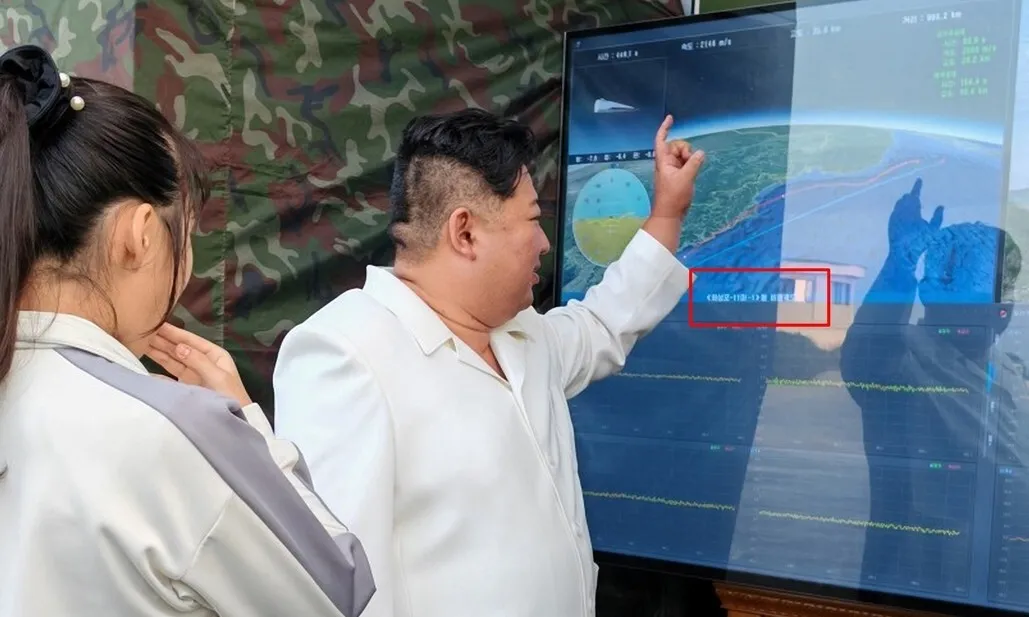
On September 20, Kim Jong-un and his daughter Ju-ae sat in front of monitors showing the flight path of North Korea’s so-called Hwasongpo-11ma-1. The readout was specific: 446.1 seconds in the air, traveling at 2,146 meters per second — roughly Mach 6.3 — at an altitude of 35.8 kilometers, covering a distance of 908.2 kilometers. The figures were displayed in clean white numerals against a dark background, the kind of precision staging that North Korean state media has perfected over decades.
Seoul and Tokyo, respectively, put the range at 450 km and 600 km. Japan’s figure came in at 590 km. North Korea’s own claim — as displayed live on state monitors — is roughly 300 km beyond what allied tracking systems recorded.
That gap is the story. Whether it reflects a real capability breakthrough or a sophisticated propaganda exercise, it points to a widening vulnerability in the way South Korea, Japan, and the United States track and interpret North Korean missile tests. The discrepancy is large enough to be consequential regardless of which side is stretching the truth, because it exposes a structural weakness in the architecture that underpins regional security.
How Hypersonics Change the Tracking Game
The physics matter here. A traditional ballistic missile follows a predictable arc — it goes up, coasts through space, and comes down in a steep trajectory that radar systems are designed to catch. Once launched, its flight path can be modeled with reasonable accuracy within minutes. Surveillance systems like the US Pave Maze antenna or Japan’s J/AQ-1 radar lock onto the launch signature, track the exhaust plume, and predict the impact zone with enough lead time to trigger warnings and potentially intercept.
A hypersonic glide vehicle operates on an entirely different principle. It ascends on a ballistic trajectory like any other missile, but then separates from its booster at altitude and begins a powered or unpowered glide phase at speeds exceeding Mach 5. During this descent, it maneuvers laterally and vertically, hugging terrain features to stay below the radar horizon. It can change direction mid-flight, pull up sharply to extend its range, or dive steeply to compress it. This variability makes it extraordinarily difficult for existing surveillance architectures to maintain a consistent track.
Hong Min, a senior researcher at the Unin Research Institute, put it bluntly: if North Korea’s claims are accurate, its missile flew at least 300 km farther than South Korean and Japanese trackers could detect, using endgame maneuvers that went completely unnoticed. In effect, the missile reached objectives that would have been considered safe from detection under the old paradigm.
That is a qualitatively different problem from simply building a longer-range missile. A longer ballistic missile is still a known quantity once it clears the atmosphere. A hypersonic glide vehicle introduces uncertainty into the terminal phase — the part of the flight that determines whether a warhead actually reaches its target and where. It means the most critical segment of the trajectory may be unfolding in a blind spot, invisible to the sensors that allied forces rely on for early warning and defensive response.
The Propaganda Question
North Korea has every incentive to exaggerate. The regime has built a long tradition of inflating military achievements for domestic consumption and to unsettle adversaries. The Joint Chiefs of Staff acknowledged this directly. Hong Doo-young, a spokesperson for the organization, warned that Pyongyang’s claims “cannot be trusted at face value” and noted that the regime is “skilled in exactly this kind of strategy and tactics.”
But even if the 908 km figure is inflated, the underlying capability — a missile that can glide and maneuver at hypersonic speeds below radar coverage — may still be real. The monitor data, while not independently verified, contains internal consistency: the speed, altitude, and duration figures align with what a hypersonic glide vehicle profile would look like. A Mach 6.3 glide at 35.8 kilometers altitude over a 446-second window produces a trajectory that is physically plausible, even if the total range is overstated.
The deeper issue is that Pyongyang does not need the exact number to be correct for the weapon to be threatening. What matters is that the technology works — that the glide vehicle can maneuver below radar coverage and reach targets that were previously considered shielded by early warning. Whether the range is 600 km or 900 km, the strategic effect is similar: allies lose confidence that their defenses can track and respond to the terminal phase of an incoming strike.
The Deterrence Implications
Extended deterrence rests on a simple promise: the United States will defend its allies, and it can see what is coming. That promise has two components — the willingness to act and the ability to detect. If North Korea can field a weapon that evades detection during its terminal phase, both components erode. The willingness may remain, but the ability to assure allies that their defenses will work becomes harder to maintain.
Missile defense systems like the Japanese Aegis Ashore sites and South Korea’s THAAD battery are designed around predictable ballistic trajectories. They track objects in space, calculate impact points, and engage warheads during their reentry phase. They are not built to track low-altitude, maneuvering glide vehicles that skip along the edge of the atmosphere and change course unpredictably. This mismatch was understood before this test, but it is now publicly demonstrated by a adversary that has been testing these systems for years.
This is not abstract. A hypersonic weapon that can glide 300 km beyond the point of detection gives Pyongyang a real strike option against high-value targets in South Korea and Japan — airbases hosting US forces, command and control centers, naval ports, missile defense batteries themselves. Targets that previously might have been considered protected by early warning are now potentially reachable with minimal warning time. The compression of decision time for Seoul and Tokyo to near-zero means that political and military leaders may have only minutes — sometimes seconds — to assess an attack and authorize a response.
For Washington, the calculus is equally uncomfortable. Extended deterrence credibility depends on the perception that US commitment is credible and enforceable. Deterrence is not just about capabilities; it is about the psychology of belief. If allies believe American missile defenses cannot track the newest North Korean weapons, the entire architecture of US-Japan-ROK security cooperation faces pressure. Trust erodes. Questions arise about whether US intelligence is falling behind, whether defensive investments are adequate, and whether the extended deterrence umbrella is losing its protective quality.
The second-order effects extend beyond the immediate military domain. Arms racing dynamics are likely to intensify. Japan may accelerate plans to acquire long-range strike capabilities, which China and North Korea will interpret as offensive threats rather than defensive measures. South Korea may push for greater access to US nuclear planning and potentially reconsider its own nuclear options, a development that would complicate nonproliferation efforts across the region. The risk of miscalculation rises when multiple states are operating with incomplete information about each other’s capabilities and intentions.
What Comes Next
Three things are likely to follow.
First, South Korea and Japan will accelerate efforts to close the tracking gap. Both countries already have plans to upgrade their early-warning sensor networks. South Korea has been developing its own Kill Chain system and a three-axis capability — detection, interception, and retaliation — that includes indigenous missile technology. Japan is investing in upgraded radar systems and exploring cooperation with US space-based infrared sensors. This test will add urgency and likely funding to those programs, pushing timelines forward and possibly unlocking budget provisions that were previously stalled in bureaucratic processes.
Second, the US will face renewed pressure to deploy more resilient defense systems — possibly including next-generation space-based infrared sensors, improved terminal-phase interceptors, and distributed tracking architectures that do not rely on a single sensor node. The current portfolio was designed for a different threat environment, one dominated by ballistic missiles with predictable trajectories. Adapting it to hypersonic threats requires not just new hardware but new doctrines for data fusion, attribution, and response coordination among allies.
Third, Kim Jong-un’s decision to include his daughter Ju-ae in the observation is notable. She is being visibly integrated into the succession narrative, appearing alongside her father at increasingly prominent military events. Pairing her with a military achievement — however inflated — reinforces the image of a dynasty that delivers on security promises and passes capability forward to the next generation. For domestic audiences, this imagery is potent. It ties personal loyalty to national strength and suggests that the regime’s military accomplishments are not accidental but inherited and sustained.
The real takeaway from this test is not the exact range number. It is that North Korea is publicly demonstrating a capability that, even at its most conservative interpretation, moves it closer to a strike option that allied defenses struggle to track. Whether the 908 km figure holds up to independent verification or not, the blind spot it reveals is already there — and it is likely to grow larger as North Korea continues to refine its hypersonic technology. The question for Seoul, Tokyo, and Washington is no longer whether this gap exists, but how quickly they can close it before the gap becomes a chasm.