North Korea's Hypersonic Test Exposes Allied Detection Gaps
Pyongyang's latest hypersonic missile test reveals a 400km range discrepancy that cuts straight through South Korea-Japan missile defense assumptions. What the numbers actually show about extended deterrence and defense spending priorities.
The Numbers North Korea Doesn’t Want You to Miss
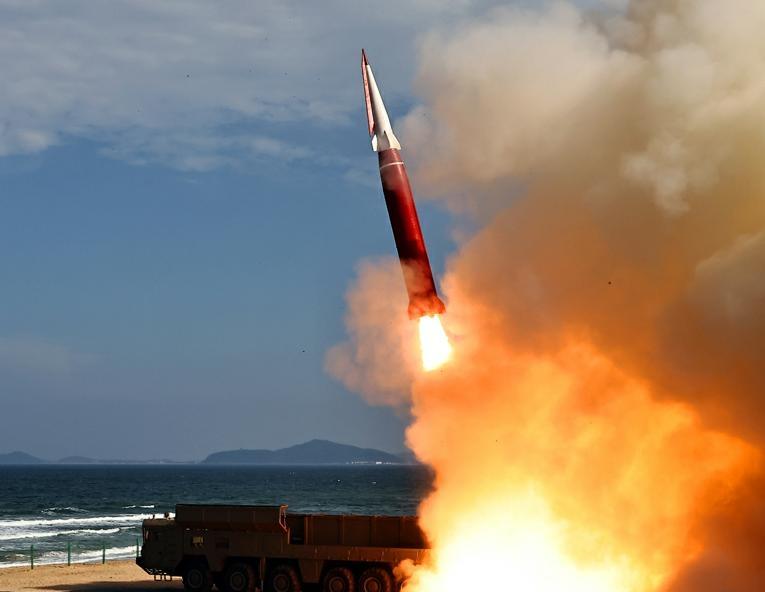
Two days after firing a short-range ballistic missile, North Korea released photographs on September 22 showing Kim Jong-un and his daughter Jong-suk watching a screen that read “Hwasong-Pho-11ma Flight Trajectory.” The regime called it a successful test of a new combat weapon system — the third public demonstration of this type of short-range hypersonic missile, following tests in October 2024 and January 2025.
But the details embedded in those photographs and the accompanying data release matter more than the propaganda framing. Pyongyang reported the missile traveled 908.2 kilometers during its glide phase alone, 446 seconds after launch. Shin Jong-woo, secretary-general of the Korea Defense and Security Forum, calculated the total range at approximately 1,000 kilometers once the remaining glide segment was factored in.
That estimate sits 400 kilometers beyond what South Korea and Japan publicly projected. The discrepancy is not a minor disagreement. It is a structural blind spot in how the two capitals — and Washington by extension — assess the threat horizon over the Korean Peninsula.
The Detection Gap Between Seoul and Pyongyang
South Korea and Japan announced a minimum range estimate of 600 kilometers for the Hwasong-11ma. North Korea’s own flight data, independently corroborated by Shin’s calculation, points to something closer to 1,000 kilometers. The difference exposes what analysts at the Korea Defense and Security Forum describe as a detection blind spot in the South Korean and Japanese surveillance architecture.
Hypersonic glide vehicles behave differently from ballistic missiles. They fly at lower altitudes and execute maneuvering trajectories that complicate radar tracking. A missile that dips below the horizon of conventional early-warning systems and then surges upward at the end of its glide phase can evade detection long enough to alter the calculus of any interceptor. That is precisely why the Hwasong-11ma — essentially a KN-23 launcher fitted with a hypersonic glide vehicle warhead — was developed: to defeat the integrated South Korean-American missile defense network.
The 400-kilometer gap means targets South Korean and Japanese planners assumed were outside effective range may in fact be in it. That includes deeper portions of South Korea’s military infrastructure and, critically, areas of Japan that fall outside the current reach of known North Korean ballistic missiles but within the glide phase of this system.
What This Means for Seoul’s Defense Budget
South Korea’s defense spending has already been on an upward trajectory, driven in part by North Korea’s accelerated missile and nuclear programs. But this test introduces a specific pressure point: the mismatch between the missile systems Seoul is purchasing or developing and the threat envelope that North Korea has now demonstrated.
The THAAD battery deployments and extended-range strike capabilities being negotiated with Washington were designed around threat assessments calibrated to ballistic missile profiles. Hypersonic glide vehicles operate in a different physical regime. Intercepting them requires sensors and interceptors that can track low-altitude, maneuvering targets in the terminal phase — capabilities that are still in development globally and not yet fielded in numbers sufficient to cover the Korean Peninsula.
Seoul faces a difficult calculus. It can accelerate procurement of next-generation defense systems whose specifications must account for hypersonic threats that may not even have fully matured prototypes in other militaries. Or it can continue investing in systems optimized for the threat profile of the past decade, accepting the risk that Pyongyang’s testing schedule will keep outpacing those assumptions.
There is also the political dimension. Defense industry stakeholders in South Korea will point to this test as validation for expanded budgets. Skeptics will ask whether the money is going toward systems that can actually address the gap. The range discrepancy itself becomes ammunition in that debate.
The Extended Deterrence Question
Washington’s commitment to extended deterrence rests on credibility. If allies perceive that US missile defense architecture cannot cover the actual range of North Korean threats, the psychological dimension of deterrence weakens regardless of what treaties or joint statements say.
The Hwasong-11ma test directly challenges that architecture. A 1,000-kilometer-range hypersonic glide vehicle can reach targets across the entire Korean Peninsula and into Japanese territory while flying trajectories that existing interceptors are not designed to engage. This is not theoretical. North Korea has now demonstrated this capability three times in public, each time with more data released than the last.
The Biden administration has pushed hypersonic defense as a priority, and the Pentagon has allocated funding for related research. But research and deployment are separated by years. North Korea, operating under sanctions with fewer resources, has managed to field a system that exploits the window between when the threat becomes visible and when the countermeasure becomes available.
For South Korea and Japan, the implication is stark: they cannot rely on US missile defense as a complete solution. Diversification of their own defensive postures becomes not optional but necessary. That includes investing in counter-hypersonic capabilities, layered detection systems, and potentially offensive strike options that complicate Pyongyang’s launch calculations.
Who Wins, Who Loses
Kim Jong-un wins politically. The test reinforces his image as a leader delivering on military modernization. His description of the weapon as an “incurable headache” for enemies was not casual phrasing — it signals that the regime considers this capability a core element of its strategic posture going forward.
Pyongyang wins strategically. Each test extracts more information from its adversaries. The fact that South Korea and Japan publicly underestimated the range by 400 kilometers suggests Pyongyang’s testing methodology is providing it with intelligence about allied detection capabilities. That is a form of combat information gain that extends well beyond the missile’s physical reach.
Seoul and Tokyo lose credibility. Their public range estimates proved inaccurate. Repeated inaccuracies erode confidence in the intelligence foundations upon which defense planning rests. Allies need to know their governments see threats clearly. When they do not, the alliance itself looks brittle.
Washington faces a dilemma it has not fully acknowledged publicly. Its missile defense systems were designed for a different class of threat. The hypersonic era has arrived in East Asia, and the institutional response has been slower than the technology. That slowdown is exactly what North Korea has counted on.
What Happens Next
North Korea has now demonstrated this capability three times in fourteen months. The testing cadence suggests it is moving toward operational deployment rather than further experimentation. Expect additional tests with even longer ranges or improved warhead designs in the coming months.
South Korea will face internal pressure to respond. Defense budget debates that might have centered on quantity or regional balance will now have to incorporate a specific capability gap. The question will not be whether to spend more but whether current procurement pipelines address the hypersonic threat adequately.
Japan, already expanding its own strike capabilities, will likely argue that the range discrepancy validates its push for longer-range missiles and deeper integration with South Korean intelligence. The trilateral framework with the United States gains urgency when detection blind spots are exposed.
The United States will be asked to accelerate its own hypersonic defense efforts and to clarify whether its current interceptors can engage targets flying the trajectory profile demonstrated by the Hwasong-11ma. Ambiguity in that answer will feed the same credibility erosion affecting Seoul and Tokyo.
Kim Jong-un’s “incurable headache” was meant to sound menacing. The data behind it is what actually matters. And the data says the headache is shared — by the defenders as much as by anyone else.