North Korea Is Preparing to Send More Troops to Russia. Just Not Yet.
South Korea's defense ministry admits North Korea is actively preparing for more troop deployments to Russia while denying any immediate move. The gap between 'preparing' and 'about to deploy' is where the real signal lives.
The Fine Print of a Warning
South Korea’s Defense Ministry issued a statement on April 23 that, at first glance, sounded like a reassurance: no signs of imminent North Korean troop deployment to Russia. Then you read the sentence before it.
Preparations continue, the ministry said. The preparations themselves are ongoing.
That distinction — between preparing and deploying — is everything. It is also the exact gap where strategic ambiguity lives, and where every capital in the region is currently negotiating with itself.
Ukrainian President Volodymyr Zelenskyy made the alarm last month, claiming North Korea was preparing to send an additional 30,000 troops to Russia. The number has circulated widely in Western media and policy circles. North Korea’s own government, through Kim Yo-jong, dismissed it on April 19 as a complete fabrication from Kyiv. The Pentagon has not confirmed the 30,000 figure.
Seoul’s formulation is more measured but arguably more useful. It confirms what open-source analysts have long suspected: North Korea is not sitting idle. It is actively preparing. It just has not pulled the trigger yet.
What We Actually Know
The Defence Intelligence Command — the ministry’s own intelligence arm — provided several data points that deserve more attention than they have received.
First, a significant number of the North Korean troops already in Russia are estimated to have suffered casualties. Second, deployment allowances appear to be going out to those soldiers. Third, North Korea has supplied Russia with more than 15 million artillery shells, when converted to a standard 152mm equivalent.
The casualty estimate is the most quietly significant detail. It means the current deployment is not a textbook exercise or a symbolic gesture. Korean troops are being killed in combat on Russian command. That changes the political calculus for Pyongyang in ways that go beyond the Russia-Ukraine conflict.
The ministry also confirmed, for the first time through military sources, that North Korea’s Hwasong-2 series tactical ballistic missiles and 600mm multiple rocket launchers — systems assessed as designed for strikes against South Korea — are mostly in the development-completion stage. The Hwasong-12 intermediate-range missile, capable of reaching Guam, is moving toward operational deployment after development. The Hwasong-16 hypersonic missile series is still being developed, with stable hypersonic glide technology assessed as insufficient so far.
North Korean ICBMs can reach the US mainland based on flight capability, but every test has been a high-angle launch — a trajectory choice that deliberately avoids validating reentry technology. The nuclear-powered attack submarine, the Kim Kuryong class, has not yet reached operational status, and the large submarine North Korea has publicly claimed as nuclear-powered will likely take considerable time to become deployable.
The Information War Has Two Fronts
The 30,000-troop claim and its afterlife reveal how information operations now run parallel to military operations in this conflict.
Kyiv has a clear incentive to maximize the North Korea-Russia link. Every confirmed North Korean soldier in Ukraine reinforces the argument that this is not a regional war but a coalition against the liberal international order. It strengthens the case for continued Western military aid and isolates Pyongyang diplomatically. The exact number matters less than the narrative frame: North Korea is fighting Russians on Russian orders against Ukraine.
Moscow has an equally clear incentive to keep the numbers vague. Confirming 30,000 troops would make the deployment a political liability for Putin domestically and internationally. Denying it outright gives Kyiv ammunition. Letting Seoul issue a careful, qualified assessment — preparations ongoing, no imminent sign — serves Russia best. It acknowledges reality without quantifying it.
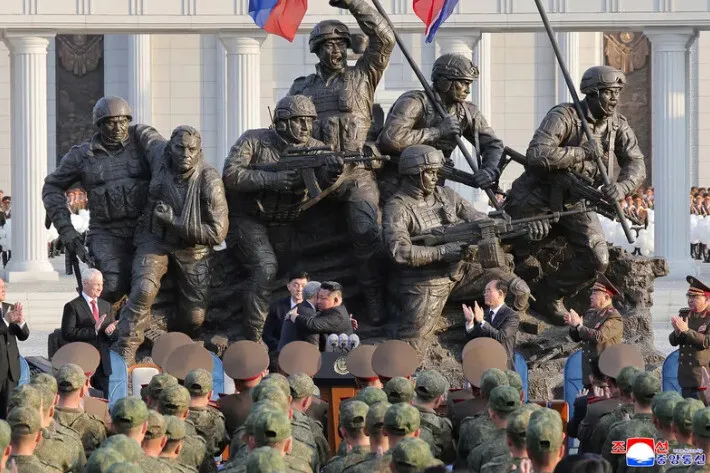
Pyongyang’s position is the most constrained. Kim Yo-jong called the deployment claims a Kiev fabrication. But Kim Jong-un himself appeared at a monument opening in Pyongyang on April 26 commemorating the first anniversary of Russia’s Kursk operation — a ceremony that functionally honors the very troops the West says are fighting in Ukraine. The contradiction is intentional. Deny the numbers publicly. Celebrate the soldiers privately.
Who Wins and Who Loses
The immediate winner from Seoul’s calibrated statement is South Korea itself. By refusing to simply echo either Kyiv’s alarm or Moscow’s denial, the defense ministry maintains credibility with both Washington and Seoul’s own public. The statement says: we are watching, we see preparation, we are not fooled by the denials, and we are not inflating the threat beyond what the evidence shows.
That matters because the next move from Pyongyang is harder to predict precisely when the preparatory phase is ongoing but the deployment decision is not visible. South Korea’s own intelligence gap — not whether North Korea is preparing, but when and how many — is the real vulnerability right now.
Ukraine loses if the 30,000 figure proves inflated. Every exaggerated claim erodes trust in future warnings. But Ukraine also gains ground even if the number settles closer to the 8,500 that some Western assessments have floated: North Korean troops in Russia is strategically significant regardless of the exact headcount.
Russia wins from the ambiguity. Whether the number is 8,500 or 30,000, North Korean troops on Ukrainian soil changes the character of the war. The precise count is secondary to the fact of the deployment itself.
What Happens Next
The most useful framework is not to ask whether North Korea will send more troops but to map the preparation-to-deployment pipeline. South Korean intelligence notes that a deployment of this scale would require moving troops and equipment by transport ship from North Korean ports — activity that would be detectable by South Korean and American intelligence before it happened.
The fact that no such signs have been spotted yet does not mean preparation has stalled. It means the preparatory phase — training, equipment staging, logistical planning — is proceeding at a distance from the deployment signal. That phase can continue for months without triggering the specific indicators that warn of imminent movement.
What is harder to mask is the technology transfer dimension. The defence ministry assessed that North Korean short-range ballistic missiles have accumulated实战 data in Ukraine and are receiving Russian advisory and parts support, improving their accuracy. This is a two-way street: North Korean fighters gain combat experience, and North Korea gains real-world performance data on its weapons systems that no test range can replicate.
The Hwasong-2 and 600mm rocket systems nearing completion, aimed at South Korea, suggest Pyongyang is investing in capabilities that could be deployed on multiple fronts simultaneously. That is a strategic posture, not a temporary arrangement.
The gap between preparing and deploying is where the next crisis will be detected — or missed. Seoul’s latest assessment draws that line carefully. The question is whether anyone across the Pacific and the Yellow Sea is paying close enough attention to the side of the line that has not yet been crossed.