Nvidia's Next Winner Might Not Be Nvidia Itself
Nvidia is set to report another record quarter, but history shows its stock rarely rises on earnings. The real opportunity may lie in Korean and regional ecosystem partners — especially LG and Doosan groups riding the AI infrastructure wave.
The earnings that don’t move the market
Nvidia is preparing to report fiscal second-quarter results on August 27, and every projection points to yet another all-time high: $91.9 billion in revenue and $2.08 in earnings per share, according to LS Securities. That is the kind of number that, in any other company, would send shares soaring. For Nvidia, it is simply the latest rung on a staircase the market has been climbing for two years.
This time, it probably won’t move the stock much. And that is the pattern worth understanding before placing any bet.
Hwang San-hae, a researcher at LS Securities, laid out the data plainly. Over the past eight quarters, Nvidia posted strong results every single time. In seven of those quarters, the stock did not rise after the earnings release. Sometimes it fell. The market had already priced in the expectations, and there was limited room for margin expansion to surprise anyone further. When revenue growth decelerates from 120 percent to 88 percent, that still looks like a beat — but it reads as a slowdown to traders who were pricing in uninterrupted acceleration.
This is not a story about Nvidia weakening. It is a story about where capital flows when Nvidia’s free cash flow and profits accelerate. The money does not stay concentrated at the top of the stack. It migrates outward, into the physical world of data centers, power grids, and automated factories.
The spillover is real
The logic Hwang traces is straightforward and easy to miss from outside Korea. When Big Tech expands capital expenditure, the immediate beneficiaries are usually the chip designers and memory makers — the obvious names on every portfolio checklist. But when Nvidia’s own cash generation strengthens, the benefit begins to spread outward. The money has to go somewhere: into cooling systems, power distribution, robotics, construction, and software. Each dollar of Nvidia profit eventually becomes a line item on someone else’s income statement.
Those are not speculative claims. They are already visible in how Korean stocks have reacted to Nvidia earnings dates this year. LS Securities tracked the top post-earnings movers and found the beneficiaries had diversified well beyond the standard semiconductor equipment list. LG Electronics, Hanmi Semiconductor, Hyundai Mobis, Hyundai Engineering, Daewoo Engineering, LS ELECTRIC, and Samsung SDS all registered notable moves following recent Nvidia reports. The breadth of that list tells you something: the trade has already shifted, even if global fund managers have not caught up.
The shift matters because most global portfolios still treat Korean exposure to Nvidia as a narrow chip-play. Samsung Electronics and SK Hynix dominate the narrative. But the actual revenue streams from the current AI buildout are now distributed across a much wider set of companies — many of them less visible to outside investors who have not been tracking the Korean market closely.
LG is the story this cycle
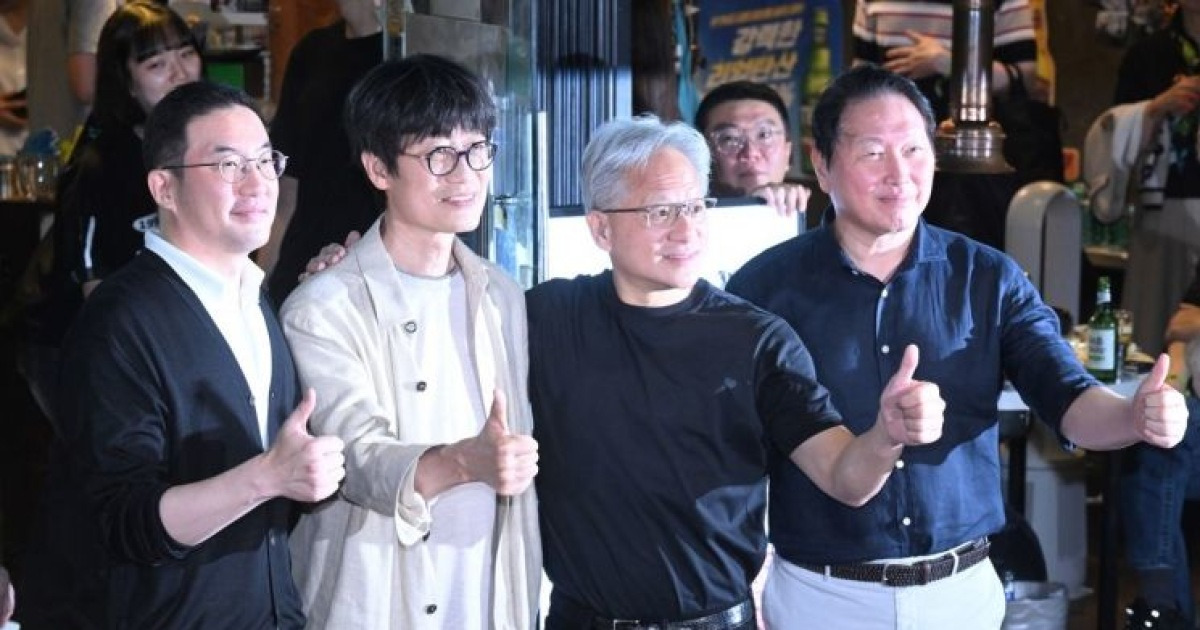
Among the Korean names, LG Group has drawn the most attention recently, and not just because Jensen Huang was photographed last June sharing a Korean barbecue meal with LG chairman Koo Kwang-mo. The image circulated widely and was read as a signal. The partnership narrative is real, and the revenue streams behind it are wider than most observers realize.
LG Electronics is not selling GPUs. It is building the cooling systems — its CDU (coolant distribution unit) technology for data centers — that keep those GPUs from overheating. As Nvidia ships more chips per rack, power density climbs, and liquid cooling shifts from an optional upgrade to a necessity. That is engineering, not speculation. LG’s CDUs are already deployed in multiple hyperscaler facilities, and the company has publicly stated that its data center cooling business is seeing order growth that outpaces its broader appliance segment.
Beyond cooling, LG’s reach extends through CNS’s data center operations, LG Innotek’s robotics and precision component businesses, and across the group into power, energy storage, and networking infrastructure. The combination is unusual: a single conglomerate touching nearly every physical layer of an AI data center — from the chip-level thermal management to the building-level power and cooling infrastructure. That layer-spanning position is what makes LG the most direct play on Nvidia’s ecosystem among Korean industrials.
The second-order effect is worth noting. As data centers consume more power, LG Energy Solution’s battery and energy storage business becomes relevant too. AI-driven load growth is pushing utilities toward on-site storage solutions, and LG is positioned to supply both the generation-side and the demand-side infrastructure.
Doosan plays a different hand
Doosan Group is taking a different path. Its exposure is less about direct Nvidia partnerships and more about the infrastructure that enables AI at scale.
Doosan Enerbility is a player in nuclear power and gas turbines — the kind of power generation that data centers require as they consume megawatts of electricity. The company has been vocal about the role small modular reactors could play in powering future AI campuses, and its gas turbine business is already seeing renewed interest from utility planners who are revising their capacity forecasts upward. Doosan Robotics is entering the industrial automation space, supplying collaborative robots that are becoming essential in data center construction and maintenance. Doosan’s semiconductor equipment business adds another dimension.
The thesis here is simpler and more structural: AI cannot run without electricity, and electricity infrastructure is one of the bottleneck constraints facing the entire industry. Doosan sits on the supply side of that constraint. While Nvidia designs the chips that drive compute, someone has to generate and distribute the power those chips consume. Doosan Enerbility is increasingly part of that answer.
The timing problem
The complication for investors is timing. Nvidia’s earnings come August 27. Korean markets will have already absorbed whatever narrative makes sense in the days leading up to the report. The question Hwang raises is whether the post-earnings reaction will favor Nvidia itself or its partners — and that depends on whether the broader environment improves.
Persistent pressure on long-term U.S. interest rates, retail sales shocks, and Middle East uncertainty are all weighing on markets. If those factors deteriorate, even a record Nvidia report could be read as a sign of AI-cycle costs and potential bubble dynamics rather than sustained opportunity. A strong earnings print in a risk-off environment can paradoxically trigger selling, as traders interpret outsize capex as a warning sign that the ROI timeline is stretching.
If they stabilize, the spillover thesis gains traction. And the window for positioning before the market fully prices in the breadth of Korean exposure is narrowing. LS Securities’ own tracking suggests that several of the names on its post-earnings mover list have already re-rated significantly over the past six months. The question is whether there is still room to run.
What global investors should watch
The key insight from the Korean market is that Nvidia’s ecosystem has quietly broadened. The old checklist — TSMC, Samsung Electronics, SK Hynix — still matters, but it is no longer the full picture. Cooling, power, robotics, and construction are now part of the Nvidia trade in Korea. That diversification is not happening everywhere equally. It is most visible in markets where conglomerate structures allow a single corporate group to capture value across multiple layers of the infrastructure stack.
For global investors, the practical move is not to bet on Nvidia’s stock price reacting to earnings — history says not to — but to identify which ecosystem partners have the most direct revenue link to Nvidia’s current product cycle and the most visibility into the next. LG Electronics’ cooling business and Doosan Enerbility’s power generation exposure both fit that description. Neither will move on Nvidia earnings alone. But together, they represent a more complete picture of who actually benefits when the AI infrastructure buildout continues — and a picture that is still underowned by most international portfolios.