Nvidia, Samsung, and SK Are Rewiring the Chip Deal — and It Changes Everything
Jensen Huang's Bancroft Klippstein Award in New York was a backdrop for something larger: a three-way alliance between Nvidia, Samsung, and SK that fuses GPU co-design with foldable hardware and Korean memory dominance. The margins of the next hardware cycle are being renegotiated.
The Banquet Was the Cover Story. The Deal Was the Point.
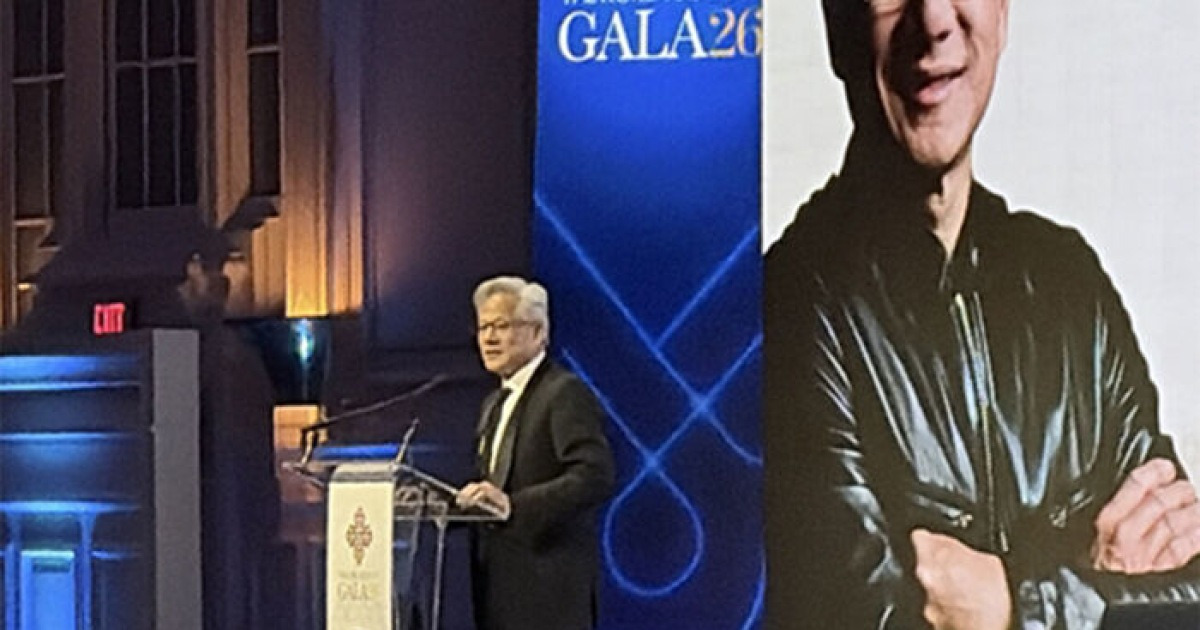
Jensen Huang accepted the Bancroft Klippstein Award from the Korea Society at a Manhattan gala on September 28. Lee Jae-yong of Samsung and Choi Tae-won of SK Group stood beside him. Their jokes landed — about shared daughters named Madison, about both their fathers having won the same award decades earlier, about a love for the Galaxy Z Fold 8 that drew laughter from the crowd. The New York Times Square screens flashed congratulations. It looked like diplomacy dressed as friendship.
It was. But the friendship has a price list, and the price list is reshaping the global semiconductor value chain in real time.
Three Companies, One Stack
What the banquet publicly celebrated was a private architectural decision: Nvidia, Samsung, and SK are now co-designing hardware at the system level, not just buying and selling components. This is the critical distinction.
For years, the Korea-US chip relationship was straightforward. Samsung and SK Hynix made memory — DRAM and NAND — and sold it to everyone who needed it, including Nvidia. The dynamic was supplier-buyer. Margins were cyclical. Korean companies were indispensable but interchangeable.
The new arrangement changes the calculus. Nvidia provides the GPU architecture and the software stack — the brain. Samsung contributes its foundry capabilities and its dominant position in the foldable-phone market. SK contributes high-bandwidth memory and the capacity to scale production fast. Together, they are building what Choi called an “AI factory” in Korea: a vertically integrated loop where the chip, the memory, the packaging, and the end-device are designed in concert rather than in sequence.
This matters because vertical integration at the system level is where the margin pool of the next hardware cycle is concentrating. Memory alone is a commodity with brutal cycles. GPU design is a monopoly with fat margins. But the space between — co-design, co-packaging, device-level optimization — is newly valuable, and whoever owns it captures more of the total hardware dollar.
The Foldable Phone Is Not a Side Dish
Lee’s aside about the Galaxy Z Fold 8 was the most revealing sentence of the evening. Foldable phones are not just a consumer-product category; they are a proving ground for GPU-memory integration at the device level. A foldable phone needs to run AI inference locally, manage thermal constraints in a thin form factor, and do it all without draining the battery in two hours. That requires co-design between the SoC, the GPU, the memory stack, and the display architecture.
Nvidia has been moving aggressively into the device-edge AI space. Samsung controls the hardware platform where that AI will live. SK controls the memory that makes it fast. If this alliance delivers a competitive foldable-phone reference design built around Nvidia GPUs, it becomes a template — for other phone makers, for other form factors, possibly for Windows laptops and automotive displays.
Samsung’s foldable market share is already leading globally. Adding Nvidia GPU co-design to that position is a moat, not a marketing exercise.
Choi’s Math Is Simple and Ambitious
Choi’s toast — wishing Nvidia’s partnership with SK would grow faster than GPU demand itself — sounds like conventional gratitude. It is actually a statement of strategic intent. If GPU demand grows at, say, 40 percent annually (a figure roughly consistent with analyst estimates for the next three years), and SK’s partnership with Nvidia grows faster, then SK is capturing share from other memory suppliers and from Nvidia’s own internal memory development efforts.
Choi also invoked his father, Chung Joong-hyun, who received the same award, making the SK group the second Korean family to hold it. That generational framing is deliberate: SK is positioning itself not as a temporary vendor but as a multi-decade partner in the architecture of AI infrastructure. The data center is the new battlefield, Choi said, quoting General George C. Marshall’s successor in the Korea alliance. The line between military and economic strategy has always been thin in Seoul. It is thinner now.
Who Wins, Who Loses, What Comes Next
Samsung wins the device layer. Its foldable phones get a performance edge that competitors cannot easily replicate if the GPU co-design remains exclusive. Apple, which designs its own chips, is outside this alliance by definition. Chinese phone makers are too sanctioned to be viable partners for Nvidia at this level. The remaining Open Android ecosystem — Google Pixel, OnePlus, Xiaomi — gets standard Nvidia GPUs off the shelf, not co-designed silicon. That is a margin gap.
SK wins the memory layer and the packaging layer. High-bandwidth memory is the bottleneck in AI training and inference alike. SK’s ability to scale HBM production alongside Nvidia’s GPU roadmap gives it pricing power that pure memory suppliers without a GPU partner do not have. Toyota-style “just in time” becomes “just in spec.”
Nvidia wins the architecture layer. By embedding Korean memory and Korean foundry capacity into its design flow, it reduces its own supply-chain risk and accelerates its product roadmap. The alternative — building its own memory fabrication or dependence on a single supplier — is more expensive and slower.
The losers are less dramatic but real. TSMC loses a potential co-design partner in the Korean ecosystem. Intel’s foundry ambitions lose a customer that could have gone another direction. Chinese AI chip startups lose a pathway to Korean memory at scale. And the US memory segment — Micron — watches from outside the inner circle, able to sell Nvidia-compatible HBM but without the co-design privilege.
The Geopolitical Layer
The Bancroft Klippstein Award was established to honor contributions to Korean-American friendship. In practice, it has become a staging ground for industrial strategy. Both Lee and Choi used it to signal alignment with Washington’s chip ecosystem while protecting Korean industrial sovereignty. That dual signal — we are with you, and we are building our own stack — is the quiet lesson of the evening.
The US CHIPS Act provides subsidies for American fabs. The Korea-US alliance provides the political cover for Korean companies to deepen their integration with Nvidia without triggering antitrust or export-control scrutiny. The three-way pact sits in a legal and diplomatic gray zone that benefits all participants until someone decides to draw a line.
The Real Number to Watch
Choi said he believes in Huang’s law: the more you buy, the more you save. That is Nvidia’s volume-pricing logic applied to an alliance. The question is whether the alliance itself becomes self-reinforcing — whether co-design creates switching costs so high that Samsung and SK cannot leave even if the economics change.
If the Fold 8 plus Nvidia GPU reference design ships in the next 12 to 18 months and sells well, the alliance locks in. If it stumbles, the jokes about shared daughters will still be remembered, but the margin math will look very different.
The banquet was polished. The deal behind it is still being written.