A Phoenix Planet Rising From the Ashes of a Dead Star
Asteroseismology and atmospheric spectroscopy reveal a giant planet orbiting HS 0209+0832, whose composition betrays an origin forged from stellar wind — not a primordial disk. The find forces astronomers to rethink how often worlds get reborn after their stars die.
A world reborn from stellar ashes
The first exoplanets ever discovered — pulsating millisecond-radio remnants orbiting a dead star — were hailed as cosmic curiosities. Their atmospheres, stripped and reprocessed by the aftermath of stellar death, seemed like one-offs. But a new finding published in Nature Astronomy shatters the assumption that planets only ever form once, in the quiet first moments after a star ignites.
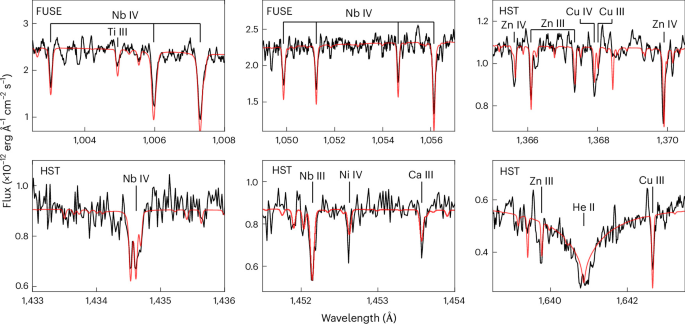
HS 0209+0832 is a hot, young white dwarf sitting just 350 parsecs from Earth. Its surface burns at roughly 35,800 kelvin — hot enough to strip most heavy elements from its visible atmosphere within months. Yet it carries them anyway: carbon, aluminum, silicon, calcium, titanium, nickel, zinc, copper, and, most strikingly, niobium. Not traces. Not the ghosts of background noise. Niobium identified through five Nb III lines and 57 Nb IV lines — dozens of distinct spectral signatures converging on a single, unavoidable conclusion.
The niobium is the smoking gun. It is a slow-neutron-capture (“s-process”) element, forged almost exclusively in the deep interiors of asymptotic giant branch (AGB) stars during their final million years. No known reservoir in the solar system, no ordinary meteorite, no comet, and no conventional planetesimal displays niobium in the proportions seen here. In fact, niobium in this system is more than a thousand times more abundant relative to calcium than it is in the Sun. Meanwhile, oxygen, silicon, and iron — the building blocks of rocky planets everywhere we’ve looked — are nearly absent.
This is not a leftover world. It is a newborn one.
How a planet is born after the party ends
To understand why this matters, you have to follow the life cycle of a star like the one that became HS 0209+0832. A few million years before it shed its outer layers and collapsed into a white dwarf, its progenitor swelled into an AGB giant. During that phase, the star drove a powerful wind, ejecting a significant fraction of its envelope into space. That wind was not ordinary solar material. It had been processed through nuclear burning deep inside the star, enriched with carbon and s-process elements like niobium, strontium, and zirconium.
If a companion — a lower-mass star or a giant planet — was orbiting close enough, that ejected material wouldn’t simply disperse. It would pool into a circumstellar disc, much like the protoplanetary disc that built the first generation of planets around the original star. Within that disc, under the right conditions, gravity could collapse clumps of gas and dust into a new planet. Second-generation. Forged not from the stuff of the original solar nebula, but from the stellar wind of a dying star.
This is the scenario the authors propose for HS 0209+0832. A close-in companion triggered a common-envelope event during the AGB phase, sweeping the stellar envelope into a compact, metal-enriched disc. From that disc, a giant planet formed — and it still exists today.
What the TESS light curve reveals
The evidence is not purely spectroscopic. TESS, NASA’s Transiting Exoplanet Survey Satellite, caught HS 0209+0832 in sectors 42, 43, 70 and 71, and the data show something unmistakable: a sinusoidal brightness modulation repeating every 4.399 days with an amplitude of 0.12 per cent. That is far slower than the typical white dwarf spin period, which clusters tightly around 1.25 days. Only one in twenty Kepler white dwarfs rotates slower than four days.
The signal fits the geometry of a phase curve from a strongly irradiated, tidally locked giant planet orbiting at just 0.04 AU — a tenth of Mercury’s distance from the Sun. The planet is bathed in extreme ultraviolet and X-ray flux from the young, 35,000 K white dwarf. The heating is so intense that the planet is actively evaporating, shedding atmosphere at a rate of at least 10¹³ grams per second if it is massive (13 Jupiter masses). Even the most conservative estimate puts the evaporation rate at roughly a hundred trillion grams per second — vastly exceeding the measured accretion rate of heavy metals onto the white dwarf. Most of that mass is swept away by radiation pressure or carried off by dynamical interactions. But enough of it rains down on the star to paint its spectrum with the fingerprint of a second-generation world.
The authors also consider whether the photometric variability could instead be caused by a cometary tail — a stream of evaporated gas trailing the planet, partially obscuring the star as it orbits. HS 0209+0832 is known to be spectroscopically variable, with its helium abundance fluctuating by a factor of two to three, and the unusual shape of the He II line at 1,640 angstroms hints at absorption from circumstellar gas. A trailing tail would explain both the photometric modulation and the variable helium signatures in a single framework.
Why this flips the textbook
For decades, planetary formation theory has assumed a simple timeline: planets form early, in the first few million years after a star is born, from the protoplanetary disc that surrounds the newborn system. After that, the game is over. What remains is debris — asteroids, comets, the occasional scattered planet — but no new worlds. Planets are children of their parent star’s infancy, never its adulthood or old age.
The discovery around HS 0209+0832 overturns that assumption in its entirety. A planet has now been identified whose bulk composition matches not a protoplanetary disc, but the nucleosynthetic output of an AGB star. Its niobium is too high. Its iron is too low. Its carbon is far too elevated. None of these patterns can be reconciled with a first-generation body, regardless of where it might have formed or how it migrated. The planet had to be made after the star died — or at least after the star began its final, violent act of mass loss.
This does not mean second-generation planets are common. It means they are possible, and now we have a concrete recipe for finding them: look at hot white dwarfs with unusual ultraviolet spectra, especially those showing strong carbon lines and s-process enhancements. Niobium and carbon are the markers. The former because it is almost exclusively an s-process product; the latter because AGB winds are carbon-rich. Both have strong UV absorption lines that survive in the atmospheres of hot white dwarfs.
What comes next
The sample of confirmed second-generation planet candidates is currently one. But the method is generalizable. Any hot white dwarf with an enriched atmosphere and the right spectral signature could host one. The authors estimate that establishing a sizable sample will require targeted UV spectroscopy of metal-enriched white dwarfs, combined with the photometric precision of TESS or its successor, the Nancy Grace Roman Space Telescope.
Beyond the detection problem lies the deeper question: how often does this happen? If AGB discs are common around binary systems, and if second-generation planet formation is efficient enough, then a non-trivial fraction of white dwarfs may host reborn worlds. That would mean planetary systems are not single-events but can repeat, at least in the aftermath of stellar death. The universe, it turns out, is more patient than we gave it credit for.
For now, HS 0209+0832 stands alone — a phoenix planet, orbiting a phoenix star, eating its own atmosphere and raining heavy elements onto the remnant of the thing that killed its parent. It is a system that should not exist, by the old rules. And that is exactly why it matters.