Google's RRSI Could Redefine AI Inference Economics
Google unveiled RRSI, a framework letting AI agents self-improve their surrounding harness without retraining — cutting token costs by over 30% while boosting benchmark scores. Why this changes the math on deploying smarter AI.
The harness is the new frontier
For years, the AI arms race has been measured in parameters and pre-training FLOPs. Bigger models, more data, deeper training runs. But Google just published a paper that quietly suggests the next competitive edge won’t come from training smarter models — it will come from wringing more out of the ones you already have.
The framework is called Regularized Recursive Self-Improvement of Agent Harnesses, or RRSI. It was developed by researchers at Google Cloud AI alongside teams at Stanford and the University of Washington, and it was posted on arXiv on January 29.
The core idea is deceptively simple. Rather than updating a model’s weights, RRSI iteratively improves everything wrapped around the model — the prompts, the tool calls, the control flow, memory management, skill modules, even sub-agent orchestration. Collectively, researchers call this the “harness.” And the harness, it turns out, is where the low-hanging fruit lives.
How RRSI actually works
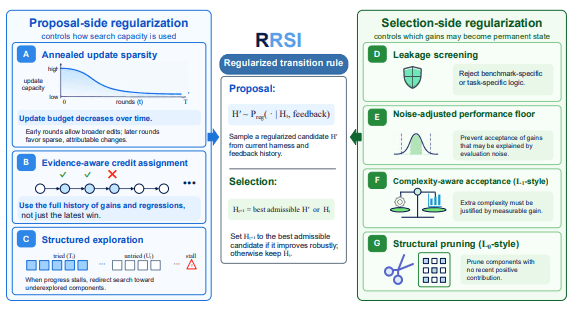
An AI agent using RRSI operates in two phases per iteration: proposal and selection. That dual structure is the paper’s critical innovation.
In the proposal stage, the agent generates candidate modifications to its own harness. But unlike earlier approaches that could spiral into repetitive failures, RRSI’s proposal phase incorporates historical records of what already didn’t work, actively steering exploration away from dead ends and bounding resource use. Early iterations propose broad, multi-component changes to explore widely. As the process continues, it narrows to single-component modifications, making it clearer which specific change drove any observed improvement.
In the selection stage, the agent evaluates each proposal against actual task performance. Here, RRSI applies a second layer of regularization: it filters out changes that look good in noisy evaluations but don’t deliver real gains relative to their compute cost. This is where the efficiency story gets interesting.
Without that selection-stage filter, agents tend to overfit — they discover tricks that maximize scores on known benchmarks without improving general capability. RRSI’s dual regularization directly combats this. The paper explicitly notes the framework’s focus on out-of-distribution robustness: changes that generalize across tasks, not just ones that game a specific test suite.
The numbers
Google tested RRSI across eight benchmarks, using Gemini 2.5 Flash as the base model in one set of experiments and a separate model in another.
On Terminal-Bench 2.1, scores rose from 74.2% to 80.2% — a 6.0 percentage-point jump. SWE-bench Verified went from 82.0% to 83.8%. JobBench climbed from 36.0% to 40.7%. GDPval moved from 48.8% to 52.3%. Frontier-Eng jumped from 17.7% to 22.0%.
Critically, the improvements carried over to five external evaluation sets that RRSI never directly optimized against, with gains of up to 4.7 percentage points. And in out-of-distribution environments, RRSI outperformed prior harness-evolution methods by as much as 22.9% — a striking signal that the framework is finding genuinely transferable improvements rather than brittle, task-specific hacks.
The token economics are equally notable. In agent workspace experiments, a single RRSI run consumed 2.42 million policy tokens compared to 3.8 million for an unregularized harness-evolution approach — a reduction of more than 30%. That means RRSI doesn’t just produce better agents; it produces them cheaper.
Why this matters beyond the lab
The immediate implication is economic. Every billion-token inference pipeline running today is paying for the same heavy model over and over, hoping the prompt and tooling around it are well-tuned. RRSI formalizes the search for better harnesses and automates it — and does so with built-in safeguards against the two mistakes most companies make when they try this informally: overfitting to their evaluation set and burning through tokens chasing marginal gains that don’t stick.
For companies deploying AI agents at scale, the practical upside is clear. You don’t need to wait for the next model release to get better performance. You can improve the system surrounding your existing model, and you can do it in a way that compounds — each iteration builds on validated changes rather than restarting from scratch.
There is also a strategic implication that goes less discussed. If harness self-improvement is the marginal path to better results, then the competitive moat shifts from model architecture toward orchestration expertise. The company that best understands how to design, evaluate, and iterate on agent harnesses may pull ahead of the company that simply has access to the biggest model. That’s a meaningful inversion of the current industry narrative.
What this doesn’t solve
RRSI is a research framework, open-sourced under Apache 2.0. It is not yet a production product. The paper demonstrates gains on established benchmarks, but benchmarks are controlled environments. Real-world agent deployments face messy, evolving workloads where the performance signals are noisier and the evaluation criteria are less clean.
The dual regularization helps, but the framework still depends on a base model capable of generating and evaluating its own proposals. That requires inference budget, and while RRSI reduces token usage relative to unregularized approaches, it still spends more than a static harness would. The economics only improve at scale if the performance gains outweigh the iterative compute cost — and that balance will vary by use case.
Overfitting is attenuated but not eliminated. Any system that searches a space of modifications risks discovering patterns that don’t hold outside the test distribution, even with regularization. The 22.9% OOD advantage over prior methods is promising, but it proves the direction, not the destination.
The longer arc
Self-improving systems have been a research goal since the earliest days of AI. What makes RRSI worth watching is that it sidesteps the hardest part — changing the model itself — and focuses on the layer that is simultaneously more accessible and more practically impactful. The harness is where AI meets the real world. It is also where most deployed systems are under-optimized today.
If the trajectory holds, we may soon see a split in the industry between companies treating their AI deployments as static model calls and those treating them as adaptive systems that improve their own operating procedures. The gap between those two approaches will widen every time a new model comes out, because the static deployers will keep chasing parameter counts while the adaptive ones will keep compounding harness improvements.
Google’s paper doesn’t close that gap by itself. But it provides a rigorous, open framework for the kind of iteration that was previously ad hoc. That changes the calculus for anyone building agent systems on top of foundation models.
The code is on GitHub. The question is who starts running it.