Beam Is the West's Counterpunch to China's Open AI Dominance
Reflection's 501B open-weight model Beam claims frontier coding and agent performance at a fraction of the compute cost used by rivals like GLM 5.2. The question is whether efficiency gains are enough to reverse China's open-source momentum.
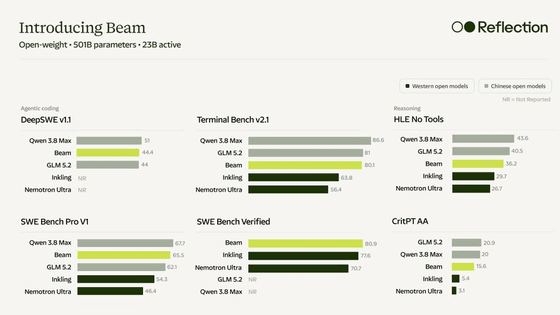
The open-weight battleground is shifting, and Beam is a declaration of war
Reflection, a San Francisco–based AI lab with $4.6 billion in backing from Nvidia, Sequoia, and Lightspeed, has unveiled Beam — a 501-billion-parameter open-weight model it says can match the coding and agentic capabilities of China’s GLM 5.2 while using only a quarter of the inference compute.
The claim lands squarely in the middle of what has become the defining contest in AI: who builds the most capable open models, and at what cost. Chinese labs have held a decisive lead since DeepSeek’s surprise releases in early 2025 demonstrated that frontier-tier models could be trained for a fraction of the price Western companies assumed was necessary. GLM 5.2, Qwen 3.8-Max, and Kimi K3 have since become the default choices for developers seeking powerful open-weight models. Beam is Reflection’s answer.
What makes this announcement worth watching isn’t just another benchmark score. It’s the architecture and training strategy behind it — and what it suggests about where the open-model race is heading next.
A 23-billion active model with 501 billion parameters
Beam uses a Mixture of Experts (MoE) architecture: 501 billion total parameters, but only about 23 billion are activated per token. That distinction matters. Traditional dense models activate every parameter on every token, which is why they demand enormous compute. MoE models route each input through a small subset of specialized “expert” sub-networks, dramatically reducing inference cost while preserving capacity.
Reflection’s claim is that this architecture lets Beam approach GLM 5.2 on benchmarks like DeepSWE (coding agents), Terminal Bench (terminal-based agentic tasks), and SWE Bench Pro (repository-level problem solving) — while requiring only one-third to one-quarter the inference compute. Against even larger models like Qwen 3.8-Max, which exceeds 2 trillion parameters, the efficiency gap is steeper still.
Beam also reportedly matches Qwen 3.8-Max on agentic task performance. Those are meaningful comparisons. GLM 5.2 and Qwen 3.8-Max are not distant benchmarks — they are the models developers are currently choosing for production workloads.
One of the largest open reinforcement-learning runs on record
The real story, however, is in the training pipeline. Reflection trained Beam entirely from scratch on 23.8 trillion tokens of pre-training data. But the more striking figure comes from the reinforcement learning phase: the company ran one of the largest documented open RL campaigns to date, using approximately 15,000 NVIDIA GB 300 GPUs over four weeks to generate more than 100 million rollouts.
That the RL phase alone consumed that level of compute and still produced measurable efficiency gains suggests Beam’s token economy — the amount of reasoning capability per token generated — has been specifically optimized. Reflection’s own language around this is direct: Beam can deliver “higher intelligence per token,” meaning lower operating costs for anyone deploying it at scale.
The data pipeline behind this is equally notable. Reflection built its own crawler, deduplication pipeline, storage systems, and an OCR system that extracted trillions of tokens from hundreds of millions of PDFs. The model’s technical staff noted that when they joined the project in late 2025, the team numbered only five to ten people with essentially no infrastructure. By the time Beam was ready, they had constructed everything in-house. That trajectory — from near-zero to frontier-level training in roughly a year — is itself a signal about where the open-model industry is moving.
The team behind Beam carries serious credentials
Reflection’s leadership is built from the people who shaped some of the most consequential AI systems in recent years. CEO Misha Laskin led reward modeling for Google’s Gemini and worked on AlphaGo and AlphaZero at DeepMind before joining Google. CTO Ioannis Zevgolis similarly contributed to AlphaGo and led RLHF efforts for Gemini. The company’s technical staff includes people who previously worked at Meta on open-weight model development.
Laskin’s public framing of Beam is unusually explicit about its geopolitical intent. He positioned openness as a safety and distribution imperative, drawing parallels between open cryptography in the 1990s and the need for openly inspectable AI models. The company’s investors — particularly Nvidia, which stands to benefit from increased open-model adoption driving chip demand — clearly share that vision.
Why the efficiency angle matters more than the benchmark numbers
Benchmarks are useful but narrow. The harder metric for any developer is deployment cost. If Beam truly delivers GLM 5.2–level performance at one-quarter the inference compute, the economics of running AI agents at scale shift noticeably. A company deploying thousands of coding agents or autonomous research assistants would see meaningful cost reductions.
That is also why the comparison to Kimi K3 matters. Beam reportedly still trails Kimi K3 on pure capability benchmarks. But the gap is framed around efficiency, not raw ability. In the open-model market, that distinction is increasingly where competitive advantage lives. Capability converges quickly. Efficiency is harder to replicate.
What this means for the open AI ecosystem
Beam arrives at a moment when the open-source AI landscape is consolidating around two camps: Chinese models built for maximum capability and efficiency, and Western models racing to match them. Ollama’s immediate support for Beam signals that the Western open-model ecosystem is coalescing around companies that can deliver comparable performance at competitive costs.
The release timeline — full Apache 2.0 weights and a detailed technical report expected later in October 2026 — will be the real test. Reflection is currently undergoing red-teaming and safety evaluation. If Beam’s open release holds up to scrutiny and performs as claimed in production environments, it could meaningfully redistribute the open-model market. If it underwhelms, the gap between Western and Chinese open models will widen further.
For now, Beam represents the most serious Western challenge yet to China’s open-source AI dominance. Its moat isn’t just architecture or training scale — it’s the claim that you no longer need quadrillions of parameters to compete. That is a message the entire open AI community has been waiting to hear.