Planet Nine Evidence Could Rewrite Solar System History
A PhD student's reanalysis of decades-old infrared survey data may have found the first direct trace of Planet Nine — if confirmed, it transforms our understanding of how the solar system formed.
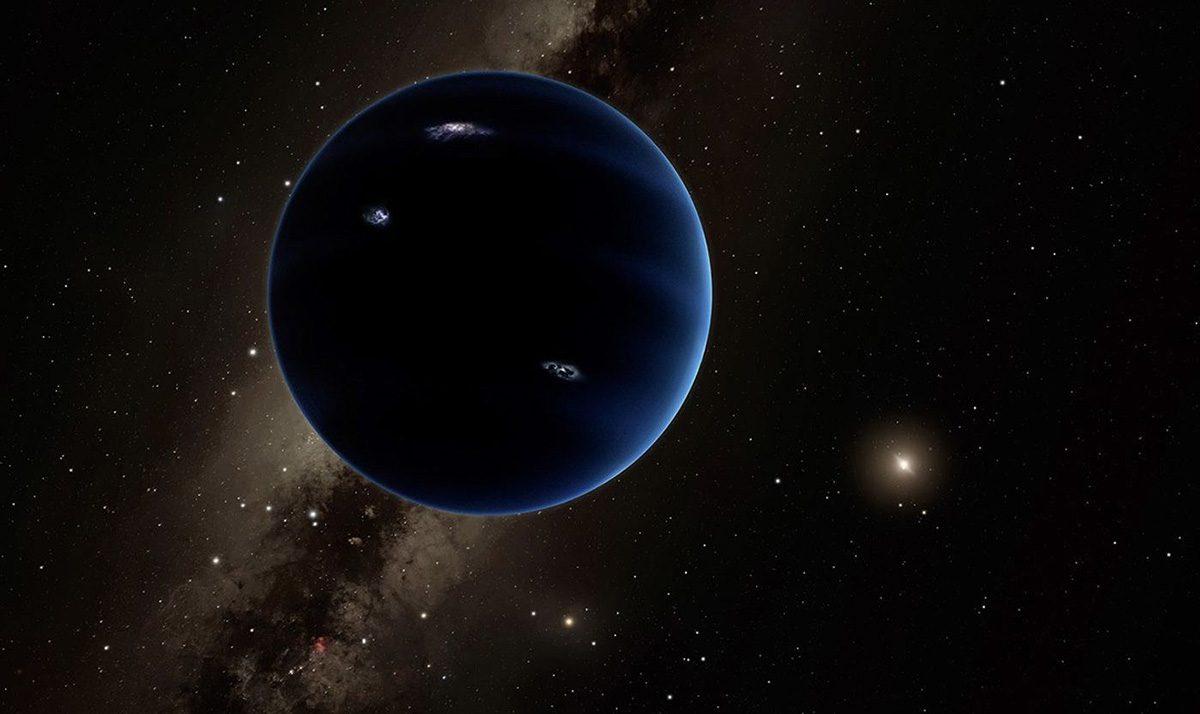
A Ghost in the Data
Terry Long Phan was looking for ghosts. The PhD student at National Tsing Hua University in Taiwan wasn’t hunting for anything visible — his target was a planet that reflects almost no sunlight and has never been directly imaged. Instead, he hunted for motion in two archives: infrared surveys completed twenty-three years apart. What he found may be the first concrete sign that Planet Nine exists.
The result isn’t proof. Two data points don’t make an orbit. But if follow-up observations confirm the signal, it will be the first direct evidence of the ninth planet that astronomers have inferred for years but never seen.
Why Infrared Changes Everything
The problem with finding Planet Nine has always been distance. At roughly three hundred astronomical units from the Sun, the planet sits more than ten times farther than Neptune. Visible-light detection suffers brutal physics. Starlight travels out to the planet, bounces off, and travels back to Earth. At that range, a Neptune-sized world appears about ten thousand times fainter than Neptune does from Earth. Practically invisible.
Infrared sidesteps the double journey. Planet Nine emits its own thermal radiation. That light makes a one-way trip from the planet to the telescope. The same object becomes only about one hundred times fainter in the infrared — a thousandfold improvement. That’s why the search has always pointed to space-based infrared observatories rather than optical telescopes.
The Infrared Astronomical Satellite, or IRAS, launched in 1983. Japan’s AKARI followed in 2006. Both mapped the entire sky in infrared. Neither was designed to hunt planets. That’s what made Phan’s approach clever: he treated their data as a time machine.
Finding Movement in Stillness
At three hundred astronomical units, Planet Nine would crawl across the sky. Its orbital speed is so low that it would appear essentially stationary within either IRAS or AKARI’s datasets. Over twenty-three years, however, it would shift just enough to notice — roughly forty-seven and a half arcminutes, about one and a half times the width of the full Moon.
Phan wrote software to scan every infrared source in both surveys, filtering for objects that moved by the expected amount between the two epochs. The automation returned thirteen candidate pairs. Manual verification whittled that to one.
That single candidate matches what a Neptune-sized world would look like in the far outer solar system. It has shifted by the right amount. It sits in the right general region of sky. Whether it is Planet Nine remains an open question.
What Confirmed Would Mean
Planet Nine has been a gravitational ghost story since 2016, when Konstantin Batygin and Mike Brown proposed that the clustering of extreme trans-Neptunian objects required an unseen planet tugging on them. The idea gained traction because the alternative — that dozens of distant objects all happen to align by chance — seemed increasingly unlikely as more were discovered.
But inference is not observation. For years, astronomers could argue about statistics, simulations, and whether the clustering was real. Direct detection ends the debate. If Phan’s candidate holds up, the hypothesis moves from mathematical curiosity to physical reality.
That changes planetary science. The solar system’s architecture is one of the hardest problems in astronomy. How did the giant planets reach their current orbits? Why is there a gap between the Kuiper Belt and the distant planet population? Where did the ice giants form? A confirmed Planet Nine at three hundred astronomical units would force recalibration of every model.
How It Got There
The leading theory says Planet Nine did not form in place. No amount of gas and dust existed far enough out to build a Neptune-sized world. Instead, it likely formed closer to the Sun — perhaps near Saturn or Uranus — and was scattered outward by gravitational interactions during the early instability of the giant planets. That scenario, called the Nice Model, already explains some features of the outer solar system. Planet Nine would add the final piece.
Its current elliptical orbit, bringing it from perhaps two hundred astronomical units at perihelion to six hundred at aphelion, suggests it was ejected by a close encounter with Jupiter or Saturn. The planet’s gravity would also sculpt the distant Kuiper Belt, shepherding objects into the clustered orbits that first hinted at its existence.
Finding it confirms that the solar system underwent a violent reshuffling we can now trace step by step.
What Comes Next
Two positions don’t define an orbit. To pin down Planet Nine’s path, astronomers need repeated observations spanning months or years. Phan has proposed using the Dark Energy Camera on the Victor M. Blanco Telescope in Chile. DECam is wide-field and sensitive enough to revisit the candidate region and measure additional positional shifts.
If DECam confirms the object moves exactly as expected, the community will demand spectroscopy. That would reveal the planet’s composition — whether it is icy, rocky, or something else — and help date its ejection from the inner solar system. Only then can astronomers claim a discovery rather than a candidate.
Why This Matters Now
Phan’s work matters because it proves the detection strategy works. Infrared parallax using archival surveys is viable. Future missions like the Nancy Grace Roman Space Telescope and the Vera Rubin Observatory will scan the sky with even greater sensitivity. They will inherit the methodology Phan tested.
The broader implication reaches past astronomy. Planet Nine would be the first new major planet discovered in the solar system since Neptune in 1846. It would join Uranus and Pluto in a lineage of objects found not by looking directly but by following gravitational clues. That process — inferring the invisible from its effects — is how most exoplanets have been detected too.
If the candidate is real, it means there may be more worlds waiting in the archives. Decades of sky surveys contain数据 that haven’t been mined for solar system objects. Phan’s approach could unlock them.
The Caveats Remain
The scientific community will react with justified caution. The candidate could be a background quasar, a distant galaxy, or instrumental artifact mimicking motion. It could also be a free-floating planet captured by the solar system, though that scenario is less likely.
Until DECam observes it again, the object remains a signal, not a confirmation. Phan and his colleagues know this. Their paper frames the result as evidence, not discovery. That restraint is appropriate.
What cannot be dismissed is the methodology. For years, searches for Planet Nine produced nothing. The candidate now suggests the planet may have been hiding in plain sight, waiting for someone to compare the right archives at the right resolution.
A New Chapter
The solar system is smaller than we thought and stranger than we imagined. If Planet Nine exists, it reminds us that the Sun’s domain extends far beyond the orbits we can see. It also shows that old data, viewed with new questions, can still produce new discoveries.
Phan’s work is a reminder that science rarely announces itself with fanfare. Sometimes it arrives as a faint smudge in infrared surveys, shifted by an arcminute or two over two decades. The job of the astronomer is to notice the shift and ask what caused it.
If the signal holds, the ninth planet will finally have a name.