Pope Leo XIV Returns to France — and Reaches Past a Secular Majority
Pope Leo XIV is using his first papal visit to France in 18 years to reposition the Vatican on AI ethics and church-state relations, aiming to expand the Holy See's influence in a region where Catholic practice has hollowed out.
A Pope Returns to a Country That Forgot Him
Pope Leo XIV stepped onto the tarmac at Orly Airport and into the oldest drama of modern European politics: can a pope speak to a country that no longer listens? Eighteen years separate this visit from John Paul II’s last trip to France in 2008. When Leo lands in Paris, church bells rang across the country — a symbolic gesture from a nation where roughly 5 percent of 69 million people attend Mass regularly, though about 40 percent still identify as Catholic.
The turnout tells the story. More than a million people are expected to greet him over four days. That number is not trivial for a continent where the institutional Church has been retreating for decades. But the real question is not whether crowds will gather; it is what Leo wants from them.
The AI Warning as Diplomatic Strategy
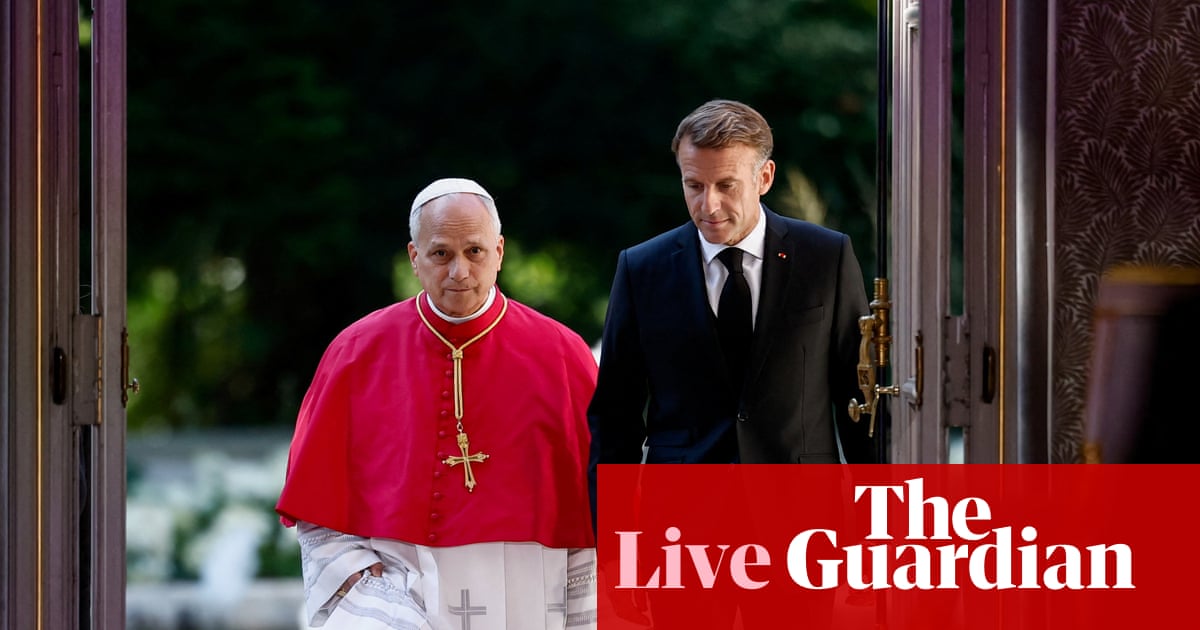
His opening salvo came at the Élysée Palace, and it was oddly specific. “We must not lose our humanity amid the paradise of machines,” Leo told Emmanuel Macron and an assembled diplomatic corps. The phrase was a direct lift from Georges Bernanos’s 1947 essay “France Against the Robots” — an odd reference for a papal address, but a deliberate one. Leo was signaling that he speaks French culture, not just French politics.
He warned that uncontrolled technological advance, including artificial intelligence, could erase the ethical discernment required to distinguish right from wrong. His remarks were a preview of a major speech at Unesco later in the day, where he is expected to expand on themes from an encyclical on AI he published earlier this year.
This is not merely theological posturing. The Vatican sees itself as competing with Silicon Valley for moral authority over the technologies that will define the coming century. Leo’s push to frame AI as an ethical crisis — not just a technical one — is an attempt to give the Holy See a seat at a table it has historically occupied only on social issues. If successful, it changes the Vatican’s role in European discourse from cultural commentator to policy influencer.
The Church-State Puzzle
Macron opened the joint remarks with a careful definition of French secularism: not a rejection of religion, but a framework that allows individuals to believe or not believe freely. That was a direct address to the anxieties of Catholic leaders who feel excluded from public life. Leo responded by affirming that “authentic secularity does not exclude religion” — a sentence designed to soften years of institutional friction between the Vatican and the French state.
The effort is notable because France has been moving in the opposite direction on several fronts. The right to abortion was enshrined in the constitution in 2024. assisted dying laws passed months ago. The French Catholic hierarchy opposed both measures. Leo did not challenge the abortion ruling directly, but he did criticize assisted dying, calling it part of a temptation to “look to science for a solution and a consolation for all our suffering.” The language was pointed but carefully qualified — he did not name France’s law, and he did not call for its repeal.
The subtlety is the strategy. Leo is threading a needle: reasserting Catholic moral teaching while avoiding a blunt confrontation with a government that has already moved past him on bioethical questions. It is a recalibration, not a reversal.
What Changes — and What Doesn’t
The visit is widely seen as a political win for Macron, who has long sought a strong relationship with the Vatican. His predecessor, Pope Francis, visited France three times but never on an official state visit. Leo’s willingness to appear alongside Macron at the Élysée signals a different posture — one that treats the Church as a partner in governance rather than a moral opposition force.
That shift carries consequences. France has positioned itself as a European leader on AI regulation and digital governance. Leo’s presence at Unesco and his repeated calls for ethical guardrails on technology give the Vatican a direct channel into that conversation. Whether it opens doors or simply provides a platform for familiar arguments remains to be seen.
On nuclear weapons, Leo was less tentative. He called for a complete ban, arguing that they offer a “mistaken belief” in security while fueling an arms race. The remarks came against the backdrop of the war in Ukraine, which continues to reshape European security architecture. The pope’s language was consistent with decades of Catholic teaching, but the timing — as France hosts a pope during heightened global instability — adds a layer of diplomatic weight.
Who Wins, Who Loses
For Macron, the visit bolsters his image as a statesman who can bridge secular and religious worlds in an era of fragmentation. It also gives him a counterweight to the cultural conservatism that has dominated other European capitals. For Leo, the trip is an opportunity to reset the Vatican’s relationship with a country that has been drifting away — not just in practice, but in self-understanding.
The losers are harder to identify precisely because the visit is framed as dialogue rather than confrontation. France’s secular establishment may find the pope’s presence inconvenient, but his measured tone limits the damage. Critics of the Church’s growing interest in technology policy may see Leo’s Unesco appearance as an overreach. Observers on the ground in France, however, may simply note that a pope they barely saw for nearly two decades is now back — and speaking their language, both literally and figuratively.
The real test will come after the crowds disperse. If Leo’s message on AI becomes part of European policy debate, the Vatican has regained influence. If it remains a set of well-wishings delivered to cathedral walls, the visit confirms what many already suspect: the Church is still relevant as a symbol, but less so as a force.