POSCO Workers Reject Wage Deal — And Global Steel Suppliers Should
POSCO workers voted down a tentative pay deal by a narrow margin, sending wage negotiations back to square one. The rejection is a bellwether for heavy-industry labor across East Asia—and a supply-chain risk for automotive and construction buyers worldwide.
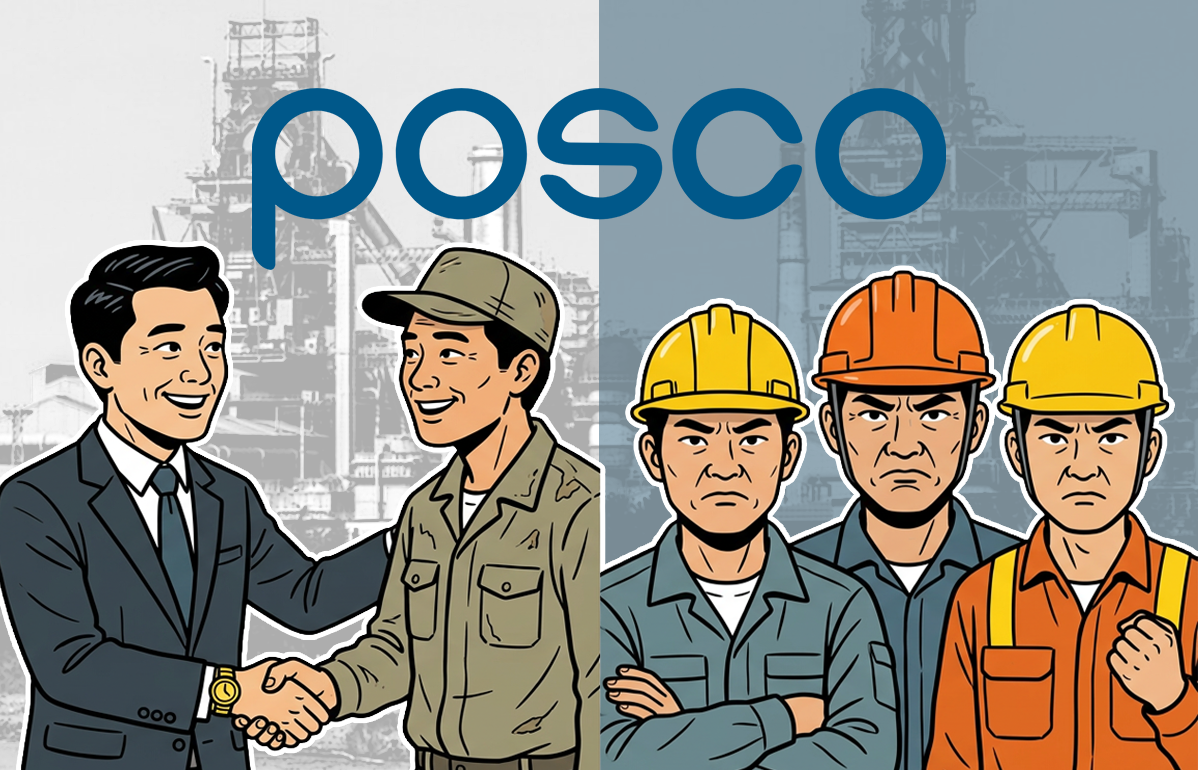
A Narrow Rejection With Wide Implications
The ballot boxes were counted. The provisional agreement died by 311 votes.
On November 7, POSCO workers cast their decision on a tentative wage deal the company and the union had spent months drafting. Of 9,177 union members who voted, 4,744 said no — 51.7 percent rejecting what was supposed to be the end of a seven-month standoff. That margin, thin enough to feel accidental, actually signals something sharper: the gap between what management thought workers would accept and what they actually want has not closed at all.
This matters beyond Gwangyang. POSCO is East Asia’s second-largest steel producer, a critical supplier to automakers, shipbuilders, and construction firms throughout the region. Any disruption to its output does not stay contained inside a factory gate in South Korea.
What Was On The Table
To understand why the deal failed, you have to read the numbers behind it. Management offered a 2.6 percent base-pay increase and a one-time payment of 6 million won ($4,100). Holiday bonuses rose to 2 million won plus 20 percent of basic pay this year, climbing to 30 percent of basic pay starting in 2028. The deal also raised weekend premiums for shift workers, boosted on-site and maintenance allowances, and expanded medical coverage to include spouses and children.
The union’s opening demand told a different story: a 7.1 percent base-pay increase, a one-time incentive bonus equal to 600 percent of monthly pay, 50 company shares, and a holiday bonus at 200 percent.
Even after roughly 30 rounds of talks since mid-June and two partial strikes in September, the final offer landed less than halfway between those two positions on the base-pay figure. For workers who had already endured strike action and waited through summer heat, that midpoint looked like a compromise that rewarded patience with very little extra.
The Real Story Behind The Vote
A 51.7 percent rejection rate might look like a close call from the outside. Inside a union membership of over nine thousand workers, that margin is loud.
What this reveals first is fatigue on both sides turned against each other. The union escalated to three planned strikes before the provisional deal emerged, squeezing production timelines. Management held firm on compensation ceilings while quietly depending on a settlement to stabilize operations heading into year-end. Neither side wanted another round of walkouts. Yet when the final document reached the floor, the union’s rank and file spoke with a clear minus sign.
The second takeaway is more structural. POSCO sits at the center of South Korea’s heavy-industry economy — steel feeds autos, appliances, ships, and infrastructure projects. When wage disputes stretch across seasons and then collapse at the voting stage, every downstream buyer faces uncertainty. Automotive manufacturers in Korea and abroad, which rely on steady coils and plates from Gwangyang, now face the prospect of renewed production pressure if talks drag further.
The timeline for resolution is unclear. Both sides have signaled willingness to return to the table. But without a new framework that addresses the core disagreement on base-pay growth, there is no guarantee talks will produce a different result the second time around.
What This Means For Supply-Chain Planners
Global steel traders should treat this as a signal, not a crisis — yet. POSCO has not announced a work stoppage following the vote. Management stated it respects the result and will continue discussions. A return to open conflict is possible but not certain.
That said, the risk pattern is familiar. Partial strikes in September already tested delivery schedules. A full renegotiation cycle, potentially extending through winter, raises the chance of further disruptions. Shipyards and auto plants that contract steel deliveries months in advance may find themselves holding spot-market exposure if POSCO’s output tightens again.
For planners specifically, watch two indicators: whether POSCO sets a new bargaining deadline, and whether the union threatens a third or fourth strike action. Either move resets the calendar and compresses the window for voluntary compliance. If a strike recurs before year-end, inventory buffers held by major importers could thin quickly.
A Bellwether For East Asian Heavy Industry
The POSCO vote is a mirror held up to a wider regional problem. Across Japan, China, and South Korea, heavy-industry unions are negotiating in an environment where profit margins in steel remain under pressure and demand cycles are slowing. Workers demand more security; employers point to slimmer returns. The political temperature in South Korea adds another variable — labor activism carries visibility that companies and governments cannot easily ignore.
If POSCO struggles to hold a settlement below 50 percent support, the lesson will travel fast. Other major employers in the region — Hyundai Steel, Samsung Heavy Industries, Japan’s Nippon Steel — face similar dynamics. A losing vote at POSCO gives dissenting union members confidence that harder demands can still fail, but it also warns management that concessions pulled too far toward the lower end carry electoral risk.
Where Things Go From Here
The immediate future points toward reopened negotiations. Union representatives have said a retry is necessary. Company spokespeople have pledged continued dialogue. The question is whether either side moves closer to the other’s center before resentment hardens further.
For the steel market, the near-term outlook depends on whether POSCO maintains normal operations during the gap period. If output holds, the rejection becomes a procedural bump. If a new strike wave follows, the implications widen into shipping delays, price volatility, and reallocation of contracts across global buyers.
One number deserves emphasis: the 311-vote margin. In a union that size, a shift of fewer than five hundred ballots in either direction flips the outcome entirely. That fragility is worth watching. Any fresh offer from management that tilts even slightly toward the union’s position — particularly on base pay — could deliver a comfortable yes. Any step backward risks deepening the impasse.
Why It Matters Outside Korea
Steel is a globally traded commodity. POSCO’s exports feed mills, fabricators, and OEMs in countries that do not vote in this ballot. A protracted dispute changes shipping routes, reroutes allocations, and tests long-term supply agreements signed by parties who had assumed Korea’s largest integrated steelmaker would keep its word.
The underlying lesson is simple. In heavy industry, labor settlements are not internal affairs. They are supply-chain events. POSCO’s rejected deal shows that even well-worn negotiation structures can produce unexpected outcomes when the gap between expectations and offers is too wide to bridge with procedure alone.
Planners who priced stability into their forecasts should reassess. The market did not break. But it just reminded everyone that labor peace in industrial corners like this is negotiable, temporary, and never guaranteed.