PS5 Emulation Hits 96% — Sony Hardware Strategy Is Now On Notice
An open-source Korean project just hit 95.88 percent PS5 coverage on PC by skipping GPU emulation entirely. The implications for Sony's console margins are existential.
The number that changes everything
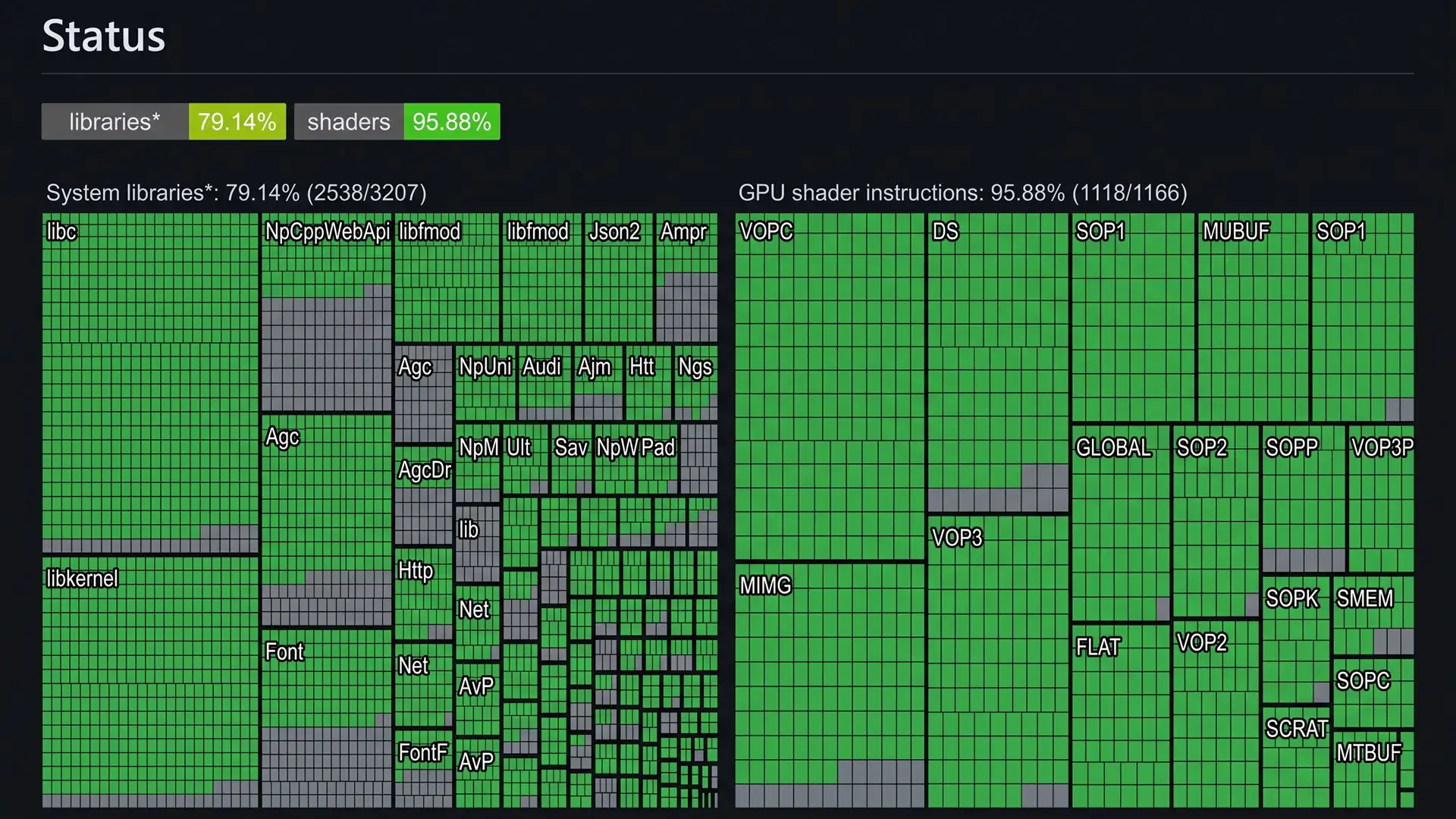
Ninety-five point eight eight percent. That is the coverage figure the AnyPS5 open-source project reported this week, and it is not a incremental bump — it is a threshold crossing.
The project, which emerged from a Korean developer community and was first documented by GameGPU, has found a way to run PlayStation 5 executables on standard PC hardware without simulating the console’s GPU. Instead, it converts the console’s graphics calls into SPIR-V intermediate code that any modern AMD or NVIDIA card can execute through Vulkan. The CPU side of the PS5 architecture — its x86-basedZen 2 cores — runs natively on PC. The only thing between a PS5 game and your graphics card is a shader compiler, not a full hardware replica.
That distinction matters more than the percentage itself.
Why GPU emulation was always the bottleneck
Every previous major console emulator faced the same wall: the GPU. Translating a proprietary graphics pipeline — one that speaks in custom instructions, uses bespoke optimizations, and relies on tight CPU-GPU synchronization — into something a standard graphics card understands has historically required either massive computational overhead or a staggering amount of reverse-engineering labor.
The PSPC3 approach of emulating the RSX chip proved too slow and too complex for practical use. The Switch emulator Yuzu eventually succeeded largely because the Switch’s GPU architecture was far less idiosyncratic than the PS4’s or PS5’s. But Sony’s RDNA 2 GPU — the same architecture found in the Xbox Series X — sits in a closed ecosystem with proprietary extensions, custom memory layouts, and a shader pipeline that has never been fully documented.
AnyPS5 sidestepped the problem entirely. Rather than trying to mimic the GPU, it translates the console’s shader language into standard Vulkan calls at runtime. The GPU does what it already knows how to do. The emulator just speaks its language.
This is not a new idea in principle. Shader recompilation has been used in Steam Play and Proton for years to run DirectX games on Linux. What is remarkable here is that the AnyPS5 team appears to have applied the same logic to a console architecture that was considered far more locked down than a Windows API.
Who wins, who loses
PC gamers win immediately. Anyone who owned a PS5 and wanted to play their library on a better machine now has a path that does not require buying new hardware or waiting for a PC port. Developers who worry about fragmented platforms may start taking PC performance seriously in a way that Sony has never forced them to.
Sony loses the most, and the loss is structural, not just financial. The PS5 sells at a margin that helps fund first-party development. A significant portion of that margin disappears if the same games run on a $400 Intel NUC and a mid-range GPU. The console is not just a distribution device — it is a walled garden that controls who plays what, when, and for how much.
Sony’s response is predictable and has been playing out for a decade: move further toward services, lock exclusives tighter, and invest in anti-piracy and platform restrictions that are harder to reverse-engineer. But the architectural shift is irreversible. Every major platform holder will face this question within five years.
What the numbers actually mean
Seventeen games remain that cannot run at full fidelity. Some of those will be impossible to emulate due to copy protection or hardware-dependent features. Others will simply require more shader translations that the team has not yet reverse-engineered.
The system library side tells a similar story. Two thousand five hundred thirty-eight of 3,207 PRX modules are implemented — roughly 79 percent. That covers the operating system layer, not the graphics layer. Graphics coverage sits higher because the shader compiler approach short-circuits a lot of the work.
The project already runs 2D games at a stable 60 frames per second on low-end hardware. High-end 3D titles are still being stabilized. The team posted that progress in a matter of days, not months, which suggests the remaining work is largely iterative rather than foundational.
The broader industry implication
Console emulation is not new. The PS3 emulator RPCS3 has reached playable status for hundreds of titles. The Wii U emulator Cemu runs nearly every commercial game. The gap between “experimental” and “usable” has been collapsing for a decade, and AnyPS5 is simply the latest proof point.
What makes this moment different is the speed and the approach. A shader-recompiler-first design means that future console generations may face emulation not as a decades-long engineering challenge but as a compiler problem — one that improves with each generation of hardware.
Microsoft already recognized this risk when it folded Xbox compatibility into its cloud and PC strategy. Nintendo has doubled down on first-party software as its moat. Sony is the only major platform holder still selling hardware as a primary profit center, and AnyPS5 proves that the console-as-hardware model is no longer defensible on technical grounds alone.
What happens next
Expect Sony to accelerate its PC port strategy — not out of altruism, but because blocking emulation entirely is no longer feasible. Titles like Spider-Man 2 and God of War Ragnarök are already coming to PC. The window for console-exclusive advantage is narrowing by the quarter.
The AnyPS5 team has not announced a release date. Coverage percentage will rise. The question is no longer whether PS5 emulation will reach maturity, but whether Sony can maintain relevance in a market where the console is increasingly optional.
The answer to that will determine the next decade of gaming hardware — and it is far from certain.