Rakuten Securities Data Leak Exposes Japan's Fintech Governance Crisis
A data leak at Rakuten Securities affecting 15.72M accounts — caused by placing real customer data in a test environment — is triggering class-action lawsuits and a regulatory reckoning that could reshape Japan's fintech landscape.
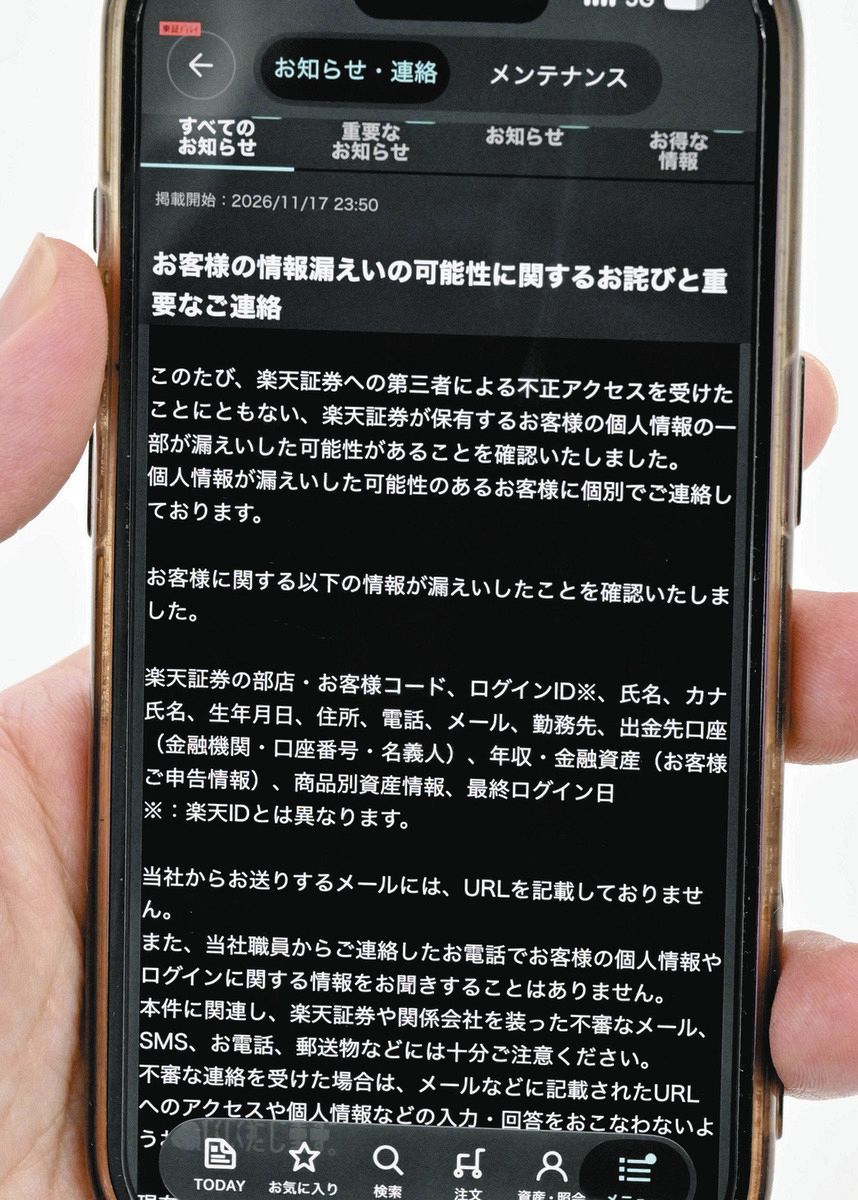
The Test Environment That Should Never Have Held Real Lives
Rakuten Securities found out on June 16 that someone had accessed its systems improperly. By November 11 — five days earlier than the discovery — real customer information had already slipped outside. The scope was staggering: 15.72 million accounts were involved. Names, addresses, income levels. Not anonymized test data. Real people.
What makes this breach unusual, and deeply troubling, is not the fact that data left the building. It is where that data came from.
The information sat in a test environment — a sandbox system meant for development, not production traffic. Security experts call this a basic violation. Shin-taro Shimizu, president of IT security firm Securia, put it plainly: using actual customer data for testing is normally unthinkable. The Financial Information Systems Center (FISC), the industry body that writes the playbook for Japanese financial institutions on exactly this subject, recommends against it outright. When actual data must be used, masking or pseudonymization is required. Whether Rakuten did any of that remains, reportedly, under investigation.
This is not a sophisticated foreign attack. This is a company putting customer records where they do not belong and then being unable to keep them there.
The timeline itself raises uncomfortable questions. According to Rakuten’s disclosure, the improper use of live data began sometime before November 11 and continued until internal controls flagged the anomaly. That window — potentially weeks or longer — represents sustained exposure, not a single momentary lapse. For customers whose income figures and home addresses now float in the open, the window of vulnerability does not close when the company issues an apology. It closes only when they can prove those records have been purged from every unauthorized repository, including those controlled by third parties who received the data during that broader exposure period.
Under Japan’s Act on the Protection of Personal Information (APPI), revised in 2022 and strengthened further in 2023, companies are required to notify the Personal Information Protection Commission when a breach affects more than 1,000 individuals. Rakuten met that threshold by a factor of fifteen thousand. The legal obligation to inform each affected account holder individually adds another layer of procedural complexity — one that the company has now stumbled through, as witnesses to its communication failures will attest.
The Regulatory Response Is Only the Beginning
Finance Minister Satsuki Katayama made her position clear at a cabinet meeting press conference on June 20. She called the response inadequate and expressed deep regret that so many people feel anxious about their data being used for crime or fraud. The Financial Services Agency has since issued a report-order, requiring Rakuten to explain what happened and what went wrong. If the agency finds deficiencies in Rakuten’s management structure, a formal business improvement order follows — a serious regulatory hammer.
But the real consequence arrived before regulators even asked for answers. Rakuten Group stock closed at ¥554 on June 20, down roughly 15 percent from its pre-announcement price on the 17th. Investors smelled something they did not like.
More immediately, over 20,000 individuals have registered for a class-action lawsuit. That number will grow. Every account holder whose name and income figure left the building through a test system now has standing to claim damages. Japanese courts have become increasingly willing to award compensation in mass data-breach cases, particularly where the plaintiff can demonstrate that the defendant failed to implement measures the industry standard clearly demanded. The FISC guidelines on test-environment data handling are precisely that kind of measure — published, well-known, and deliberately designed to prevent the exact scenario Rakuten now faces.
Legal analysts at Tokyo-based firms have noted that the income-data component of the leak is particularly sensitive. Unlike a password dump, which can be rotated, income information is static and directly useful to identity thieves constructing synthetic profiles for loan fraud. Financial institutions that extend credit using Rakuten-affiliated brands may find themselves fielding disputes from customers whose identities were patched together from leaked brokerage data and publicly available records.
Why Global Readers Should Care About a Japanese Brokerage Failure
Western audiences tend to view Japan’s fintech story through the glossy lens of Super Apps — Rakuten, Sony Bank, LINE. They see millions of bundled users across e-commerce, insurance, payments, and securities. What they miss is how that bundling creates opaque governance structures. A single login becomes a gateway to dozens of financial products. Customer data flows freely between subsidiaries. And when one arm of that machine fails, the damage multiplies fast.
Rakuten Securities alone holds roughly 15 million total accounts, making it one of the two largest online brokers in Japan alongside SBI Securities. Both are massive. Both sit inside ecosystems where cross-subsidiary data sharing is treated as a feature, not a risk. The FISC safety measures exist precisely because Japanese regulators know this architecture is fragile.
The breach exposes a structural problem, not a one-off lapse. When you bundle banking, insurance, card services, and brokerage into a single corporate family — as Rakuten has done across dozens of brands — compliance oversight struggles to keep pace. Different subsidiaries use different data systems. Different teams control access. And somewhere in the middle, real customer data ends up in a test environment because nobody clearly owned the policy that would have stopped it.
This is the hidden cost of the ecosystem play. Rakuten’s strategy has always been scale through integration — one app, one points currency, one identity across everything a customer touches. The upside is convenience. The downside, now laid bare, is that convenience requires data to move. And data in motion is harder to govern than data at rest. Where exactly did the 15.72 million records travel within Rakuten’s own infrastructure before they reached the test environment? Who approved that movement? These are the questions that class-action discovery will force open, and the answers will likely implicate processes shared across multiple Rakuten businesses, not just the securities unit.
The Response That Made Things Worse
Perhaps most damaging was how Rakuten handled communication. The company notified affected customers individually by email — but only after internal approval processes delayed the outreach. No press conference. No public apology from leadership. For a company built on its Rakuten Points brand, where consumer loyalty is the product, silence is strategic malpractice.
Shimizu of Securia also flagged the procedural failure: even if the initial data placement was intentional and approved, the subsequent delay in notifying customers suggests a corporate culture that prioritizes operational convenience over transparency. In Japan’s tightly regulated financial sector, that gap between internal decision-making and external accountability is exactly what triggers regulatory escalation.
The email notification itself drew criticism from privacy advocates. Many recipients reported that the message lacked specificity about what data had been exposed and for how long, offering instead generic language about “potential unauthorized access.” In a jurisdiction where the APPI mandates prompt and accurate breach notification, vagueness is itself a compliance risk. Several consumer advocacy groups have signaled they may file complaints with the Personal Information Protection Commission separately from the civil litigation, creating a parallel enforcement track that could compound Rakuten’s regulatory exposure.
What Comes Next
The FSA’s report-order is stage one. If Rakuten cannot produce a credible explanation for why real customer data sat unmasked in a test system for an extended period — and how it leaked — a formal business improvement directive will follow. That directive carries enforcement teeth. Non-compliance can result in public censure, trading restrictions, or removal of executives.
For Rakuten Group, the reputational cost extends beyond securities. Any future M&A activity, any new financial license application, any partnership deal will now carry this breach as due diligence overhead. Competitors — particularly SBI Securities, which has spent years positioning itself as the secure alternative — will point to this incident repeatedly. Already, SBI’s marketing materials have begun referencing “independent governance standards” in subtle but unmistakable contrast to Rakuten’s troubles.
The broader second-order effect is likely to accelerate a quiet consolidation in Japanese fintech. Smaller players operating within ecosystem bundles will face the same scrutiny without the same legal resources to weather it. Customers, spooked by headlines about income data leaking through test environments, may begin pruning their Super App portfolios — closing secondary accounts, consolidating with competitors, demanding greater transparency about where their data lives. The Rakuten Point currency, once a seamless lubricant for cross-service engagement, could become a liability if holders associate the brand with institutional negligence rather than convenience.
For Japanese fintech more broadly, the lesson is immediate: the bundled-services model demands commensurate governance rigor. Data classification policies, test-environment access controls, and cross-subsidiary audit trails are not optional compliance exercises. They are the difference between a headline and a structural crisis.
The 15.72 million affected accounts represent not just a data leak. They represent a trust deficit that Rakuten, and the broader Japanese fintech ecosystem, will be paying off for years. The question is whether the industry learns from that bill or simply passes it to the next generation of customers who will learn, the hard way, what happens when convenience outruns accountability.