A Robot Just Broke Bolt's Record. The Real Story Is What Comes Next.
A humanoid robot ran the 100m in 9.39 seconds, shattering Usain Bolt's 17-year record at the World Humanoid Robot Games in Beijing. The milestone signals a tipping point for the $100B+ physical AI market—and raises questions no one is yet prepared to answer.
The 9.39-Second Moment
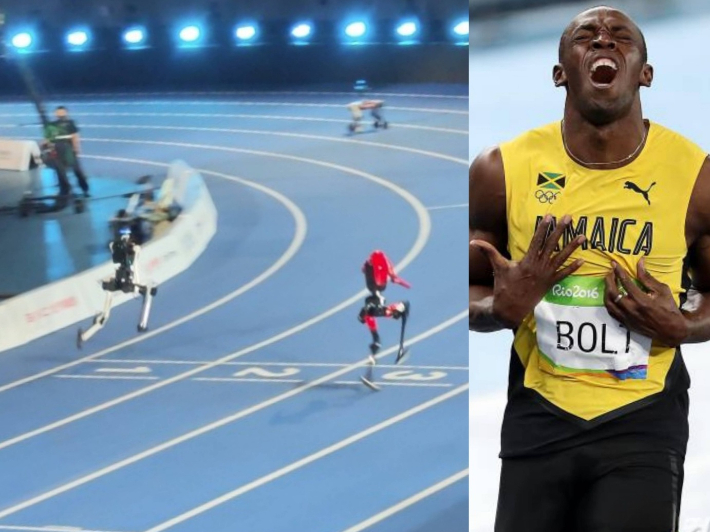
On May 22, inside Beijing’s National Speed Skating Arena, a crowd of roughly 10,000 watched a screen flash a number that should not have been possible: 9.39 seconds. A humanoid robot named Tiangong Ultra, built by the team Tianzhuo, crossed the 100-meter finish line 0.19 seconds faster than Usain Bolt’s 9.58, the record set at the 2009 World Championships in Berlin.
The crowd erupted. Not because it expected this—no one did—but because for the first time, a machine had not just participated in a human sprint, it had surpassed the fastest human who ever lived.
The context matters. Last year, at the first World Humanoid Robot Games, the same model clocked 21.50 seconds. In twelve months, it more than halved its time. That is not incremental progress. That is a jump that would be unthinkable in human athletics, where improvements are measured in hundredths of a second over decades.
Tiangong Ultra also performed a high-jump demonstration that day, clearing nearly three meters—well above Javier Soto’s human record of 2.45 meters. The robot competed at a multi-sport event featuring 2,526 machines across 51 disciplines, with 666 teams from 16 countries. This was not a lab experiment. It was a public competition, broadcast to a live audience.
Why This Isn’t Just a Sports Story
The immediate instinct is to treat this as a novelty. It isn’t.
The 9.39-second run is the first time a physical AI system—an embodied machine operating in the real world, not a chatbot or a game player—has outperformed a human elite athlete in a benchmark athletic event. The comparison to AlphaGo is almost too convenient to ignore. In 2016, AlphaGo defeated Lee Sedol, the world’s top Go player, and the moment became a cultural reference point for AI surpassing human capability. But Go was abstract. It existed on a board. There was no friction, no gravity, no consequence for a misplaced limb.
Running 100 meters at world-record speed requires control of an environment that is unforgiving and unstructured in ways that a Go board never was. The robot must manage momentum, ground reaction forces, balance, and timing in real time. A stumble is not a wrong move—it is a fall. A misstep is not a miscalculation—it is a collision with the track.
Tiangong Ultra did neither. It ran cleaner and faster than any human ever has.
The Market Nobody Is Fully Pricing In
Physical AI is one of the most heavily funded frontiers in tech right now. The market for embodied robotics and physical AI systems is projected to exceed $100 billion within this decade. Companies across South Korea, China, the United States, and Europe are racing to build machines that can move, manipulate, and operate in human environments—not just process information, but act on it.
The implication of a robot running faster than Bolt is not that sports will be replaced. It is that the engineering breakthrough required to make this happen—real-time motor control, adaptive balance, dynamic force management—translates directly into applications that matter far beyond the track: factory automation, disaster response, logistics, elder care, and infrastructure inspection.
The team behind Tiangong Ultra cut its 100-meter time by more than half in a single year. That trajectory, if it holds even partially, means the gap between robot and human performance in physical tasks will close faster than most industry forecasts assume. Companies that treat this as entertainment rather than an engineering signal are already behind.
Who Wins, Who Loses, and What Happens Next
The winners here are the teams and institutions that treat embodied AI as a core competitive advantage rather than a PR play. Tianzhuo demonstrated that rapid iteration in a public competition format accelerates development in ways that closed-door labs do not. Open benchmarks force accountability. They also force improvement.
The losers are the skeptics who still treat physical AI as fiction or a distant horizon. The data from Beijing says otherwise. A machine that can maintain world-record sprinting speed also has the foundational locomotion required for warehouse robots, search-and-rescue platforms, and mobile manufacturing units. The leap from “can run” to “can work” is shorter than most policymakers realize.
What happens next is the harder question.
Sports governing bodies are not ready. There is no rulebook for whether a robot’s time counts as a record, whether categories should separate human and machine performances, or how to broadcast a competition where the human athletes are now objectively slower than the machines they once outperformed. The International Association of Athletics Federations has no position on humanoid robot times. This will change, and the change will be messy.
The commercial side is moving faster than the regulatory side. Chinese and South Korean robotics firms are already positioning these capabilities for industrial deployment. If Tiangong Ultra’s control algorithms can be adapted for humanoid workers on factory floors, the value proposition shifts from novelty to cost reduction. The question is not whether robots can run fast—it is whether they can run fast enough to make a logistics company willing to pay for them.
There is also a cultural dimension that deserves attention. The 10,000 spectators in Beijing were not hostile. They were surprised, delighted, and clearly impressed. Public acceptance of physical AI is not a given, but it is not declining either. When a robot performs at a level that feels like science fiction made real, the default human reaction tends toward wonder rather than fear. That window of openness is narrow. It will not last forever.
The Aftermath Nobody Is Discussing Yet
The most consequential detail in the Beijing event may be the one least reported: the pace of improvement. Tiangong Ultra went from 21.50 seconds to 9.39 seconds in one year. A human sprinter improving by that margin would be the greatest athletic breakthrough in recorded history. For a machine, it is simply what happens when you scale compute, refine control models, and test publicly.
If that acceleration continues, the next world record won’t be broken by a human. It will be broken by a robot that spent 2025 learning how not to fall.
The sports world will adapt. It always does. New categories will emerge. Exhibition events will separate human and machine performances. The records that matter to fans will remain human. But the engineering reality is already irreversible: the fastest 100 meters on Earth is no longer owned by a person.
That is the story worth watching.