Romania's Drone Incursions Are Redrawing NATO's Eastern Flank
Russia is summoning Romania's envoy in Moscow one month after Bucharest declared a Russian diplomat persona non grata over repeated drone breaches. A small state on NATO's eastern edge is becoming the testing ground for how far Moscow will push.
The Summoning Is the Story
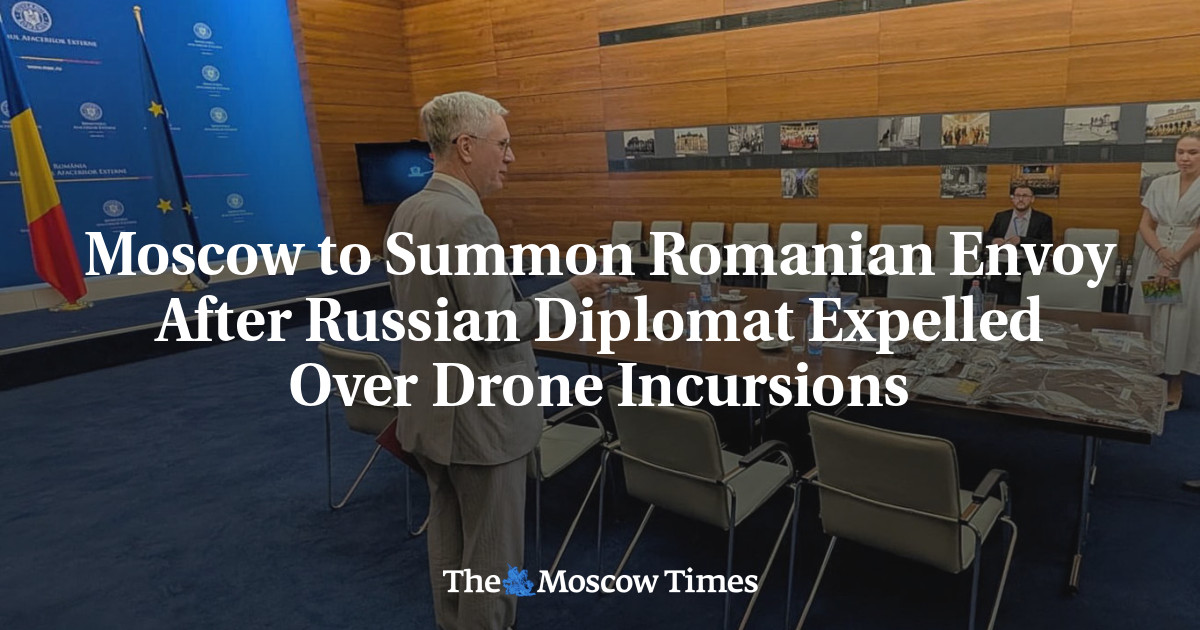
Romania is expecting its chargé d’affaires in Moscow, Liliana Burda, to be summoned on Thursday. The timing is not coincidental. It falls exactly one month after Bucharest declared Russia’s ambassador Vladimir Lipayev persona non grata — the first formal diplomatic expulsion in a tit-for-tat that began when Romania’s military shot down three drones it attributed to Russian origins between July 24 and July 26.
Russia’s Foreign Ministry did not publicly confirm the summons or its stated reason as of publication. But the pattern is unmistakable. Moscow promised retaliation in late July and has now delivered. The question is not whether this cycle will repeat. It is whether it stops here, or spirals further.
What makes this moment significant is not the summons itself but what it represents: a calibrated escalation in which Moscow is quietly redefining the boundaries of acceptable provocation along NATO’s southern flank. The drone incidents are no longer anomalies. They are a method.
Why a Drone Is a Diplomatic Weapon
A drone fragment on a display table sounds like a minor incident. For a NATO member state, it is not. Romania shares a 650-kilometer border with Ukraine. Since the full-scale invasion began in 2022, it has logged repeated airspace violations. Each one is a signal: Russia can reach deep into NATO territory without triggering Article 5. And each one forces the alliance to decide, quietly and publicly, whether the threshold for collective defense is being tested.
The Romanian government has been careful in its language. It called the breaches “illegal and irresponsible” and “absolutely unacceptable and intolerable.” It showed drone fragments to Lipayev. It recalled its ambassador to Moscow for consultations — a routine but pointed diplomatic gesture. What it has not done is invoke NATO’s crisis mechanisms. Not yet.
That restraint is itself a calculation. Romania wants to keep the dispute bilateral. It does not want to be the state that drags the alliance into an incident it cannot control. Bucharest has every reason to avoid a scenario in which NATO is forced to respond to events that are deliberately designed to sit in a legal gray zone — actions that are aggressive but fall short of an armed attack as defined by international law.
Defense analysts inside the Romanian Ministry of National Defence have privately flagged that the drones are not random. Their flight paths show deliberate routing through radar shadow zones near the Danube Delta, where sensor coverage is thinnest and the geographic complexity makes attribution harder. Romania has deployed additional air defence assets to the Constanţa and Tulcea counties, but these installations were not designed for sustained, low-altitude drone interception. The infrastructure gap is real and acknowledged internally.
The Second-Order Effects
Beyond the immediate diplomatic exchange, the incursions are producing ripple effects that Romania’s partners are only beginning to measure.
First, the incidents are altering the calculus of civilian air traffic. Romania’s national carrier, TAROM, and several logistics firms operating out of Otopeni International Airport have reported increased scheduling adjustments when Russian drones are detected in the late afternoon and early evening — the hours when visual identification is hardest and when the conflict’s main combat operations tend to be most active in eastern Ukraine. These adjustments are minor today but could become costly if the pattern intensifies.
Second, the psychological toll on border communities should not be underestimated. In towns like Mihail Kogălniceanu and Sulina, residents who welcomed NATO deployments two years ago now report a different kind of anxiety. The drones do not land. They do not explode. They simply appear on radar and then disappear — or, in three cases this summer, come down in fields and forests. The uncertainty is the weapon.
Third, and perhaps most strategically, the drone incursions are pressuring NATO’s integrated air and missile defence system. The Alliance has invested heavily in layered defence across Eastern Europe, yet the current threat profile — small, slow, low-flying unmanned systems — is not well suited to the high-value interceptors and radar systems that were designed for ballistic missiles and manned aircraft. This mismatch is a well-known problem in defence planning circles, but the Romanian incidents make it concrete and immediate.
Who Wins, Who Loses
Moscow wins by proving it can operate inside NATO airspace with impunity. The drone incursions are not necessarily mistakes. They are pressure tests. Each crossing asks: Will the West respond disproportionately? Will allies fracture over a small state’s border? Will the conflict in Ukraine spill outward — or will NATO hold its ground?
The Kremlin also gains domestic political value from the incidents. In Russian state media, the narrative has shifted from defending the war in Ukraine to portraying NATO as an aggressive bloc that is being provoked by its own southern expansion. Romanian troop contributions to NATO’s battlegroup and Romania’s role as a logistical hub for Ukrainian aid have been reframed in Moscow as evidence that Bucharest is a belligerent, not a neutral bystander — a classification that justifies, in the Russian framework, a proportional response.
Bucharest loses by being the proving ground. Romania has done nothing to provoke these incursions. It hosts NATO forces. It supplies Ukraine. It is one of the alliance’s most reliable eastern flank states. And yet it is the one bearing the risk.
NATO loses credibility either way. If it responds strongly, Russia can claim the alliance is overreacting — that a drone is not an attack. If it responds weakly, the deterrent value of Article 5 erodes. Small states learn that the alliance’s protection has a gray zone, and gray zones are where coercion thrives.
What Happens Next
The summons of Burda is diplomatic theatre with real consequences. Moscow is signaling that it views Romania’s expulsion of Lipayev as the escalation — not the drone strikes. By targeting the envoy rather than the military action, Russia reframes the narrative: it is not the aggressor, it is the one responding to provocation.
Expect more summons. More expulsions. More drone fragments on display tables. The cycle is designed to exhaust diplomatic bandwidth, not to provoke open conflict — yet.
For Romania, the immediate task is coordination with NATO. The alliance has struggled with exactly this kind of gray-zone aggression. Romania’s repeated incursions are a case study in how existing deterrence frameworks fall short when the adversary operates below the threshold of armed attack.
Romania’s government is likely to push for a NATO-level assessment of the incidents in the coming weeks, even if it stops short of formally invoking Article 4 consultation procedures. The distinction matters: invoking Article 4 signals concern; invoking Article 5 signals war. Bucharest wants the former without the latter. That is a narrow path.
For the wider alliance, the lesson is sharper than any briefing could convey. The eastern flank is not a static line on a map. It is a zone of continuous pressure, and the states on that line — Romania, Poland, the Baltic nations — are paying a cost the rest of NATO has not fully priced in.
One month ago, Romania expelled a diplomat over drones. Today, Moscow is summoning an envoy in response. The exchange is already escalating. The next drone fragment may arrive sooner than anyone expects, and when it does, the question will not be whether NATO responds — it will be whether the response is measured enough to avoid a spiral and strong enough to restore a sense of deterrence. So far, neither side has found that balance.