RTX 5090's $7,000 Price Tag Signals a Fierce New Battle for AI Compute
Consumer graphics cards priced at $7,000 are no longer a joke — they are a blunt signal that AI developers and gamers are colliding over hardware the professional chip industry cannot supply.
The Joke Became a Price List
For years, tech commentators mocked the casual observation that flagship graphics cards were named after their own price — the RTX 2080 costing roughly $2,080, the RTX 3090 approaching that number. It was a punchline about NVIDIA’s aggressive pricing strategy, the kind of industry insider wit that circulated on forums and Twitter threads without much weight behind it.
The RTX 5090 has now made the joke literal and cruel.
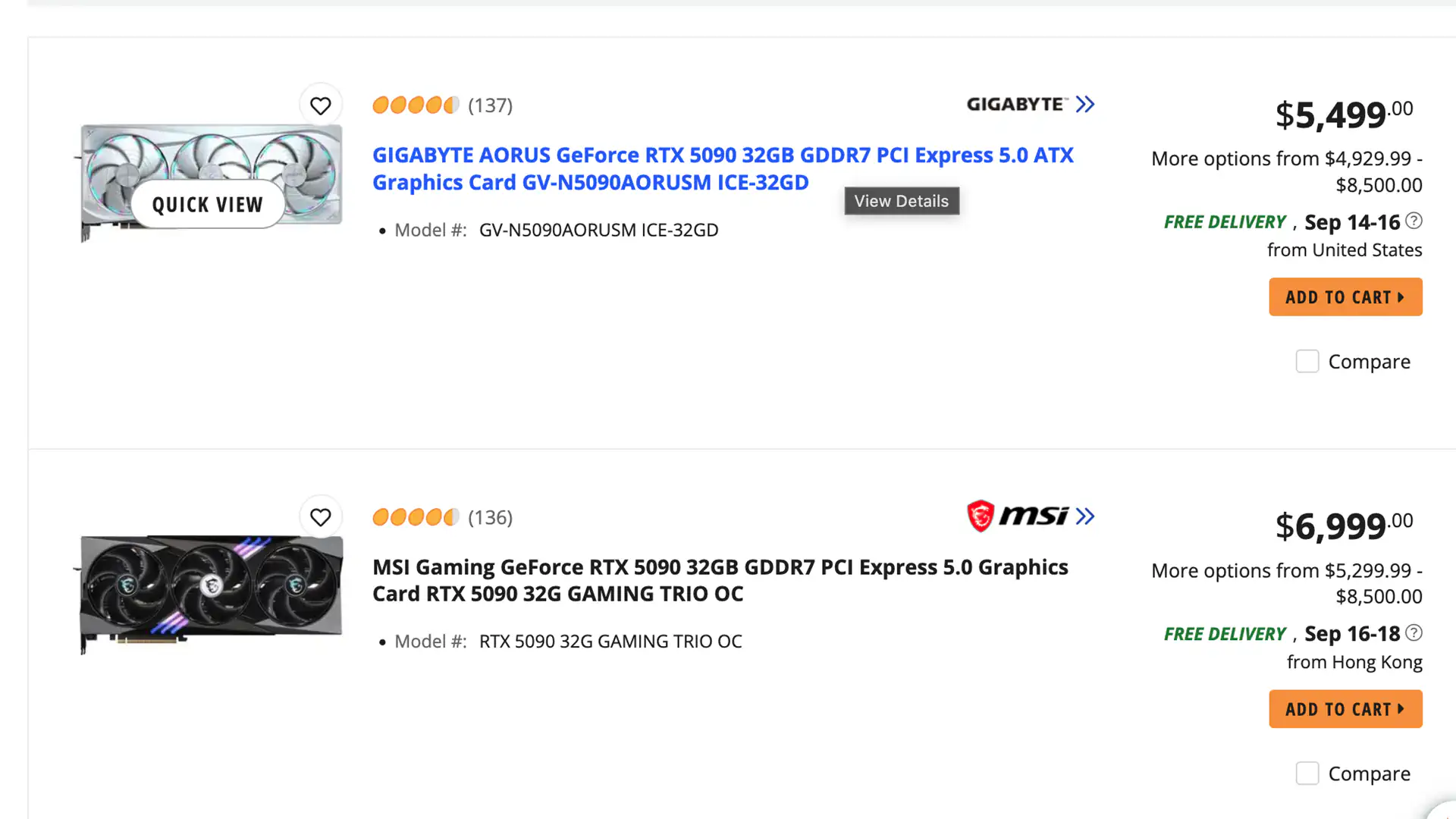
Non-reference models from Gigabyte and MSI are selling in major channels for between $5,499 and $6,999. Limited production batches from other manufacturers are reportedly moving at $8,500. These numbers were unthinkable when the card launched at its MSRPs. They were the kind of inflated resale figures that appeared only during the crypto-mining boom or the early pandemic supply crisis — periods of panic buying and genuine scarcity. This is something different, and the distinction matters.
The previous shortages were driven by demand surges that temporary constraints could eventually absorb. The current squeeze has structural roots: the AI compute market has expanded so far beyond original design parameters that consumer hardware has been reclassified as a viable stopgap by buyers who previously would never have considered it.
Who Is Buying a $7,000 Gaming Card
The primary buyers are not playing Cyberpunk or Starfield. They are AI developers, machine-learning engineers, and serious hobbyists running large language models locally.
The RTX 5090 carries 32 gigabytes of GDDR7 memory — a specification that previously existed only on professional-grade accelerators like NVIDIA’s own H100 line or AMD’s MI300 series. Consumer cards have never carried even half that capacity. This is the critical detail English-language coverage often glosses over: the 5090 is not just faster. It is uniquely positioned by its memory size at a fraction of the cost of an actual datacenter GPU.
When you compare the math, the desperation becomes clear. An H100 rental price has surged 22% in recent weeks. Actual H100 units — purchased new — command prices far beyond most startup budgets. The RTX 5090 at $5,500 to $7,000 offers a path to run models like Qwen locally, train fine-tuned variants, or generate video outputs at a cost that is, in absolute terms, staggering but comparatively reasonable against server-grade alternatives that remain all but impossible to source.
Several developers in the independent AI space have told reporters they spend more time monitoring retailer inventory pages than working on actual model development. Automated purchasing bots, long associated with sneaker drops and console launches, now operate in the GPU market around the clock — a symbol of how completely the purchasing experience has shifted from leisure to logistics.
The Collision Course
What we are witnessing is a market collision between two worlds that were never meant to share the same shelf.
AI researchers and small-scale model developers — people who would normally queue for weeks for an H100 or A100 — are flooding consumer channels because the professional supply chain is choked. NVIDIA has allocated the vast majority of its Blackwell and Hopper production toward datacenter contracts with hyperscalers. The remaining chip supply cannot meet the exponential growth in AI inference and training demand globally. Stockouts are the norm, not the exception.
Meanwhile, the enthusiast gaming market — which once relied on flagship GPUs as the crown jewel of custom PC builds — has been quietly priced out. A single graphics card now costs more than a fully specced high-end workstation. The absurdity is not lost on the community, but it is a secondary concern to anyone trying to deploy a language model before a competitor does.
The collision is not symmetrical. Gamers can delay upgrades or switch to integrated graphics. AI developers operating without institutional backing face hard deadlines — model releases, investor expectations, competitive pressure — that do not bend to hardware availability.
Second-Order Effects
The consequences of this mismatch are already rippling outward in ways that extend well beyond pricing.
University research labs are reporting the earliest signs of distress. PhD students who once depended on campus GPU clusters for thesis work are now competing with well-funded startups for the same consumer hardware. Several computer science departments in South Korea have quietly reduced their intake for AI-focused graduate programs, citing compute access as a binding constraint rather than enrollment capacity.
The used and refurbished market is experiencing parallel strain. Previous-generation cards like the RTX 4090 — already carrying 24GB of VRAM — are seeing price increases of 40% or more. Sellers who held onto older hardware during the post-mining selloff are now realizing that what they considered dead weight has become a secondary tier of compute infrastructure.
There is also a quiet shift in developer behavior. Smaller teams are beginning to optimize their models for lower memory footprints — pruning, quantization, and distillation techniques that were once considered optimization luxuries are becoming survival requirements. This is changing the trajectory of model design itself, pushing the industry toward efficiency at the expense of raw capability in ways that may not reverse even if hardware supply normalizes.
Cloud providers are not immune. Major hyperscalers have responded to institutional demand by raising spot-instance prices for GPU-equipped virtual machines. A single H100-hour that cost under ten dollars eighteen months ago now runs closer to fourteen. The ripple effect reaches every startup that cannot afford capital expenditure and must rent compute instead.
Who Wins and Who Loses
The winners are NVIDIA, which benefits from price appreciation on both fronts — professional card sales and consumer channel margin expansion — and early movers in the AI space who secured inventory before the current squeeze intensified. Component suppliers feeding NVIDIA’s supply chain, particularly those producing high-bandwidth memory, are also seeing demand surge beyond original forecasts.
The losers are everyone else. Independent researchers. Small startups without hyperscaler relationships. Gamers upgrading at the traditional cycle. Universities purchasing lab equipment on constrained budgets. The fragmentation of GPU access is creating a two-tier AI ecosystem: one tier with reliable compute access and another scrambling for whatever consumer hardware can be sourced.
Korea’s market is particularly visible here because distribution channels there are transparent and pricing data is readily available, but this is not a regional anomaly. Similar dynamics are occurring across Europe, North America, and Japan. The Korean case is simply a leading indicator of what the broader global market is experiencing.
What Happens Next
The situation will not resolve quietly. Several scenarios are plausible, and they are not mutually exclusive.
First, NVIDIA could accelerate the production of consumer cards with equivalent memory configurations or release a new tier in the lineup designed explicitly for AI workloads. Rumors of a dedicated AI-focused consumer GPU have circulated for months without official confirmation. If such a product materializes, it would likely command a premium similar to the current 5090 pricing, but it would also legitimize the category and potentially expand total supply.
Second, the used and refurbished market will intensify. Prices for previous-generation cards like the RTX 4090 are likely to climb further as buyers recognize their value as secondary training and inference platforms. This creates a cascading effect: as 4090 prices rise, buyers who cannot afford them move down to the 4080 tier, and so on, compressing affordability across every segment.
Third, and perhaps most consequential, smaller AI companies may be forced to raise the bar for entry. If the cheapest path to local model deployment requires capital outlays approaching those of a luxury vehicle, the open innovation circle narrows considerably. The companies that survive will be those with either deep pockets or clever workarounds — distributed inference, model compression, or partnerships with cloud providers who have compute to spare.
A fourth scenario deserves mention: the emergence of alternative architectures. AMD’s MI300 series, Google’s TPUs, and various specialized AI accelerators from Chinese manufacturers could absorb some of the overflow demand. But these alternatives face their own supply constraints and software-ecosystem limitations that make large-scale substitution unlikely in the near term.
The Bigger Picture
The RTX 5090’s pricing is not a gaming story. It is a signal flare from the compute frontier. Every company racing to build, fine-tune, or deploy AI models is feeling the same pressure, whether they are buying H100s or hunting through retailer listings for a $7,000 graphics card.
The joke about the card’s name matching its price was never really about humor. It was about the direction the market was already heading. The only difference now is that the direction has sharpened into a number everyone can see: $5,499, $6,999, $8,500. The question is no longer whether compute will remain accessible. It is who will find a way to afford it first.
What emerges from this squeeze will shape the AI landscape for years. The companies that treat hardware scarcity as a temporary inconvenience will find themselves behind those who adapt their architecture, their economics, and their timelines to a world where compute is the scarcest resource in the room.