Russia's Drone Strike on a NATO-adjacent Train Is a New Grey-Zone Playbook
A Russian drone struck a railway stop in western Ukraine just 2 km from Polish airspace, after diplomatic trains carrying Boris Johnson and a former CIA director had passed through. The strike marks an escalation in Russia's grey-zone warfare that is testing NATO's eastern flank.
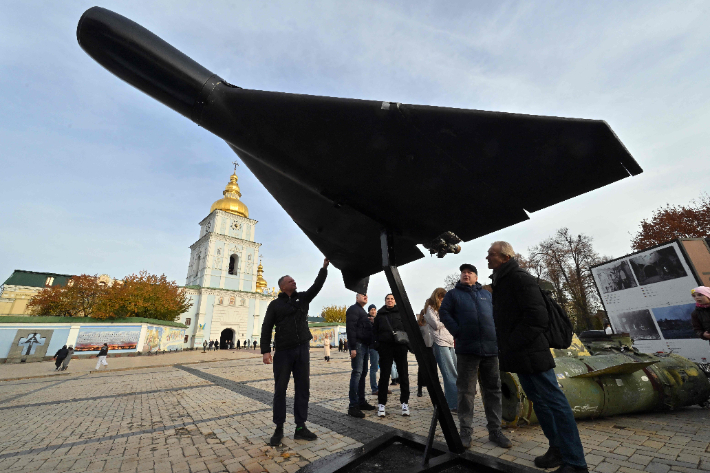
The Target Wasn’t Just a Rail Station
On October 13, a Russian drone struck the village of Yahodyn in western Ukraine’s Lviv Oblast. It was a minor rail hub — a single-track junction servicing local passenger and freight movement — but its geographic significance far exceeded its physical footprint. The station sat approximately two kilometers from the Polish border, deep enough to remain Ukrainian territory yet close enough that any debris or malfunctioning ordnance posed a tangible risk to Polish soil.
The timing carried weight beyond coincidence. A diplomatic train carrying former British Prime Minister Boris Johnson and former Swedish Prime Minister Carl Bildt had already cleared the Yahodyn crossing hours earlier, continuing westward toward Poland. A second train, carrying former CIA Director David Petraeus, was scheduled to arrive at the station when the drone struck. Ukrainian railway authorities later confirmed that both Johnson and Petraeus were considered potential targets in Moscow’s calculus.
This is not the work of opportunistic targeting. The precision of the timing — striking when Western figures were known to be transiting the region — signals a deliberate architecture of coercion. Russia is probing NATO’s eastern boundary with measured increments, testing whether the alliance can distinguish between acts of war and acts of intimidation when no NATO member’s territory is directly violated.
The Railway as a Diplomatic Artery
For much of the conflict, the rail corridor threading through western Ukraine to Poland has operated as an informal but vital diplomatic artery. Senior officials from capitals still debating the pace and scope of military aid have ridden these trains. They meet Kyiv’s leadership in person. They exchange intelligence outside formal channels. They project solidarity through physical presence — something video calls cannot replicate.
The route survived on an assumption: that while Ukraine was under sustained missile and drone attack, certain corridors remained functionally safe because they lay outside active combat zones. Yahodyn had never been struck before. No NATO-affiliated figure had ever been targeted while using it. That presumption has now been shattered.
Russia’s defense ministry offered its standard justification: the strike targeted Ukrainian railway infrastructure used to funnel military cargo toward the western front. The language mirrored a familiar Kremlin script — every escalation framed as defensive retaliation, every attack presented as response to NATO’s support for Kyiv. But framing a strike near a border station hosting Western dignitaries as purely military logic strains credibility. The proximity to Poland, the selection of a rail node used by diplomatic convoys, and the sequence of events all suggest a secondary objective: demonstrating that Moscow can strike where NATO citizens operate with impunity while staying just inside Ukraine’s sovereignty.
The Grey-Zone Architecture
What Russia is executing represents a maturing grey-zone strategy — a concept that has moved from academic discussion to operational reality. German Interior Minister Alexander Dobrindt articulated this publicly on October 1, referencing a bomb-laden drone discovered at Leipzig-Halle airport that same month. Germany, he stated plainly, faces daily hybrid attack. Not technically in a state of war. Not in a condition triggering any clear legal pathway to Article 5. But under sustained, coordinated pressure designed to erode defenses without crossing the threshold that would unite the alliance.
The Yahodyn strike fits this architecture precisely. A drone crosses an airspace boundary — but remains two kilometers inside Ukraine, not entering Polish airspace. A train is struck — but no NATO citizen is killed. A warning is delivered — but the language remains ambiguous enough that any individual incident falls below the collective defense threshold. It is the drip-drip model of coercion: each event, examined alone, appears manageable. Examined collectively, they redraw the map of acceptable risk.
Second-order effects are already visible. European defense planners are reassessing the security of humanitarian and diplomatic corridors that were previously considered low-risk. Insurance premiums for transport through western Ukraine are rising. Private security firms report increased demand for route-protection services attached to official visits. The psychological recalibration is occurring faster than any formal policy response.
Who Wins, Who Loses
Russia wins if NATO member states begin treating their own diplomatic and military circuits through Ukraine as hazardous. Every postponed visit, every rerouted shipment, every internal debate over whether a train journey is worth the exposure represents a victory for Moscow’s attrition strategy. The goal is not to destroy Ukraine’s rail network — that war Russia is already losing — but to make its use politically costly for Western supporters.
Poland gains nothing from this escalation. Its territory was not struck, and its air defenses were not activated. But its border village sat within the kill zone, and the psychological boundary separating “safe” from “contested” has shifted visibly westward. Warsaw now faces a strategic dilemma: reinforce its border posture diplomatically and militarily, or risk being perceived as insufficiently supportive of Kyiv’s infrastructure.
Ukraine loses its diplomatic rail corridor as an unprotected asset. The route still exists physically, but the strategic calculus around it has changed permanently. High-profile visitors will factor in a real and present threat that did not exist with this intensity before the strike. Kyiv may need to invest in hardened protocols — timed movements, decoy trains, accelerated scheduling — to restore confidence in the corridor.
The United States and United Kingdom face a credibility problem on multiple fronts. Both governments have spent months asserting that Russia is desperate, that its military is overextended, that its precision-strike capabilities are degrading. Hitting a train carrying a former CIA director and a former British prime minister — then claiming it was aimed at military logistics — suggests either operational incompetence or a willingness to gamble with NATO’s collective nerves. Either interpretation damages the narrative of Russian decline that underpins Western political support for Ukraine.
The Institutional Response Gap
The most consequential dimension of this incident may not be tactical but institutional. NATO lacks a coherent doctrine for grey-zone escalation. Article 5 requires an armed attack — a threshold that deliberately excludes the kind of calibrated provocation Russia is now practicing. The alliance’s political structures, designed for consensus-based decision-making in crises, are poorly suited to responding to campaigns of incremental aggression that never accumulate to a single definable act of war.
Germany has already flagged the need for enhanced NATO-level responses to grey-zone tactics. This issue will surface again at upcoming defense minister meetings and likely on the agenda for future summitry. The question is whether those discussions produce concrete measures — expanded air-patrol mandates along the Polish-Ukrainian border, pre-deployed air-defense batteries in eastern NATO states, standardized protocols for diplomatic transit through contested corridors — or whether they produce only statements of concern that reinforce the very paralysis Russia is exploiting.
What Happens Next
The immediate aftermath will involve diplomatic protests from Western capitals, intelligence assessments reviewing the drone’s launch site and flight path, and likely some quiet reassessment of travel routes through western Ukraine. Publicly, NATO will reaffirm that Article 5 remains intact. Privately, member states will be counting drones, mapping launch corridors, and recalibrating risk thresholds for official travel.
Russia will almost certainly continue this pattern. The Yahodyn strike is not an endpoint — it is a template. Future incidents will test how much closer to NATO territory Moscow can push before the alliance draws a line it cannot take back without triggering the very war it has spent months avoiding. The next strike may target a different transit route. It may involve a different class of munition. It may cross the border by a meter rather than two kilometers. The strategy remains constant: incrementally normalize aggression while keeping every individual act just below the threshold that would trigger a unified response.
The war in Ukraine was never confined to the battlefield. These strikes are a reminder that the front line runs through institutions, through diplomatic routines, through the everyday assumptions of safety that NATO members took for granted on their eastern flank. That line is moving. The question now is whether the alliance will recognize it has moved — or wait until the border village is the one on fire.