Russia's Empty Duma Election Is the Story That Isn't
Russia's 2026 Duma vote is so lifeless that the real signal isn't United Russia's win but the Kremlin's panic: a suppressed campaign, a banned anti-war party, and a post-election window where a second mobilisation looms. For Washington and Brussels, the election changes nothing about the war — and that should sharpen, not soften, the pressure strategy.
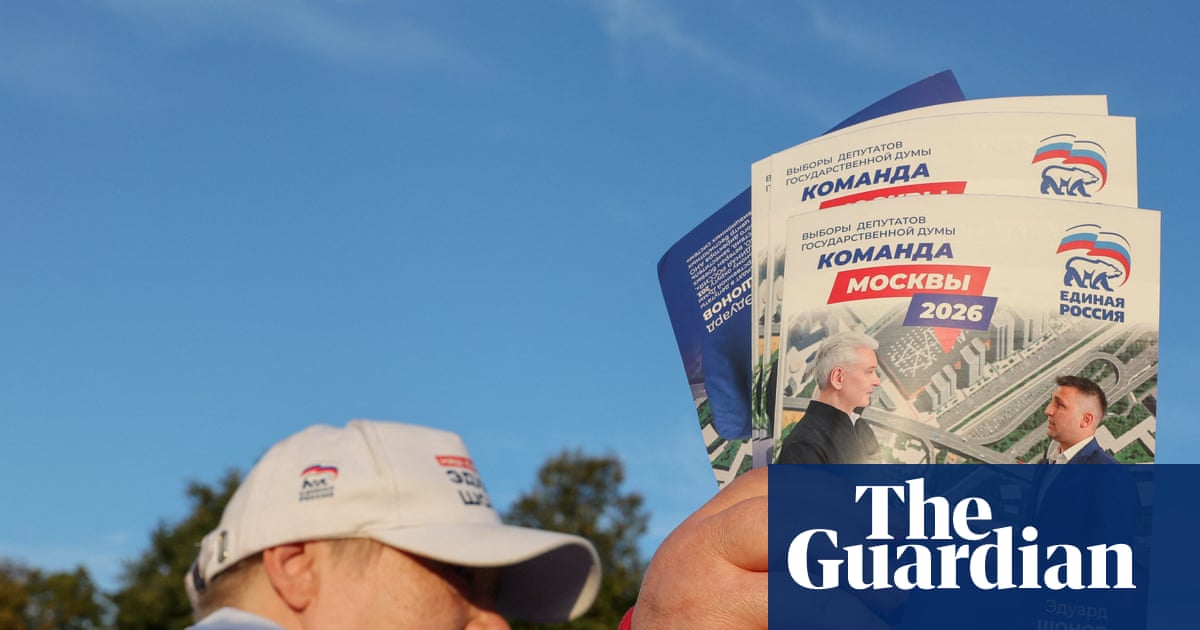
The Victory No One Fights For
Russia’s State Duma election is over in all the ways that matter: United Russia will hold parliament for the 24th consecutive year, the so-called systemic opposition — Communists, the far-right Liberal Democrats, a couple of centrist list parties — will collect enough seats to keep the theater intact, and no one will lose sleep over the margins. The three-day vote closes on Sunday. The result is not the story.
The story is that the Kremlin is terrified of what Russians might think about the war, and so it has stripped the contest of every element that would force that thought into the open. The lifelessness of this campaign is not an accident of apathy. It is a management decision.
Farida Rustamova, who runs the independent Vlast newsletter, puts it plainly: “No one wants to come into the spotlight or discuss anything sensitive.” Debates have been broadcast from half-empty studios because candidates simply failed to show up. United Russia’s video outreach leans on low-budget AI clips, slogans flat enough to register on the wrong end of a focus group. Not a single party has addressed the question that dominates kitchen-table conversations in Moscow, St. Petersburg, and provincial cities: how much longer does this war last, and what does it cost at home?
The authorities did not just suppress the opposition. They suppressed the momentum. A person close to the Kremlin, speaking on condition of anonymity, described the strategy as deliberately keeping the election low-key because “greater interest would not benefit them.” The goal is not to energise the base. It is to make the whole exercise feel small enough that no one bothers to measure their own disquiet against it.
The Yabloko Ban and What It Actually Proves
The most revealing act of this cycle was not the predictable United Russia dominance but the decision, made last month, to bar Yabloko from the ballot entirely. For two decades Yabloko had been the thin, almost ornamental liberal voice in Russian politics. It had not seriously contested a national election in years. But by 2026, polling showed something the Kremlin did not want to see: support for an explicitly anti-war platform was growing, not shrinking. The party was no longer negligible. It had become a measuring stick.
So the measuring stick was removed.
Vladimir Gelman, a professor of Russian politics at the University of Helsinki, frames the election in functional terms: “Even though these elections are neither free nor fair, they are still the only source of legitimacy.” The Kremlin does not need a Duma that legislates. It needs a Duma that performs consent. The performance is getting harder to stage. Banning Yabloko is the equivalent of deleting a question from a survey and calling the response rate higher.
This matters for Western policy in a specific, often-missed way. Brussels and Washington have, at various points, treated Russian domestic instability as a wild-card — a reason to hesitate on escalation, to hope that internal pressure would prod Moscow toward the negotiating table. That calculus is becoming harder to sustain. When the regime actively removes the one institution that could channel war-fatigue into a political signal, the feedback loop that might have constrained Kremlin risk-taking tightens, not loosens. There is no domestic pressure valve left that the West can count on. The only lever remains external: sanctions, military aid to Ukraine, diplomatic isolation. The election confirms that the pressure has to come from outside, because inside, the regime has sealed the room.
Putin’s Speech and the Legitimity Script
In a televised address before the vote, Putin linked the act of voting to the war directly: “Your choice and your will will once again demonstrate that millions of people stand behind our soldiers.” This is not a campaign speech. It is a loyalty test dressed as an election. Voting is framed not as a right but as a demonstration of unity, a public re-commitment to the invasion. The 2024 presidential result — secured with genuine opposition barred, extending Putin’s rule to at least 2030 — set the pattern. The Duma vote extends it downward into the legislative branch, making any future challenge to the war’s legal framework virtually impossible from within the system.
For a Western reader, the implication is straightforward: the architecture of accountability that European partners once hoped to preserve through engagement and conditional partnerships is gone. The Duma will not be a site where a future government votes to reconsider the war. It is a rubber stamp with a slightly more theatrical procedure than it had in 2021.
The Question Nobody Votes On: A Second Mobilisation
Here is where the election stops being a story about Russian politics and becomes a story about the war’s next phase. Ukrainian drone swarms hit oil refineries, factories, and logistics hubs across Russian territory over the summer. The military advance has been grinding, expensive, and slow. And the one rumor that no official in Moscow will confirm and that every young man between 20 and 30 checks on his phone each morning is a second mass mobilisation.
The 2022 precedent is etched in the public memory. In September of that year, hundreds of thousands of Russians crossed borders by car, train, and on foot the moment Putin announced the first wartime draft. This year, the scene in Yerevan, Armenia, where young men are renting apartments and waiting out the post-election window, carries the same energy. Dmitry, one of them, told The Guardian: “I’ll just wait a few weeks after the elections. Let’s see if anything changes after the vote.” He is not alone. A person close to the Kremlin confirmed that several of his friends have sent their sons abroad.
Putin has dismissed the mobilisation question twice in recent weeks. Those dismissals are doing work. They are buying the administration a quiet election period. But the post-election space is where the harder decisions live. A compliant new Duma, installed with no credible opposition, gives the Kremlin legal cover and legislative speed to act on measures that would be politically costly if they had to face a hostile legislature or a public that remembers the 2022 exodus. The election, in other words, is not the event. It is the unlock.
What Happens Next, and Who Loses
The Duma will be sworn in within weeks. United Russia will hold the floor. The Communists will perform their scripted dissent. The Yabloko vacuum will be filled by no one, which is the point. The war will continue at whatever pace the generals set, unchallenged domestically.
The losers are clear. The Russian middle class that stayed, watched the refineries burn, and voted in a ceremony designed to measure nothing. The young men who cannot tell whether the next month brings a text-message draft order or a few more weeks of normalcy. The Ukrainian state, which gains nothing from a Russian internal election it cannot affect and which must continue absorbing the war’s costs without the prospect of a political shift in Moscow to ease the pressure.
The winners are narrower. The Kremlin’s security services, which have now proven they can run a three-day national vote with empty debate studios and no measurable competition and still call it a mandate. And the war itself, which loses no institutional obstacle to its continuation.
For Western governments, the takeaway is not policy recalibration. It is confirmation. The channel of domestic Russian pressure that, however slim, existed in 2023 and 2024 has been closed. Yabloko’s ban is the lock. The election is the sound of the door shutting. What remains is the external pressure — sustained, coordinated, and, if the mobilisation rumors are anything other than rumors, prepared for a scenario in which Russia escalates domestically in the name of the war it has already lost the moral argument on.